@Nyarlathotep
Before I begin, y’all presented me an article involving a six year study involving over 200 participants who sought to discover how many of Jesus’ words in the Bible actually belonged to him. 20% were found to belong to an actual historical personage. I never knew about this study until I came to this forum, but that in itself is contributing evidence.
I will also add, that although I believe in the historicity of Jesus, I really thought that you were going to attempt to offer something more than mere modern opinions to back up your claims that he did not exist.
CITATION
Close
[note 1] Jesus existed:
Stanton (2002, p. 145): Today nearly all historians, whether Christians or not, accept that Jesus existed and that the gospels contain plenty of valuable evidence which has to be weighed and assessed critically. There is general agreement that, with the possible exception of Paul, we know far more about Jesus of Nazareth than about any first or second century Jewish or pagan religious teacher.
Wells (2007, p. 446):“Today, most secular scholars accept Jesus as a historical, although unimpressive, figure.”
Ehrman (2012b, pp. 4–5): “Serious historians of the early Christian movement—all of them—have spent many years preparing to be experts in their field. Just to read the ancient sources requires expertise in a range of ancient languages: Greek, Hebrew, Latin, and often Aramaic, Syriac, and Coptic, not to mention the modern languages of scholarship (for example, German and French). And that is just for starters. Expertise requires years of patiently examining ancient texts and a thorough grounding in the history and culture of Greek and Roman antiquity, the religions of the ancient Mediterranean world, both pagan and Jewish, knowledge of the history of the Christian church and the development of its social life and theology, and, well, lots of other things. It is striking that virtually everyone who has spent all the years needed to attain these qualifications is convinced that Jesus of Nazareth was a real historical figure.”
With all this, savvy historians tend to steer a wide course around Jesus himself. Particularly given the yawning vacuum of external sources for primordial Christianity, scholars cannot speak—certainly not with any sense of comfort—about the original stimulus producing this religion. That is, no contemporary Jewish or Roman account constitutes primary, external evidence of the actual events of Jesus’ life…So if the New Testament does not transmit Christ’s words literally—which is not the same thing as saying it’s not the “Word of God”—the situation encompasses a hopeless conundrum for those intent on deciphering what-really-happened-in-the-past. On the other hand, believers and theologians who have freedom to traffic in mysteries or miracles may find easy and ready solutions to this problem—or difficult ones, but solutions all the same—by calling on resources historians do not find on their menu of executable options. So, without external sources to contradict, corroborate or give dimension to the testimony of its authors, the gospels of the New Testament do not admit history as such, which exempts the life of Christ itself from the direct scrutiny of historical investigation.
[/quote]
Josephus was contemporary with James, the brother of Jesus. Josephus refers to him as such, and chronicles his execution.
In his work Antiquities of the Jew: Book 20, Chapter 9, 1, refers to the stoning of “James the brother of Jesus” by order of Ananus ben Ananus, a Herodian-era High Priest.
“Ananus, who, as we have told you already, took the high priesthood, was a bold man in his temper, and very insolent; he was also of the sect of the Sadducees, who are very rigid in judging offenders, above all the rest of the Jews, as we have already observed; when, therefore, Ananus was of this disposition, he thought he had now a proper opportunity [to exercise his authority]. Festus was now dead, and Albinus was but upon the road; so he assembled the Sanhedrin of judges, and brought before them the brother of Jesus, who was called Christ, whose name was James, and some others, [or, some of his companions]; and when he had formed an accusation against them as breakers of the law, he delivered them to be stoned.”
The translations of Josephus’ writing into other languages have at times included passages that are not found in the Greek texts, raising the possibility of interpolation, but this passage on James is found in all manuscripts, including the Greek texts and is accepted as authentic.
Modern scholarship has almost universally acknowledged the authenticity of the reference to “the brother of Jesus, who was called Christ, whose name was James” (τὸν ἀδελφὸν Ἰησοῦ τοῦ λεγομένου Χριστοῦ, Ἰάκωβος ὄνομα αὐτῷ) and has rejected its being the result of later Christian interpolation. Feldman & Hata 1987, pp. 54–57
Secondary sources for James include, but are not limited to: Eusebius, Origen, and Hippolytus.
Additionally, Paul is a historically attested-to figure who was contemporary with both James and Peter. He not only lived contemporaneously with them, he met with them and studied with them, and even argued with them.
Fourteen of the 27 books in the New Testament have traditionally been attributed to Paul are undisputed by scholars as being authentic with varying degrees of argument about the remainder. He was an actual person.The Epistle to Philemon, almost universally accepted as an authentic letter of Paul, includes the name “Luke” among other “co-workers” of Paul who are sending greetings to the letter’s recipients. His association with James, brother of Jesus makes him a more credible source than Aristotle was to Socrates, a person that you deem yourself as credible.
The Mishnah and the Talmud contain several derogatory references to Jesus and to Mary. Several of them reflect the early Jewish traditions of portraying Jesus as a sorcerer or magician. The references to Jesus and his execution aim to discredit his actions, lineage, or character, not deny his existence.
Kostenberger, Andreas J.; Kellum, L. Scott; Quarles, Charles L. (2009), Jesus in the Talmud by Peter Schäfer (24 Aug 2009) pp. 9, 141
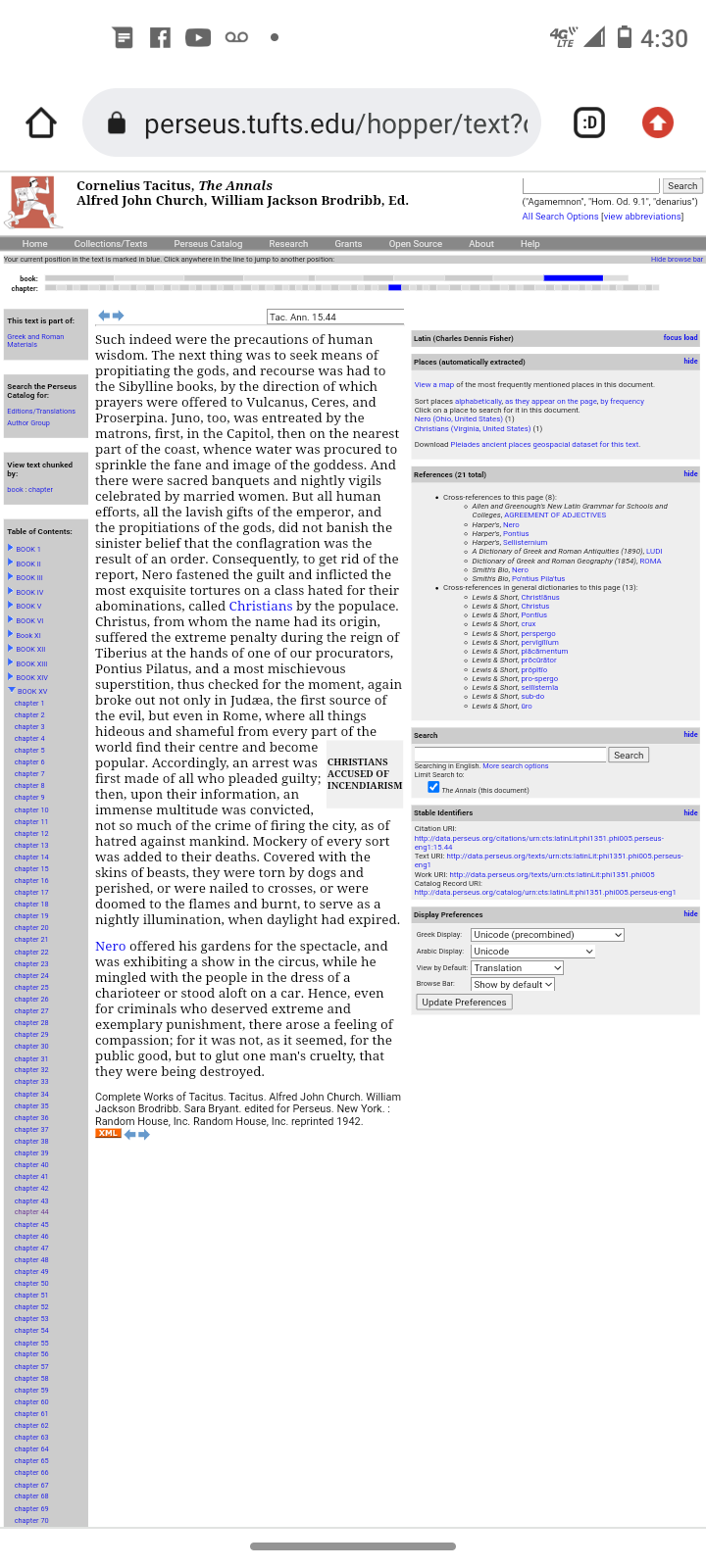
Tacitus, in his Annals book 15, chapter 44, describes Nero’s scapegoating of the Christians following the Fire of Rome. He writes that the founder of the sect was named Christus (the Christian title for Jesus); that he was executed under Pontius Pilate; and that the movement, initially checked, broke out again in Judea and even in Rome itself.The scholarly consensus is that Tacitus’ reference to the execution of Jesus by Pontius Pilate is both authentic and of historical value as an independent Roman source.