I saw this question on another website and wondered how different the answers would be here.
1 Like
I would expect it to depend on the denomination. Falling attendance has been a thing worldwide for the mainline denominations; in Europe for example it’s not at all unusual to find a few parishoners rattling around like BB’s in a boxcar, in some big old stone church or cathedral that was built for hundreds or even thousands. Such buildings owe their continued operation at least as much to being on the local historic preservation registry as to any ongoing interest in organized religion on the part of the general public.
As to the rise of the “nones” (religiously unaffiliated but mostly to some degree still theists, although it does overlap with atheists) – that would be because of wider dissemination and accessibility of scientific knowledge, wider access to, and necessity for, higher education, a tendency for younger generations to have had more exposure to supposedly scary / different people and finding them to be just fellow humans, etc.
It’s clear that organized religion of the authoritarian persuasion is very threatened by this, and is taking EXTREME measures to try to counter it, such as trying to cudgel higher educational institutions to give up their intellectual freedoms and toe some sort of party line that either overtly favors Christianity or at least is too timid to push back against key Christian doctrines as seen by the authoritarians, such as bigotry and exclusion towards non-conforming minorities of any kind.
But this is a negative feedback loop that will just make the problem worse for them, although, depending on how it plays out, there could be a painful short (in the scope of history) period where the pursuit of objective, evidenced knowledge and understanding is furtive because it’s been driven underground. I’d expect the rest of the world to move on without us and a handful of other regressive / revanchist countries, such that in a surprisingly short time we will no longer be any sort of world power with any sort of credibility. The resulting brain drain will leave just the knuckle-draggers in place to glory in their Pyrrhic victories.
1 Like
It’s no secret that a lot of church’s try to control their members lives by telling them what they can and can’t do. Several in my town behave a lot like cults. Cult as in members weren’t allowed to date, they had to go through the church and get permission. If permission was given, they would want to supervise the dates.
Sometimes they’d send it’s most trusted members to follow you around town and spy on you.
They even promote censorship. I know the church my mom attended was telling everyone not to watch Harry Potter because…witch craft when those movies are coming out. Then they told everyone not to watch vampire movies or this or that. They even black listed a lot of music genres.
All in all, a lot of fucked up shit they were pulling. Not sure if they’re still doing it since I haven’t been in a church for 7 yrs due to being forced to go. I’m so glad I wont ever have to again. I even avoid dating religious women out of fear that they might try and force me to convert and be put back into the church system. Big fat no to that shit storm of a problem.
But no one wants to be controlled or feel like they’re part of a fascist group who tries to control your every move. I think thats why even the religious are just worshiping at home probably. Not to mention, church’s beg for your money during the tithe service or the members get shamed for not putting more in the tithing plates.
It’s all stupid really. But I am glad that the church system is losing it’s power.
1 Like
I think one factor is likely the increased use of social media. Folks have more opportunity to fulfill their need for socializing than prior to this age of interconnection.
That exposure to information and different opinions is widely and readily available has also impacted that attendance.
An additional factor, imo, is laziness. As the acceptance of not attending church/temple services started to slowly grow, more and more folks gave/give into , “screw it, I’m not dressing up and going to church/temple today,” and they weren’t socially ostracized for it…reinforcement.
I’d venture the guess, though, that the rate of church/temple attendance is going down way faster than the rate of giving up belief in gods is going up.
(In some enclaves, church/temple attendance is going up.)
2 Likes
I think the Internet has a lot to do with this.
I believe that a lot of organized religion is a scam . . . and information, opinions, news, and so forth is readily available on the Internet, so people have a broader view and are much less insular.
A side effect of this openness is that people realize that much of what religious leaders are shoving down their throats is utter bullshit . . . so they stop going to church.
And this is a very good thing.
3 Likes
I think Daniel Dennett had a wonderful explanation of the drop and the “belief in belief” in the Atheist Alliance International 2007 Convention DVD where he talked about how we’ve gone from the “Mt. Everest” of the image of God and how we are now “into the fog” with such expressions like “the ground of all being.” I don’t think people know WHAT they are talking about when they say “God” nowadays. That plus the repressiveness of religions is why I think more people are dropping out.
Hopefully this is the beginning of the end for Christianity. As the old saying goes “don’t want it, don’t need it.”
I just watched a programme on TV here (in Norwegian language only, might not be viewable abroad), in the format of a short lecture on why less and less people believe in religion here. Here is some of the statistics presented:
Question: Is religion important in your daily life?
Surprise, surprise, Scandinavians are among the least religious.
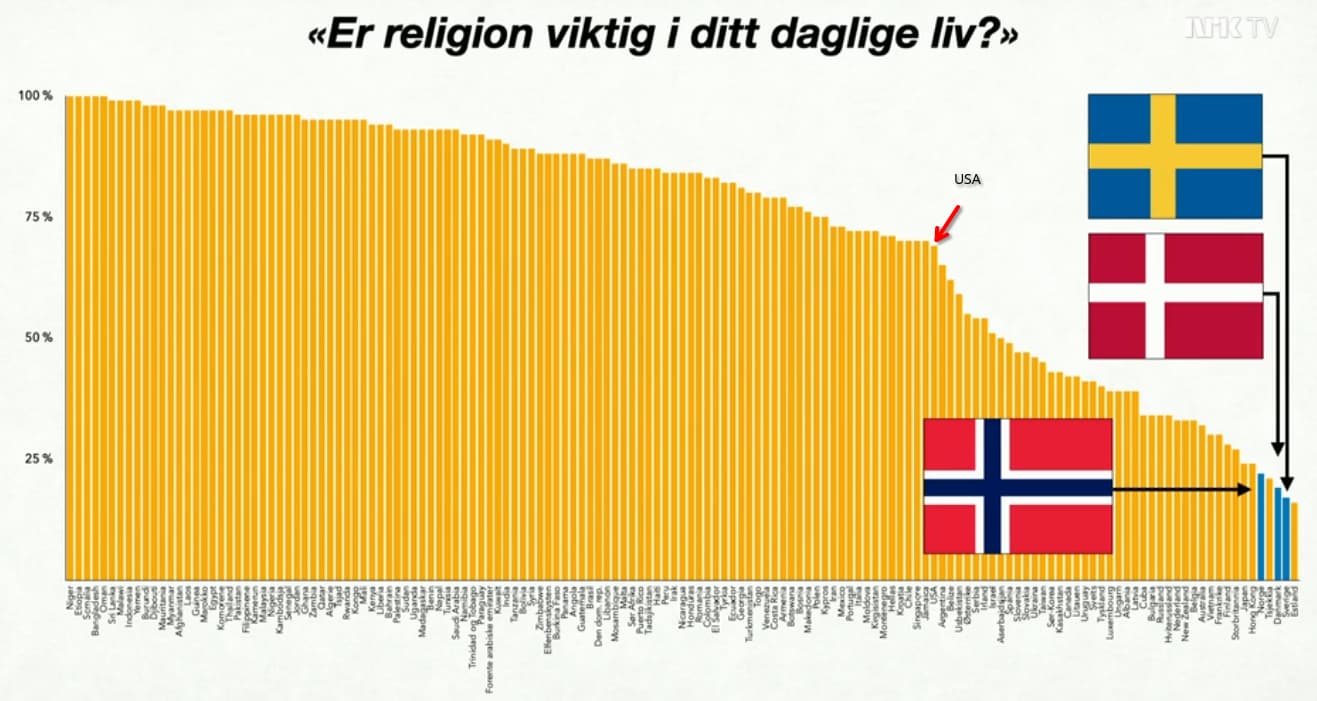
(I also marked the US in the graph)
In the Nordics, we’ve also grown skeptical towards religion:
(Graph title: Do you agree that religion leads to/causes conflict?)
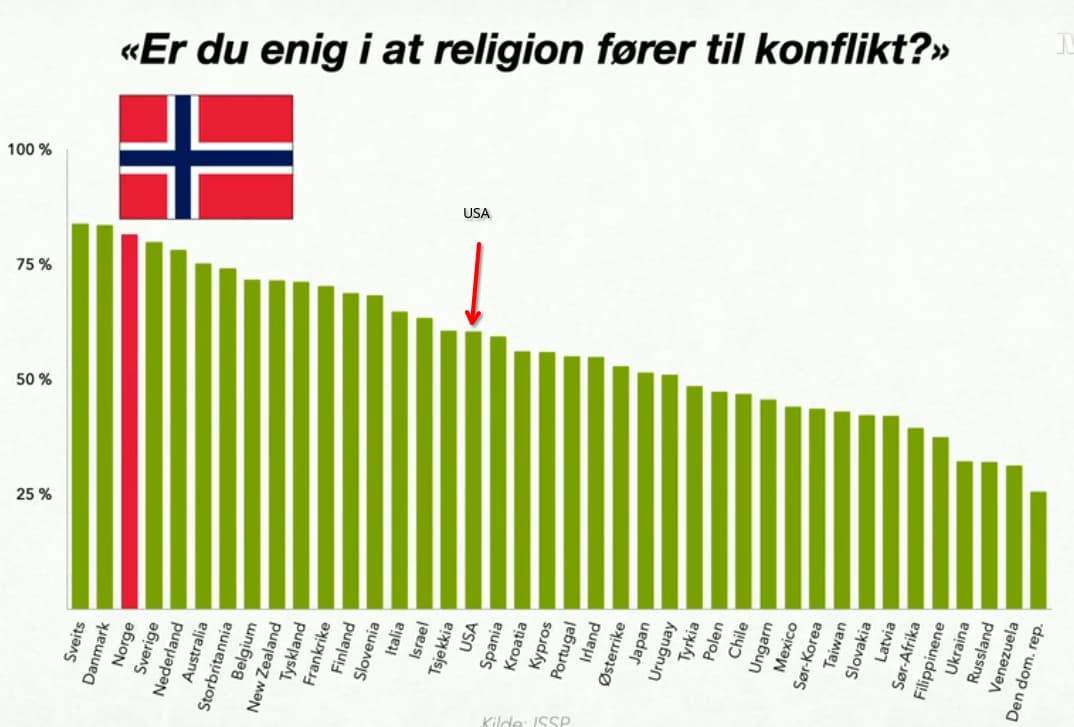
Correlation between education (horizontal axis) and religious beliefs (vertical axis) – the trend is that the more educated the population is, the less they believe (with the USA as an outlier):

A similar trend can be seen if we compare life expectancy (horizontal axis) with religious belief (vertical axis) – with higher life expectancy (more safe/less dangerous lives) , the lower the religiosity:
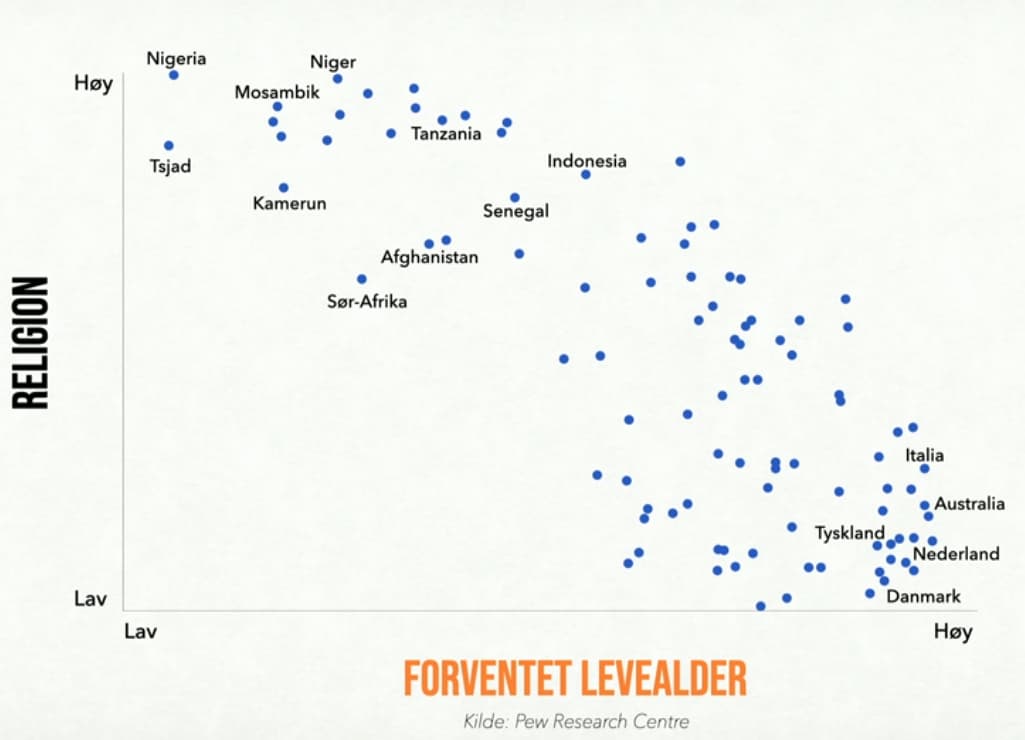
A christian news outlet gave a comment to the programme (my translation):
[The presenter’s] conclusion is that our safety and prosperity means that we to a lesser degree need God in our lives. We’ve moved from an existence with such a high degree of uncertainty that we needed God as insurance, an anchor point, to a society where we largely have what we need. [The presenter] points out that instead of saying “if God wants”, we say “if I want”.
(my emphasis). They then go on to comment that there is even a biblical precedence here (Deuteronomy 8:6-11):
6 Observe the commands of the Lord your God, walking in obedience to him and revering him. 7 For the Lord your God is bringing you into a good land—a land with brooks, streams, and deep springs gushing out into the valleys and hills; 8 a land with wheat and barley, vines and fig trees, pomegranates, olive oil and honey; 9 a land where bread will not be scarce and you will lack nothing; a land where the rocks are iron and you can dig copper out of the hills.
10 When you have eaten and are satisfied, praise the Lord your God for the good land he has given you. 11 Be careful that you do not forget the Lord your God, failing to observe his commands, his laws and his decrees that I am giving you this day.
I tried finding the statistics referred to, but was unsuccessful. I blame the programme producers for only giving very vague and unhelpful references (“Pew Research Center”, “Gallup”, etc.). I did, however, find some interesting statistics over at Gallup International which tells the same story, Two Decades of Change: Global Religiosity Declines While Atheism Rises. Some of the finds are:
Education level has an inverse relationship with religiosity: 67 % of those with low education reported being religious, compared to 56 % with medium education and just 50 % of those with higher education (university level or above).
Religiosity is significantly influenced by a country’s average national income. In low-income countries, 78 % of respondents identified as religious, compared to 67 % in middle-income countries, and just 36 % in high-income countries. Conversely, atheism was most prominent in high-income settings, where 14 % identified as convinced atheists, compared to only 3 % in low-income countries. The proportion of people identifying as “not religious” also increased with national income—17 % in low-income countries, 22 % in middle-income, and 42 % in high-income countries.
Between 2005 and 2024, global perceptions about religion have shifted notably. The proportion of people identifying as religious declined from 68 % in 2005 to 56 % in 2024, reflecting a steady global trend toward secularization. Meanwhile, the share of those identifying as not religious increased from 21 % to 28 %, and convinced atheists rose from 6 % to 10 %.
3 Likes
This has gotten me to pondering…
So, there are data that indicate religiosity is declining (in some places). Okay. The big questions then to me are: What change(s) are resulting / will result from it? Overall, will (has) kindness, generosity, acceptance, etc., increase(d)? Overall, will (has) bigotry, war, rudeness, etc., decrease(d)? Is being shitty and kind to each other part of human nature?
3 Likes
Which is why it’s a mistake to get overly excited about “the rise of the nones”. Turning against organized religion is not necessarily giving up on religiosity or theism or adjacent woo like “new age”. Nor does it preclude people finding alternative ways to be dysfunctional like subscribing to conspiracy theories or crackpot pseudo-science.
What I want to see is not less religion so much as more critical thinking. The latter will take care of the former.
3 Likes
I think that these are interesting questions, so here’s my take:
- Organized religion lashes back. We are seeing this with public officials who are pushing a religious agenda in the public sphere. As an example, Ryan Walters is the Superintendant of Education in Oklahoma, and is trying to force mandated Bible readings in public schools. There is another influential pastor in a South Dakota town who is trying to mandate his version of Christianity for an entire town . . . which includes the idea that women should not vote.
- There will be violence as we transition to a more secular society, with the assassination of Charlie Kirk being an example.
- There will be a temporary decline in the quality of healthcare, as religion has a big influence in healthcare . . . and the pushback by religion against increasing secularity will include greater restrictions on abortion, restrictions on treatment of LGBTQ people, and less availability of psychiatry. As an example, Florida and Texas are trying to remove school psychologists in order to replace them with chaplains.
- There will be greater attempts at censorship as religion trys to maintain its relevance by stifling free speech.
If all of this seems dismal (and it does), then please note that I believe that this state of affairs is the result of the transition to a more secular society, and that things will improve drastically once this period of conflict is in the past.
I hope I live long enough to see organized religion lose its grip on human progress toward a more generous, tolerant, and nurturing society.
1 Like
I’d like to say things are getting better, but that doesn’t seem to be the case. Even though fewer people are attending, the influence the church hasn’t diminished. I would have hoped that the more liberal denominations would balance the conservative denominations, but I’ve realized that is just not in the nature of what liberal denominations are about.
If I am honest with myself, I don’t think things are going to change much - and even if they do, the change will be slow.
I would have to disagree specifically on the use of “organized religion”, if one considers organized religion to be defined as a particular belief system (Christianity, Islam, etc.) or even a significant/mainstream/international denomination of a particular belief system.
I do fully recognise and accept that the situation in America is what it is, but I don’t think it’s fair to equate that with the wider global representation of those religions.
I can understand why the US form of “Christianity” does appear (at least from my limited knowledge outside the USA) to be in some ways, and in specific elements, insidious. It has become inexorably linked to politics, it is overbearing, and in some ways and some aspects, it appears contrary to the wider belief system (in my view), so as above, I can fully accept why there would be the animosity toward what is experienced in the USA in particular. My only objection is to it being linked to the wider system.
I do think those in positions of power and responsibility in a global capacity could do more to acknowledge this disparity and challenge it openly, so as to make the rejection of certain behaviours, practices, and views that much clearer.
Are you asserting that the politicization of religion is specific to or most predominantly occurs in the U.S?
2 Likes
I’m saying that from my view, what happens in the U.S. is specific to the US. I recognise that religions are politicised in other countries, including Christianity, to varying degrees, but the politicisation of Christianity in the U.S. is very different to other countries, stands out as being more pervasive, and has elements of extremism (as highlighted with Kevin’s points about the various actions/behaviours taking place/having taken place).
Hmmm….is religion politicized in the U.S.? To an extent, yes. But it is far from being as pervasive as elsewhere.
It has elements of extremism? I guess that depends on the scale you’re using. So what does that even mean?
1 Like
Let me see if I can explain this.
If you take the political situation in the US, what is missing are the mainline liberal denominations. All the hubbub is from the conservative denominations, which I think only represent half of US denominations. And we aren’t including those who are Christian, but don’t identify with any particular denomination , which I think represents a block equal to the other blocks previously mentioned. Yes, what I am saying is that I think the hubbub is being caused by less than a third of the population.
So it is very important to identify who one is talking about. Personally I think “organized religion” means an identifiable denomination, not the unaffiliated.
In terms of Christianity, I would say the U.S. it is the most pervasive example (not counting the Vatican City of course) - issues like abortion etc. are heavily tied to party lines and very polarised.
As for extremism, the Christian nationalism movement seems to veer towards this - anti-lgbtq+ laws, books being banned, educational curricula being re-written, etc. are extreme acts.
I understand that other nations with majority Christian populations may have strict laws and views, but to my knowledge, this is more the underlying state of such nations, and not a politically polarised situation like in the U.S.
With the U.S., it is the polarisation that stands out - certain views are not representative of the clear majority (perhaps they are even just an empowered minority), and yet laws and restrictions are being imposed to force a particular belief system / view on a significant percentage of the population who disagree with it.
2 Likes
Exactly. Liberal Christians are rather like liberals in politics. They find any sort of assertive stance against authoritarians to be distasteful and un-loving (the canonical metaphor is “they bring a plastic fork to a gunfight”). They take “live and let live” so far that they leave the regressives alone and expect them to return the favor. They don’t.
I think liberal Christians as I’ve encountered them could deploy a good deal of social pressure on fundamentalists, shaming them for the way they forsake the basic teachings of Jesus such as treating strangers like your own, judge not lest you be judged, love one another, etc etc. But I see no widespread exceptions. In the US, one could be forgiven for thinking that Christian nationalists / fundamentalists are the mainstream and the spokespeople for the entire faith. They suck all the oxygen out of the “room” so to speak.
Yes it is “organized” as in “organization”. The “nones”, as a polling category (I think the term was invented by Pew Research Center, although I’m not positive) are people who, if they are believers, hold to a purely personal faith but don’t belong to any official denomination. Typically they content themselves with private devotional activities or at most perhaps follow online or media nondenominational teachers. Most of them aren’t really practicing Christians except for the occasional prayer or adhering to whatever ruleset they grew up with. They distrust “organized religion” for various reasons, some of them actually pretty good.
I don’t believe you are correct.
2 Likes