The Big Bang : A Universe From Nothing?

I agree with you on one level Nyarlathotep.

There is much to be sad and cynical about in this world.

But the point I was making in my reply to Sheldon was about science’s reliability when compared to the unreliability of the emotionally-driven flights of fancy indulged by religionists.

Thank you,

Walter.

2 Likes

You can even perform a simple thought experiment to test the claim I’ve just made.

Get five scientists around a table. One is an atheist, one a Jew, one a Muslim, another is a Sikh and the last one a Christian. Then ask them two questions.

  1. What is the name of god?

Each will answer according to their own personal views and they will not agree. There will be no agreement among them, even though they respect each other’s right to hold different beliefs.

  1. What is the chemical formula of water?

Each scientist will give exactly the same answer, two atoms of hydrogen bonded with an atom of oxygen. Even if they work in different branches of the sciences, they will still agree upon this answer because they know that it has been so well researched and studied that to deny it would be foolish.

This simple exercise demonstrates the universal reliability of science. The answers it gives are not dependent on emotions, feelings, intuition, the moving of the spirit or the counsel of angels. Nothing personal, private, intimate or subjective.

That’s because all scientists are required, by the very nature of their work, to leave their personal beliefs at the door and to work objectively together in an agnostic discipline that has nothing to do with matters of faith, spirituality, theology or religion.

The fact that some scientists also hold religious views is therefore irrelevant to science’s status as reliable and agnostic.

Thank you,

Walter.

1 Like

I agree, but the claim there is scientific evidence for a deity is another matter of course, and it’s reasonable to assume elite scientists are best placed to know if this were the case, and so when 93% of (for example) the US National Academy of Sciences says they don’t believe in a personal deity, the inference is unavoidable.

NB this is not a claim no deity exists, or that science has disproved anything.

1 Like

Must…resist… Arrrgh! No! Cannot!

Taken literally, that would be H4O2 or 2H2O, not just H2O as it is conventionally written (“two hydrogen atoms bonded with an oxygen atom”). However, if you’re talking about a reaction equation for creating water from hydrogen and oxygen, the left side of be 2H2 + O2 → 2H2O would indeed be your molecule version.

Just my inner OCD acting up. :sweat_smile:

2 Likes

He! He! He! :rofl:

You know why I wrote it the way I did, Goml?

Because I couldn’t remember how to place the number 2 in a lower position, just as you have. So I just shrugged my mental shoulders, said fuckit (silently) and wrote the damn thing out in full. If that’s triggered an OCD episode for you, then I’m sorry. But at least I’ve learned something new from your reply.

Talking about learning new things, which of the icons at the top of the dialogue box is for doing that? For writing out H2O properly?

I laugh at myself for not knowing this, btw. Walter waxes verbose on Singularity theory, General Relativity and will also write at length about Inflation and Particle Physics. But he can’t figure out how to type out a chemical formula properly.

Oy vey! :roll_eyes:

U+1F980 => :crab:

Quick tip re Unicode …

If the forum software accepts what are known as HTML entities, this is a platform independent means of embedding Unicode characters in your post.

The format is as follows:

π

To use an HTML entity, you have to use the decimal version of the Unicode value, so you have to dig out your calculator and set it to perform the conversion from hexadecimal.

The above example should render the Greek letter pi if the forum software accepts it:

π

Here’s how you do it:

  • Subscript – Use H<sub>2</sub>O to typeset H2O
  • Superscript – Use f(x) = e<sup>x</sup> to typeset f(x) = ex
  • Greek letters: &alpha; &beta; &gamma; &delta; &Alpha; &Beta; &Gamma; &Delta; to typeset α β γ δ Α Β Γ Δ and so on.
  • Other symbols: &leq; &geq; &approx; &sim; &int; &sum; for ≤ ≥ ≈ ∼ ∫ ∑

Here’s an ugly rendering of an integral:
&int;<sub>a</sub><sup>b</sup> f(x) dx => ∫ab f(x) dx

Find numeric codes for Unicode symbols (e.g. &#8987; for :hourglass_done:) here: HTML Unicode UTF-8 Symbols
Here are some HTML codes for lots of symbols: HTML Symbols | HTML Emojis

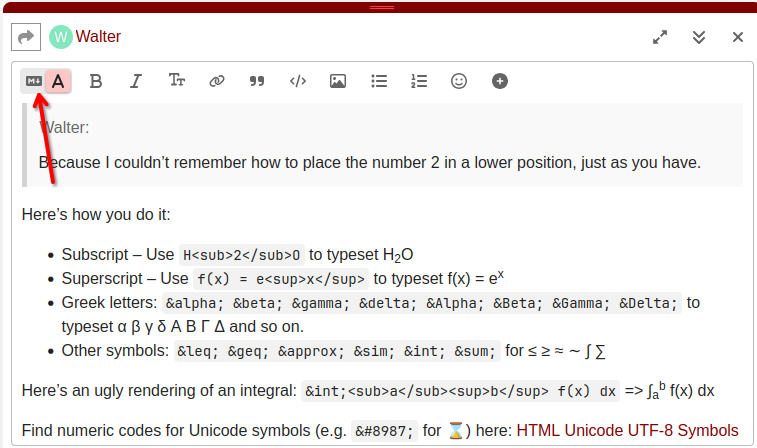
To input these, switch to the “Standard Markdown editor” by clicking at the button indicated by the red arrow, here:

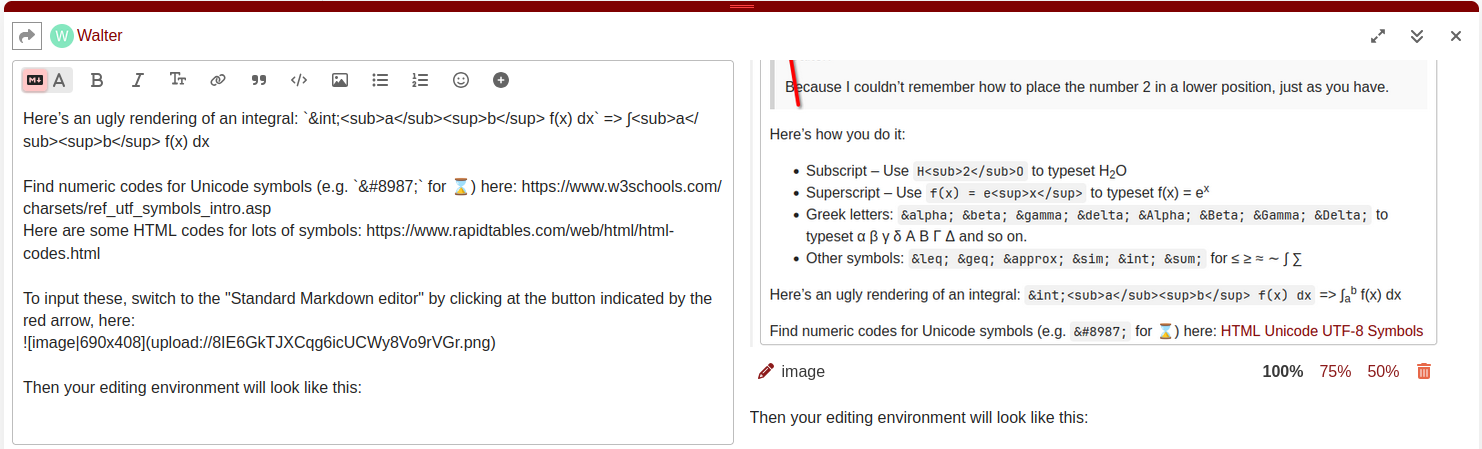
Then your editing environment will look like this, where you type in the left part and get a formatted version to the right:

Other stuff: Footnotes[1] is input like this: Footnotes^[like this]


  1. like this ↩︎

Found it!

Thanks, guys!

:+1:

I (think) I understand why quantum mechanics become more and more important as the scale gets smaller and smaller.

I have wondered what role the Uncertainty Principle plays in the Big Bang, as I have the idea that the reason why time may not have existed “before” the Big Bang is similar to the idea of why the Uncertainty Principle dictates that if we measure–with precision–the velocity of a subatomic particle, then we are wildly inaccurate about its position . . . and if we measure this particle’s position with accuracy, then this measurement throws off the velocity.

When we consider these trade-offs, it seems–at least to me–that there is no way to define the passage of time in the singularity that created the current presentation of the Universe.

To properly measure time, we would need to measure a change in something. We can keep track of time with an hour glass, a sundial, or the decay of a radioactive isotope (along with many other ways to measure time).

The catch is that these methods are macroscopic.

So, how do we measure the progression of time when quantum mechanics dictates that the degree of accuracy in position is at the expense of accuracy in velocity, and vice-versa?

This means (to me) that time may as well not exist in the original singuarity. We have no way to distinguish the passage of a day from the passage of a million years.

But maybe I’m wrong.

No, no. Both you and Get_off_my_lawn are quite correct, Kevin.

The Hawking - Penrose Singularity theorem suffered from general Relativity’s inability to cope with the infinities found at the initial singularity. This was the Achilles heel of the theorem, so that despite appearing to be successful on some levels, it could never be a proper description of the origin of the universe.

For that Quantum Mechanics would have to be factored in.

This is exactly what I’m writing about in my other thread about Inflation theorem. It avoids the infinites of Singularity theorem so that the question, ‘What came before the Big Bang?’ is changed to ‘What came before Inflation began?’.

The kicker in Inflation theorem is that the hot Big Bang comes AFTER a brief period of inflation, when the universe grew from quantum size to bigger than the observable universe. Your comments are very timely, btw. I’ve just been discussing the inflationary phase of the universe’s evolution and I’m about to ask the question, ‘What’s Inflation got to do with the Big Bang?’.

Thank you,

Walter.

I have sometimes wondered if cosmic inflation is a result of the Universe spinning.

If we picture an old-fashioned record player turntable with a spinning record, a mark on the record near the center is revolving slower than a mark on the outside edge of the record, which means that an object on the outside of the record has more centripital force trying to carry it away from the center than the centripital force on an object closer to the center of the spinning record.

This makes it seem–to me–that if the Universe is a vast hypersphere that is spinning in a higher dimension, then something like centripital forces would explain why the farther away an object is, the faster it would be receeding away from us.

So let us suppose that the singularity that existed before the current presentation of the Universe had a certain spin, and–perhaps because of the Uncertainty Principle–something changed in either the mass and/or spin, which caused this centripital force to pull everything apart, which we interpret as the Big Bang?

I also have heard that virtual particles are constantly appearing and disappearing into nothing, so if this spinning singularity had its mass changed by virtual particles, then in a tiny fraction of time this change in mass caused the centripital force to change enough to overcome the forces that were holding the singularity together?

In other words, if I have a weight on the end of a string and I’m spinning it around my head (like a slingshot), and someone throws a glue-covered rock at this spinning weight so the mass of the weight increases, then the string can break and the weight goes flying off somewhere away from me.

I may not fully know and/or understand what I’m talking about, but I seem to think that there is a relationship between centripital force and the expansion of the Universe, as there are paralells between objects on a spinning surface that receed from each other and how objects in the Universe are also receeding from each other . . . although I may be thinking about such heady ideas in an overly simplistic way.

I think your supposition needs a little more thought, Kevin.

The initial singularity, as described by Hawking and Penrose, is the origin of all of time and space. With these come such things as direction (up - down, left - right, backwards and forwards) and duration (past, present and future). But before the singularity existed, if I can use the word ‘before’ here, neither direction nor duration existed.

Unless we allow ourselves a free hand to speculate that they did.

The trouble is, if you want to invoke an initial singularity, then unless you say otherwise, surely the one formulated by Hawking and Penrose, which uses Einstein’s equations of General Relativity, is the only one that fits the bill?

Anyway, my point is this. In the context of the Hawking - Penrose initial singularity, there was no ‘before’ the singularity. Nor was there anything for it to be spinning in relation to. And since neither time nor space existed then, it did not have an axis to spin around nor did it have any physical dimensions itself to spin around the axis it didn’t have.

Do you see the problems?

Taking examples from our three dimensional and temporal universe, like record turntables or strings with weights, and applying them where the is no time and no space simply won’t work.

And there’s another problem caused by mixing up initial singularities (which work only in General Relativity and not Quantum Mechanics) with virtual particles (which work only in Quantum Mechanics and not General Relativity). GR and QM cannot work together like this.

That’s why a unified theory of Quantum Gravity is needed and is still being sought by scientists. The nearest we’ve come to unifying GR and QM in a workable way is Semi-Classical physics.

Semiclassical physics - Wikipedia

In case you are interested I am discussing the Semi-Classical physics in the Inflation Theorem in my other thread.

Thank you,

Walter.

Does it really make sense to say that something is of “a quantum size” when we’re talking about what is about to become our observable universe? What do you compare this “quantum size” to? Something “non-quantum sized” outside what is to become our universe? But that would imply there is space outside that is in a non-quantum universe (and hence already inflated state) outside this “quantum sized” universe embryo. This does not make sense to me. What would make more sense is to say that the pre-inflationary embryotic universe was in a hot quantum state and had a much larger extent (however one may define or understand spatial extent and spacetime), and then something triggered inflation (an instability, perhaps?) in a local part, which then spread to and throughout neighbouring proto-universes. I know, pure speculation, but since we do not have any theory or observations that can give us a clue about what actually happened, one speculative approach is as good as any other :clown_face:

I touch upon this in my second thread, Goml.

In this thread I talk at length about the Initial Singularity that results from using only General Relativity. As we know, this is where GR breaks down. It is ONLY in the context of Singularity theorem that the notion of nothing pre-existing the singularity comes into play.

But that doesn’t apply in Inflation theorem. There a pre-existing quantum domain is posited to exist before one of its fluctuations generates our universe. So, ‘events’ do happen in this domain, even if our concepts of space, time and causality don’t describe it properly.

That was my justification for writing what I did about a hot Big Bang coming after the period of Inflation. As you will see, when I make my next post in that thread, this hot Big Bang is radically different from the one described using an initial singularity.

Hopefully, all will become clear when I make that post and, of course, questions arising from it will be answered (hopefully!) by me to the best of my ability.

Thank you,

Walter.

To explain a little further about the difference between the hot Big Bang of Singularity theorem and the hot Big Bang of Inflation theorem, it might be worth looking at where the former fails.

We know that the discovery of a cosmological constant with a positive value in 1998 violated the terms and conditions under which Singularity theorem applies. We also know that General Relativity breaks down at infinities, meaning that it cannot actually tell us anything about the very thing it predicts - a singularity.

But there is a third problem with Hawking and Penrose’s theorem that arises from the way they reversed the flow of time to get the initial singularity to ‘push’ the universe open and to cause it to expand. Their theorem comes in two parts, the first dealing with the gravitational singularities of black holes and the second dealing with the cosmological singularity that was the origin of the entire universe.

Their calculations showed that the core of a massive star MUST collapse to form a gravitational singularity when that star explodes and dies. Such a collapse is spherical because the star itself is spherical. The sphere of the core implodes, collapsing into itself in a spherical fashion, growing smaller and smaller until it becomes a point of infinite density and infinite spatial curvature.

But if you reverse that spherical collapse and apply the equations in reverse to how the initial singularity MUST expand, then it must likewise do so in a spherical fashion, becoming larger and larger until it becomes the entire universe. Which means that the universe it creates is a sphere. Which is a problem, because a spherical universe violates the underlying principles of General Relativity and also violates the Cosmological Principle.

Cosmological principle - Wikipedia

In General Relativity the status of all observers and every location are considered to be equal and equivalent. There is no absolute frame of reference by which locality or movement can be measured. That is why in GR, everything is relative, not absolute. My location cannot be ascertained by measuring anything except another observer’s. Yours cannot be ascertained by measuring anything except another observer’s. Therefore the positions of all observers are relative to each others. Nothing is absolute.

But in the spherically expanding universe that emerges from the initial singularity there is an absolute frame of reference. Any sphere will have a centre, a radius and a boundary. So one observer could be closer to the centre than another. Which means that their status is not equal, equivalent and relative.

This violates the basic principles of General Relativity.

And so Hawking and Penrose’s time-reversed expanding universe, which was generated by using the equations of General Relativity ended up violating the very thing that created it.

However, Inflation theorem suffers from none of the above problems. There are no infinities in it to generate a singularity which will cause a breakdown in GR. There is no centre and no edge to the universe in Inflation theorem, which means that all observers everywhere share the same equal and equivalent status. Finally, a positive cosmological constant is not a problem that spells the failure and refutation of the theorem, as it did for Singularity theorem.

I will explain all about these things in the coming days in the Inflation thread.

Thank you,

Walter.

Looking forward to it.