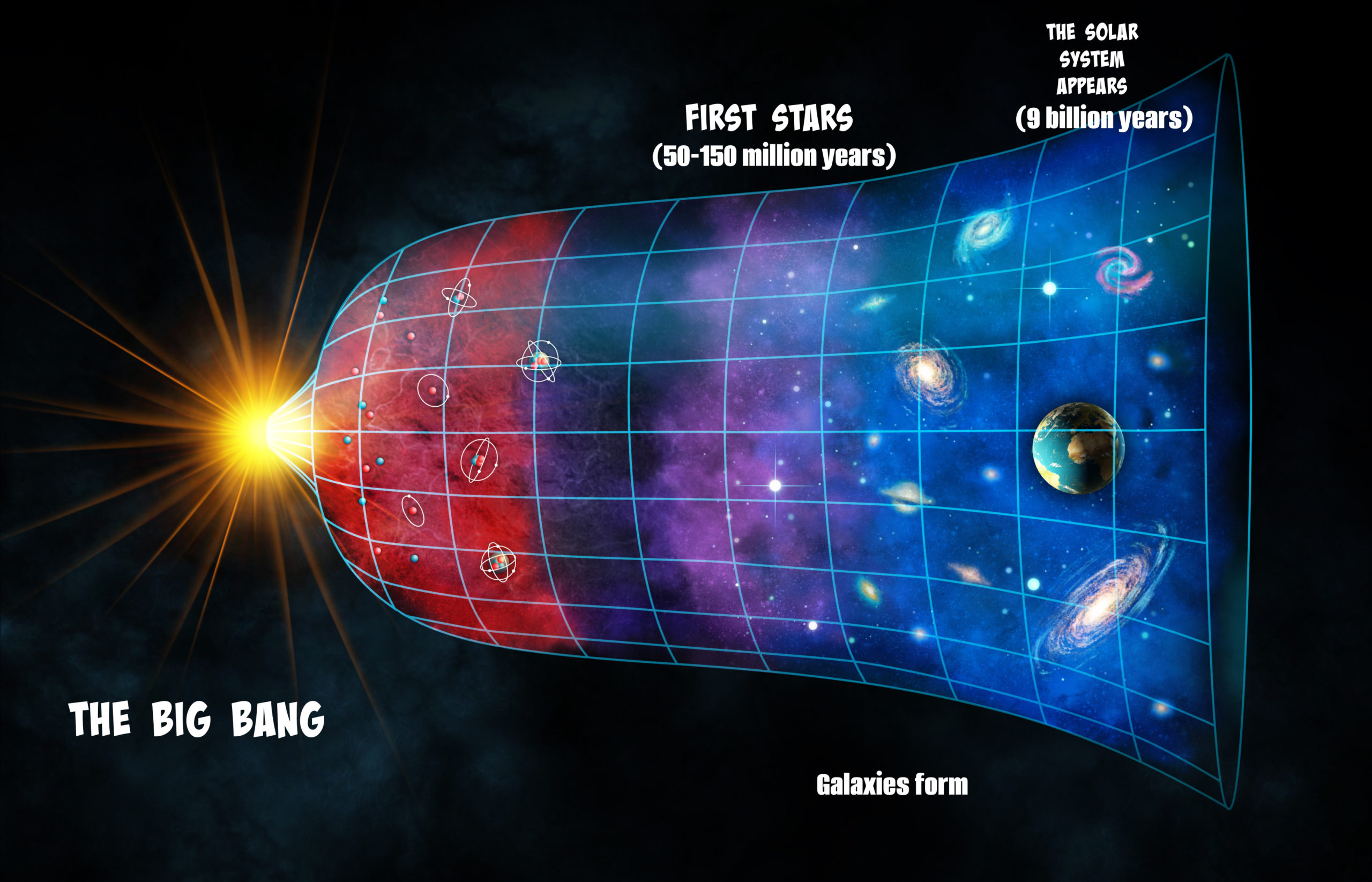
The Big Bang : A Universe From Nothing?

There are several persistent and recurring misunderstandings about the Big Bang which often rear their heads when we are visited by Christian apologists trying to make arguments for their god. In this thread I will attempt to rectify and explain the misunderstandings about the universe springing into existence out of nothing. This misunderstanding has often been asserted by Christians as being evidence that science confirms what is written in Genesis 1: 1 - in the beginning god creating the heavens and the earth out of nothing.

But this is not so. As I will demonstrate in this thread.

First, we need to go back to 1929, when Edwin Hubble discovered that galaxies are receding from one another as the universe expands. As simple reversal of this expansion logically concludes that the further, we go back in time, the closer the galaxies are to each other. Extrapolate this far enough back and the universe starts to become a very crowded place, with the galaxies piling up on top of one another. Eventually, as we go further back the temperature, pressure and density of the very early universe rises dramatically. Go back far enough and the universe becomes so hot and dense that General Relativity tells us something very strange indeed.

There comes a time when, as the heat and pressure become so high, that GR itself breaks down, leading to what is known as a singularity. This is something that GR cannot describe in terms of equations or numbers or physical values of any kind. It is an unknown. The singularity that is theorized to have existed at the very beginning of the universe is known as the initial singularity. It was believed that the Big Bang itself emerged from and originated from the initial singularity.

But there is no point asking where did the initial singularity come from or when did it start to exist? This is because the singularity itself is the cause of all of time and all of space. At least if you only use GR when you are extrapolating backwards in time by reversing the expansion of the universe. So, there is no before the initial singularity, because time did not exist before it did.

Singularities of a similar kind are theorized to exist in the centre of black holes. But, this has yet to be confirmed by observations and may prove impossible to do so. Therefore, this currently remains a purely theoretical prediction. However, for the purpose of this thread, black holes singularities are our way of gaining a better understanding of the initial singularity at the beginning of the universe.

For that we must thank two British scientists, Stephen Hawking and Roger Penrose.

Between 1965 and 1970 they jointly published five ground breaking scientific papers about black holes, which they refer to as gravitational singularities. This terminology needs some explaining. When a very massive star reaches the end of its life the thermonuclear reactions in its core come to an abrupt halt. The outward pressure of heat and radiation leaving the core used to precisely balance out the immense inward pressure of the star’s outer layers, allowing the star to shine stably for millions of years. But when the core suddenly switches off there is nothing left to stop the star from imploding. It does this catastrophically in what we call a supernova explosion.

If a sufficiently massive star undergoes this kind of core collapse, Hawking and Penrose mathematically proved that a black hole singularity MUST be formed. The force that causes the core collapse is gravity and so what is formed is technically known as a gravitational singularity.

Gravitational singularities are sufficiently similar to the initial singularity of the Big Bang for us to use the former to understand something about the latter. To do this we need to look at Hawking and Penrose’s sixth scientific paper on singularities, which dates from 1970. It is entitled The Singularities of Gravitational Collapse and Cosmology. Here is a link to it.

https://royalsocietypublishing.org/rspa/article/314/1519/529/13052/The-singularities-of-gravitational-collapse-and

I won’t delve into what the paper says at this point. Instead I will now throw this thread open to any questions from the members that have arisen from what I’ve written so far. Please ask away if there’s anything that I haven’t explained to your satisfaction or which you feel needs further clarification. I’ll do my best to answer them.

Thank you,

Walter.

2 Likes

DON’T PANIC!

Hawking and Penrose’s science paper looks scary and confusing because it’s full of weird and wonderful equations, technical language, and complicated concepts. But we don’t have to go into any of them to find out what we need to know. Instead, all we need to do is read the abstract of the paper (a kind of preamble), get a broad understanding of their thinking and then look at a few sentences within the body of the paper itself. I will provide guidance and explanation along the way.

Let’s start with Hawking and Penrose’s mathematical proof that a really massive star ends its life in a supernova explosion and, in doing so, collapses in upon itself to form a black hole. At the centre of this black hole a gravitational singularity is theorized to exist. This singularity is of zero size, possessing no height, width, or depth. No volume, no diameter, circumference, or surface area. It is a point of infinite density, where the curvature of spacetime is infinite too. That’s what we think it is in terms of space, but what do we think it is in terms of time?

Hawking and Penrose used Einstein’s equations of General Relativity to model the collapse of the star and the formation of the gravitational singularity. This is significant because in GR, the stronger the gravitational field, the slower the passage of time. This is nicely shown in the film Interstellar, where two astronauts visit a planet orbiting a supermassive black hole for, what seems to them, a few hours. When they return to their mother spaceship 23 years have elapsed! The extreme gravity of the black hole has slowed down their experience of the passage of time.

For the singularity of a collapsed star the situation is even more extreme, with time slowing down to a complete halt. Time does not elapse for a gravitational singularity. Therefore, we have something which has no physical size in space and for which time does not exist. Does that sound at all familiar?

Hawking and Penrose quickly realized that their equations were telling them something, not just about the collapse of a massive star, but also something about when the universe itself was infinitely dense. Yes. Exactly. The same conditions that occur when you run the expansion of the universe backwards in time until you reach the Big Bang.

The initial singularity that I described earlier, from which the Big Bang itself emerged, is very similar to the gravitational singularities that occur when a massive star dies, implodes, collapses, and becomes a black hole. In both cases we are talking about things which have zero size, infinite density and for which time does not elapse or even exist.

Both scientists further realized that Einstein’s equations did not depend on the forward passage of time. That is, General Relativity works equally well, not just going forward in time but also going backwards. Because GR is itself a mathematical description OF space and time. The thing that describes time itself isn’t bound by any of the limitations of time.

So, they did the logical thing and reversed the flow of time in their equations.

What they found seemed to work perfectly and it also seemed to explain certain things about the origin of the universe. But before I go ahead and explain further, I think it best to pause here. For everyone to read and digest this message but also to compare it with my previous one.

As before, I can answer questions or present further explanations if they are needed.

Thank you,

Walter.

Just a quick one: The big flaw here is that in this pure GR approach, quantum effects are ignored. As you extrapolate back in time, you finally get to a point where time/space scales are so short/small that quantum effects start to dominate (Planck time and Planck length). And here the predictive powers of GR break down, and new theory in the form of quantum gravity is needed. And that happens before we hit a mathematical singularity. According to current consensus, at least.

1 Like

Yes. Exactly so, Goml. That is what we know NOW.

But back in the 60’s Hawking and Penrose were feeling their way forwards, reaching for new ways to explain recent findings in astronomy and cosmology.

Your objection is entirely valid, but we will come to it later on in this thread, ok?

Walter.

Walter,

Every time I go through an analysis of the Big Bang and we get to the singularity, I stumble over the idea of infinite density. I can grasp the concept of infinity as a mathematical concept, and I can grasp the concept of infinity as a Physics concept, but when it comes to reality, I think infinity doesn’t exist.

It’s sort of analogous to Newton’s Laws of Motion and the orbit of Mercury. The theory doesn’t match reality. So just like Newton’s laws needed Einstein’s General Relativity to better match reality, I suspect the concept of the infinitely dense singularity is awaiting a better explanation. Is Hawking/Penrose providing that, but I haven’t got there yet?

In GR, the volume of a black hole isn’t a well defined concept; so you are wise to be suspicious of any statement about the volume of a black hole (density is derived from volume). It is why when you see a physicist talking about black holes you’ll see the math will likely reference the surface area, not the volume.

This is only my opinion: singularities don’t exist in the real world, they come from pushing the math past a point where it is known to be an unreliable model for the real world. It is a result that is basically guaranteed to be wrong.

Additionally there is a series of degeneracy pressures that prevent gravitational collapse (or any increase in density) but they can be overcome. First comes electrons, then neutrons, then presumably quarks. And presumably there are additional undiscovered (heavier) fermions that will each have their own degeneracy pressure thresholds. It is my guess that one or more of these prevent infinite density (and can’t be overcome).

Also, when a black hole absorbs some information, its surface area grows in proportion to the information: suggesting that if density is a meaningful concept in that situation, then the density was already maxed out (requiring the black hole to grow instead of get more dense). That is kind of what a black hole is, a region of space that has maxed out its density (again, assuming density even means something in this situation).

Or ā€œtimeā€ or most any other conventional concept of reality.

1 Like

Dear Caprimark1 and Nyarlathotep,

Hawking and Penrose will not be providing a better explanation of the initial singularity for us. Nor will I be doing so, based upon Quantum Mechanics or any other physical theory. There is a reason for this.

The purpose of this thread is NOT to answer the question, ā€˜Did the universe come from nothing?’

Instead, if you go back and read my introduction, I started this thread and am adding to it for the purpose of showing where Christian apologists go wrong in their understanding of the Big Bang. To do that I have to cover General Relativity, which Hawking and Penrose used to formulate their singularity theorem.

But, just as Get_off_my_lawn correctly pointed out and as you’ve correctly pointed out too, GR cannot give us what we need to understand the Big Bang properly. A fully functioning blend of GR with QM is needed for that. Such a new theorem will deal with quantum effects from degeneracy pressures and deal with the infinities that currently plague our models of the very early universe. But we are not yet in possession of such theorem.

So both you and Nyarlathotep are spot on with your observations.

But in this thread I’m not talking about a theorem that was successful. I’m talking about one that failed. I need to do that in order to describe the mistakes that Christian apologists commit when they discuss the Big Bang. We will see this later on, when I describe how the Hawking - Penrose singularity theorem failed.

Once we have this under our belts it then becomes clear that almost every Christian apologist who tries to use physics and cosmology to make a science based argument for their god, trips themself up by latching onto a failed, refuted and discarded theorem.

I hope this makes sense.

Thank you,

Walter.

To continue…

Stephen Hawking realized that Roger Penrose’s collapsing star (black hole) singularity theorem had an interesting feature that he could use in a novel way. Because Einstein’s GR equations do not have a fixed and absolute frame of reference in either time or space, the direction of time could be reversed in the calculations, without disturbing the accuracy of the results.

So, if a collapsing star of high enough mass inevitably leads to a black hole and a singularity, then the time-reversed version of that scenario is equally valid. With a black hole gravity is always attractive and always pulls in space-time, matter, and energy. So, a time-reversed version would always repel and ā€˜push out’ space-time, matter, and energy. In GR, both scenarios are equally valid.

In 1969 Hawking and Penrose worked together to write their 1970 paper, ā€˜The Singularities of Gravitational Collapse and Cosmology’, concluding that according to only GR, the universe must have had a definite beginning, with an initial singularity as the ultimate source of the entire universe.

One of the advantages of using a time-reversed singularity was that Hawking and Penrose could partially explain why the universe was expanding, with galaxies moving away from each other.
They realized that if in a normal, forward-moving time frame a black hole singularity’s gravity always ā€˜pulls’, then in a reversed and backward-moving time frame, the opposite kind of singularity must always ā€˜push’. Their time-reversed singularity provides the necessary ā€˜push’ that caused the universe to expand and caused the galaxies to begin moving away from each other.

This seemed very promising because they now had a tentative explanation as to why the universe was expanding, when no real explanation existed beforehand. The innate problems of a lack of QM in the mix and the infinities associated with the initial singularity were deemed to be things that could be solved at some future time.

So, they published in 1970, to the immediate acclaim of the scientific community and to the delight of Christian apologists. Here, it seemed, was scientific confirmation of Genesis 1:1. The entire universe and all of space and time springing into existence out of nothing and out of nowhere, just as scripture appeared to say. God literally speaking everything into being and science discovering that he used the initial singularity to do it.

With the advent of the internet Christian apologists went online to employ singularity theorem as evidence of the Bible being confirmed by science. Here is an example from William Lane Craig’s Reasonablefaith site, where he pays tribute to Stephen Hawking. (Please note that this page was put up in the early 2000’s and has since been taken down.)

https://www.reasonablefaith.org/media/reasonable-faith-podcast/a-tribute-to-stephen-hawking/

KEVIN HARRIS: What would you say would be the importance of his contribution?

DR. CRAIG: There are two things that stand out. One would be his development with Roger Penrose in the early 70s of the Hawking-Penrose singularity theorems. Prior to that time the singularity that marked the beginning of the universe in the standard Big Bang model was thought to be perhaps merely a mathematical artifice, perhaps a feature of only a very idealized universe that had ideal homogeneity and what is called isotropy – being the same in all directions. But what the Hawking-Penrose singularity theorem showed was that any sort of universe which is governed by the equations of the general theory of relativity when extrapolated in the past will inevitably shrink down to a singularity – to a point of infinite spacetime curvature, temperature, density, and so on, and therefore would mark the beginning not only of all matter and energy but of physical space and time themselves. They helped to show that this prediction of the standard model was not some unrealistic prediction of an ideal model but would in fact characterize the real universe insofar as it is governed by the equations of Einstein’s general theory. Interestingly enough, Hawking helped to put in place some of the strongest evidence for the truth of the second premise of the kalam cosmological argument, namely that the universe began to exist. That is why his work became of such interest to me as a young philosopher working on this particular cosmological argument for God’s existence.

Of course Craig is about as wrong as he can be here. But to his audience of believing Christians this sounded like manna from heaven. Here was a leading man of the faith plainly saying that science and the Bible agreed with one another.

The supreme irony of ALL the sites on the internet that repeated WLC’s bogus claims is that they were not just ALL wrong, they were ALL out of date. The Hawking - Penrose singularity theorem had been already been refuted in the year 1998. In my next posting, I will explain how and why. Unless questions arising from this one need answering. Which I’m happy to do.

Thank you,

Walter.

2 Likes

Just before we dive into the complexities of the Hawking – Penrose singularity theorem, it’s worth doing a recap of how things were going down in the public’s understanding of the Big Bang from the 70’s onwards.

With the discovery of the Cosmic Microwave Background Radiation signature of the Big Bang in 1964 and the subsequent satellite exploration of it in greater and greater detail…

Cosmic Background Explorer - Wikipedia (1989 to 1993)
Wilkinson Microwave Anisotropy Probe - Wikipedia (2001 to 2010)
Planck (spacecraft) - Wikipedia (2009 to 2013)

…the idea of a universe bursting forth from nothing and nowhere was becoming more and more firmly cemented in the public consciousness. Hawking and Penrose’s widely publicised mathematical proof was simply the frosting on the cake.

Every tv documentary, popular science book or magazine and every popular-level internet site showed the Big Bang in two ways. Either in a spherically expanding explosion appearing out of nowhere or in this kind of diagram.

Both such images are necessarily gross oversimplifications of what they were meant to depict, but that important detail often goes overlooked by the average man on the street, who looks at them and sees a universe springing into existence with a BANG! out of nothing and out of nowhere.

This is the starting point for almost all Christian apologists. They do not come to Jesus for logical or evidence-based reasons. They come to the foot of the cross for emotional reasons and only afterwards do they look for arguments that support what they have already chosen to believe by faith. In their eyes, what they think they know about the Big Bang from tv, books and the internet…

ā€œSCIENCE CONFIRMS THAT THE UNIVERSE CAME OUT OF NOWHERE AND NOTHINGā€

…agrees perfectly with Genesis 1:1, where god created the heavens and earth. This pseudoscientific Christian meme is then echoed and re-echoed endlessly in the echo chambers of Christian forums and websites until it becomes dogma.

And then they come and visit us with this wildly incorrect notion firmly lodged in their minds.

Oy vey!

:roll_eyes:

Now it’s time to look at what went wrong with the Hawking – Penrose Singularity theorem in 1998. To do this we will need to look at the abstract of that science paper, which is a kind of quick synopsis or preamble of it.

A new theorem on space-time singularities is presented which largely incorporates and generalizes the previously known results. The theorem implies that space-time singularities are to be expected if either the universe is spatially closed or there is an ā€˜object’ undergoing relativistic gravitational collapse (existence of a trapped surface) or there is a point p whose past null cone encounters sufficient matter that the divergence of the null rays through p changes sign somewhere to the past of p (i. e. there is a minimum apparent solid angle, as viewed from p for small objects of given size).

The theorem applies if the following four physical assumptions are made:

(i) Einstein’s equations hold (with zero or negative cosmological constant),

(ii) the energy density is nowhere less than minus each principal pressure nor less than minus the sum of the three principal pressures (the ā€˜energy condition’),

(iii) there are no closed timelike curves,

(iv) every timelike or null geodesic enters a region where the curvature is not specially aligned with the geodesic. (This last condition would hold in any sufficiently general physically realistic model.) In common with earlier results, timelike or null geodesic incompleteness is used here as the indication of the presence of space-time singularities. No assumption concerning the existence of a global Cauchy hypersurface is required for the present theorem.

This all sounds very complicated and exotic, but there’s really only one thing we need to remember and just one point to look at, where the theorem fails. Which I have highlighted. I will explain further.

What we need to remember is that Hawking and Penrose had to make a number of assumptions in this theorem because both of the things they were writing about, the interiors of black holes and the very beginning of the universe, were and still are unobservable. So, despite their theorem also being a perfect mathematical proof, it is only as good as the assumptions they based it upon.

A house is only as strong as its foundations and if they are made of sand…?

Anyway, they assumed the universe had a cosmological constant with a negative or zero value. But in 1998 it was discovered that this was not so. Our universe seems to possess a small, but positive cosmological constant. I’ll let Roger Penrose himself tell the story with an extract taken from his book The Road to Reality : A Complete Guide to the Laws of The Universe. Published in 2004. Chapter 28, pages 772 to 774.

What is the present observational position? Well, things have now shifted very significantly again, with the startling evidence (and from more than one source) that there seems to be a significant positive cosmological constant, Lambda.

(Some discussion of the mass-energy content of the universe)

Then came the bombshell of the cosmological constant. We recall from 19:7 that Einstein regarded the introduction of Lambda as his ā€˜greatest mistake’ (perhaps mainly because it contributed to his failure to predict the expansion of the universe). Although since then it had always been taken as a possibility by cosmologists, rather few of them seem to have expected to find Lambda to be non-zero in our universe.

(Some discussion of quantum vacuum energy)

Nevertheless, when in 1998 two teams observing very distant supernovae (see 27:8) – one headed by Saul Perlmutter, in California, and the other, headed by Brian Schmidt in Australia and Robert Kirschner in Eastern USA – came to the remarkable conclusion that the expansion of the universe had begun to accelerate, as is consistent with the upward turn in the graph of Fig. 27.15d, which is the hallmark of a positive cosmological constant!

There it is.
The death knell for Penrose’s own theorem. He and Hawking had written it, working upon the assumption that the universe did NOT possess a cosmological constant with a positive value. But in 1998 it was discovered by two science teams that it did. This result has now been further confirmed by follow up observations.

Back in 1969 they wrote this caveat, which you see in the abstract, just before the four assumptions are listed.

The theorem applies if the following four physical assumptions are made:

Well, the first of those four assumptions is wrong. Which means that the theorem doesn’t apply. It fails. So it can’t be used by anyone to prove that the universe emerged out of the initial singularity. It doesn’t prove that at all.

So, when William Lane Craig started using it in the early 2000’s to argue that science confirms Genesis, that theorem he relied upon had already been refuted by new data and had been discarded by Hawking and Penrose and the rest of the scientific community.

Sorry Bill, but you’re not just wrong, you’re out of date AND wrong!

Thank you,

Walter.

I suspect there may be questions about what the cosmological constant is, now that I’ve mentioned it and because it caused the downfall of the Hawking - Penrose Singularity theorem.

I will do my best to explain what I can about it.

Thank you,

Walter.

Now, to further confirm what we discovered in the abstract of the paper, here are the four places in the main body of the theorem where Hawking and Penrose explicitly state that for their theorem to apply, the value of Lambda, the cosmological constant of the universe, must be of a negative value or a zero value.

https://royalsocietypublishing.org/rspa/article/314/1519/529/13052/The-singularities-of-gravitational-collapse-and

                                              1: Introduction (page 3)

Secondly, in common with II, III, IV and V, we shall require the slightly stronger energy condition given in (3.4), than that used in I. This means that our theorem cannot be directly applied when a positive cosmological constant Lambda is present.

The energy condition (3.4) used here (and in II, III, IV and V) has a very direct physical interpretation. It states, in effect, that ā€˜gravitation is always attractive’ (in the sense that neighbouring geodesics near any one point accelerate, on the average, towards each other).

[ My explanation : Gravitation is always attractive in GR if the universe being modelled has a negative or zero value for its cosmological constant. If the value is positive then that particular model no longer applies to our universe.]

We note, finally, that in Einstein’s theory (with ā€˜reasonable’ sources) it is only Lambda > 0 which can prevent gravitation from being always attractive, the Lambda term representing a ā€˜cosmic repulsion’.

                                              3: The theorem (page 11)

To incorporate a cosmological constant Lambda, we would have to replace T ab in the above by T ab + Lambda K -1g ab.

Thus, (3.6), as it stands, would still imply (3.4) so long as Lamba is equal to or less than 0.)

What all this comes down to is that you can concoct mathematically and logically beautiful and ā€œcorrectā€ equations (speaking of math or modal logic) that are just plain wrong or beside the point if the underlying assumptions are in any way incorrect. In other words even though everything balances out you can still be describing an imaginary universe rather than the actual one we live in. I suppose it’s a common misconception that coherent math or logic points to a correct model, and all incorrect models would have math / logic that would be incoherent. ā€˜Tain’t always so.

However it’s also true that in a sense no mathematical or logical chain of reasoning can be entirely void of any assumptions / axioms. I would imagine it’d come down to probabilities. Was Hawking & Penrose’s assumption that the cosmological constant was zero or negative, just conjecture? It doesn’t offhand ā€œfeelā€ the same as saying, say, that two parallel lines will never intersect in a 2-dimensional space. I wouldn’t hold my breath thinking someone might say, ā€œwell, actually, they canā€.

I guess what I’m asking is, Hawking & Penrose would not have bothered with their hypothesis unless they thought it more likely than not that the constant was non-positive. Where did they go wrong, or did they? And how do we get a sense for how proposal in physics or logic is on a shaky foundation?

Excellent questions, Mordant.

But first, your observation about a mathematically beautiful theorem not properly describing the universe we inhabit, serves to highlight the errors made by William Lane Craig in his tribute to Stephen Hawking and in his ministry to the faithful who were hanging on his every word.

He claimed that the H - P singularity theorem changed the status of the Big Bang from pure theory to legitimate scientific proof. With something proven in this way legitimising belief in its actual existence. From there he further claimed that Christians were entirely correct to believe that Genesis 1 : 1 had therefore been confirmed by science.

Wrong! False! Lies! Untrue! Disinformation!

A mathematical proof legitimises nothing unless what it predicts is observed in reality. The H - P singularity theorem can never be observed in reality because the earliest phases of the universe’s birth cannot be observed at all. Our view of those earliest moments are forever blocked from our view because the universe did not become transparent until about 300,000 years after the Big Bang.

Recombination (cosmology) - Wikipedia

Immediately after the Big Bang, the universe was a hot, dense plasma of photons, leptons, and quarks. At 10āˆ’6 seconds, the Universe had expanded and cooled sufficiently to allow for the formation of protons. This plasma was effectively opaque to electromagnetic radiation due to Thomson scattering by free electrons, as the mean free path each photon could travel before encountering an electron was very short. This is the current state of the interior of the Sun.

So the early universe was as hot, as bright and as dense as the interior of the Sun. Which means that the photons we would use to observe the early universe cannot travel freely through that plasma. It is opaque to photons.

Everything science claims to know about the very early universe comes not from direct observation of that time but from inference about what we know from particle physics, general relativity and inflation theorem. So Craig is dead wrong here.

He’s also wrong in claiming that if something is mathematically proven it must be true in the real world. If that were so, then all the things that mathematicians have proven using pure math actually exist. So there’s no need to go and verify their existence by looking for physical evidence.

At a stroke Craig has completely undermined empirical science. Why bother making telescopes, particle accelerators or any scientific instruments at all? There’s no need. Just prove something mathematically and ā€˜bingo!’ it becomes real.

No. No. No. The things predicted by mathematical proofs only become ā€˜real’ when ā€˜real’ evidence for them is observed in reality. And since the initial singularity predicted by the H - P singularity theorem can never be observed it can never be accorded the status of real.

Which is why Craig has no justification for further claiming that the H - P theorem allows him to claim in his Kalam Cosmological Argument that the universe began to exist. He can’t claim that because he doesn’t know that. Nobody knows that. Nor will anyone ever know that using Hawking and Penrose’s theorem.

Not just because the initial singularity can never be observed but also because the theorem itself has been refuted by ā€˜real’ evidence discovered in 1998. The cosmological constant with a positive value.

Which brings me nicely on to discussion of why Hawking and Penrose though it could never have a positive value.

1 Like

Real life is getting in the way of me continuing immediately, Mordant.

Sorry 'bout that.

I’ll carry on here and answer your questions later.

Bye!

1 Like

Back again.

To answer your questions Mordant its necessary to look at the issue in a wider context. Wider in historical terms, that is. Back in the early years of the 20th century, when a young Albert Einstein was grappling with the equations of General Relativity, what was the prevailing understanding about the universe as a whole? Or putting it another way, what would he have been taught when he was a student?

The answer is that the everyone believed the universe to be static (neither expanding or collapsing) and eternal, having no beginning or point of origin. Stars were born, lived and died and then were replaced by new stars - endlessly. One reason for this view is that in the late 19th and early 20th centuries nobody realised that we lived in a galaxy. In fact, nobody knew what a galaxy was. The faint spiral smudges that sometimes appeared on photographic plates of deep space were taken to distant nebulae, composed of gas and dust. Nothing more.

So there was no reason to think that anything moved, expanded or collapsed.

Yet, when Einstein tried to get his equations for GR to accurately reproduce the static universe everyone believed was out there, he failed. Every model of the universe in his calculations spontaneously began to collapse in upon itself or expand violently. No matter how he changed things, he found his universes expanding or collapsing. They just wouldn’t stay still!

Eventually he threw up his hands and introduced a new term into his equations. This was the cosmological constant. It was a fudge that stopped his model universes from collapsing or expanding, keeping them nice and stable and static, just as everyone thought they should be.

In effect the cosmological constant is a kind of force that counteracts the natural instability of GR, exactly stabilizing the entire universe to keep it static and unmoving. But when Edwin Hubble found that the universe WAS expanding in 1929, Einstein realized his mistake. He called using the cosmological constant to stabilize the universe his greatest blunder. If he had stuck to his guns and published GR with an expanding universe he would have predicted what Hubble found decades in advance. It would have been another triumph worthy of a Nobel prize. But he lost his nerve and the rest is history.

The lesson here Mordant is that sometimes scientists are too tied to what they are taught. It blinkers their thinking and causes them to not consider the improbable, the unlikely and the downright bizarre. Sometimes Mother Nature throws us a curveball. But do we have the imagination to see what she is really telling us?

Anyway, if we now fast forward to the mid 1960’s a somewhat similar story will play out, this time involving Hawking and Penrose. The accepted idea of the universe in their time was that it was expanding from a hot, dense and energetic state, billions of years ago. But nobody knew what caused the Big Bang (Inflationary theorems wouldn’t arrive until late 1979) and nobody knew why the universe was expanding.

So when they found that by reversing the time frame of their singularity equations they could account for the universes’ expansion, Hawking and Penrose thought they were getting close to the answer. Why the Big Bang banged. If GR alone could do that for them, why would there be any need to bring another, new force into the mix? Sure, they knew about the cosmological constant from Einstein’s misadventure with it. They knew that it might have to be taken into account in their equations, but they expected its value to be vanishingly small.

You can see this expectation manifested in two ways in the ground we’ve already covered in this thread. First, in the surprise expressed by Penrose, as shown in the extract I cited from his book. Which I posted here yesterday. The second place we can see their expectations about the cosmological constant is in the body of their singularity theorem itself. This paragraph immediately follows discussion of a positive cosmological constant violating the conditions of their theorem.

This means that our theorem cannot be directly applied when a positive cosmological constant Lambda is present. However, in a collapse, or ā€˜ big bang’, situation we expect large curvatures to occur, and the larger the curvatures present the smaller is the significance of the value of Lambda. Thus, it is hard to imagine that the value of Lambda should qualitatively affect the singularity discussion, except in regions where curvatures are still small enough to be comparable with Lambda.

To explain, what this means is, according to their calculations and their understanding, the larger the curvature of space-time, the smaller the significance of Lambda. So, as we know, the space-time curvatures of GR in the initial singularity become infinite. That being so, the role played by the cosmological constant should be very small indeed. Either zero or some negative value, just as they state throughout the theorem.

I hope this isn’t too complex and confusing Mordant. But it does show that Hawking and Penrose were both blindsided by Mother Nature, just as Einstein had been decades earlier. I don’t believe there’s any fault or blame to be attributed here. Other than, perhaps, that the human imagination is sometimes too limited to grapple with reality.

Another British scientist coined a rather apt saying that applies here. J.B.S. Haldane’s famous quote, ā€œThe universe is not only queerer than we suppose, but queerer than we can suppose,ā€ appears in his 1927 book Possible Worlds. These day, of course, we wouldn’t say it that way, but rephrase it like this.

The universe is not only stranger than we suppose, but stranger than we can suppose.

Thank you,

Walter.

1 Like

Thanks, Walter. This puts it nicely in perspective. So it is simply that our imaginations or the Overton Window of what is thinkable often fail us. And scientists, being human, can suffer from this as much as we ordinary mortals.

The beauty of science is that it gradually coaxes us to tease out its realities despite our difficulties in being open to possibilities that seem too Out There.

Of course I can well imagine the appeal of a conspiracy theory regarding the H-P misadventure, on the part of YEC types who are trying to preserve some sense that science is somewhat compatible with scripture: H-P had this perfect equation that accounted fully for everything, and as soon as science realized it had thrown literalists a bone, it arbitrarily decided, in some smoke-filled back room, to claw the H-P hypothesis back in order to cover up this ā€œevidence for the Bible accountā€.

What they would not imagine of course is that I very much doubt creationists were even in the back of the minds of Hawking, Penrose, or the teams that invalidated Hawking-Penrose. They were just looking for the best explanation for the available data at the time. But because literalists and creationists must always be shoe-horning reality to their beliefs, they naturally project and assume scientists must be doing the same – only for nefarious motives, as they are not on ā€œGod’s sideā€.

I have seen this bias over and over again from Christian fundamentalists. They think it is all about them. In reality it is not that unbelievers are opposed to them so much as that they are indifferent to them. They are irrelevant to serious good-faith discussion on the topic. That is why when someone accuses me of being ā€œhatefulā€ or ā€œangryā€ about Biblical Truthā„¢ because I’m an atheist, I like to point out that’s not the case – I simply don’t care. It’s fun to watch their heads explode, or sometimes just sort of the sound of a record-skip as they don’t even register that point.

Ah thanks, Mordant.

What you say confirms that I haven’t lost you. Here I’m not calling your intelligence into doubt so much as doubting my own ability to put across these tricky concepts.

As regards the limitations of the human mind, recently we’ve seen the universe catch us out again.

The Death Blow to Dark Matter? - Random Fun - Atheist Republic

New Finding : Cosmic Expansion Slowing Down? - Debate Room - Atheist Republic

So the cosmic expansion which Einstein didn’t believe existed and which Hawking and Penrose didn’t believe could speed up now looks like its slowing down. Is it any wonder that we poor, recently-evolved primates are struggling to understand reality?

Oh and to be fair to WLC, he’s not a YEC.

He’s firmly in the Old Earth camp, so it wouldn’t be right to daub him with a YEC brush here.

Thanks,

Walter.

1 Like