That is before my time. I did have a commiedork64.
I keep tellin’ ya, you’re a youngster 
He hacked into his uni’s system with that VIC.
My first computer was an Apple 1 I bought at the local Byte Shop. I later stupidly traded it for a set of golf clubs. Apple 1’s now go for mid six figures.
1 Like
Someone is currently selling limited edition C64’s with modern hardware – they run the old game cartridges & everything, have the OS and necessary licensing. If I had more time on my hands I’d buy one but I was also more in the TRS-80 world, Model 4 and LS-DOS and later Model 16 running Xenix. That is what set me down the path of writing line-of-business software.
I never liked the VIC 20 and the C64. The keyboard was good, but the limited Basic it offered was at that time off-putting for me. And the extensive use of magical incantations in the form of PEEKs and POKEs obscured the workings of an otherwise capable platform.
At around 14 years old, I was fortunate enough to get a formative year of full access to a diverse range of hardware for professional use — minicomputers, mainframes, and even a small supercomputer. Access through VT100-style terminals and terminal emulators, and a near total lack of graphics capabilities. Loads of fun! This made me realise that game-oriented platforms didn’t really appeal to me, but rather compute-centered hardware and operating systems for scientific computing. Later, at university, Unix workstations and compute servers were the thing. So ever since this, I have always preferred Unix-style OSes.
3 Likes
I also had unfettered access to several minicomputer systems from the late 70s to the mid 80s. Mostly PDP-11 and VAX systems running DEC operating systems (RSX11M, RSTS/E), VMS, and BSD Unix. Languages used were Fortran, Pascal, and C.
People these days are spoiled with PCs with gigabytes of memory and terabytes of storage. Back then, a PDP-11 with 512K of memory and a 5MB disk could support 16 simultaneous users.
That is true. However, those systems (and the applications they ran) were far less capable than modern systems. Not only in compute speed and features of the OS, but also in what hardware they supported. A modern OS kernel supports an enormous array of types and makes of hardware, as well as virtualisation. And you pay for this in kernel size (although most of the drivers come in dynamically loadable modules) and in the amount of CPU you have to throw at it. Modern user interfaces also tend to be bloated, where the emphasis seems to be on eye candy rather than functionality. Also, modern applications can (and must) be able to handle datasets and data types that are several orders of magnitude bigger than the ones form the 1970s and -80s (think images, audio, video). And all this require more CPU, RAM, and storage than ever before. But now we have a new and unnecessary CPU/GPU/TPU and memory hog in the AI hype, where AI systems are being forced on people, irrespective of whether they want or need it. And you pay for it by needing insane hardware just to run a web browser, a word processor and a spreadsheet.
Mostly text-only terminal based apps with relatively crude UIs by today’s standards, to be fair.
But yeah IIRC a TRS-80 Model 16 supported 4 users out of the box with either 256K or 512K (can’t remember), max RAM was 1 MB. Motorola 6800 processor, don’t recall the clock speed. VT-100 compatible terminals.
Funny story from that era – I supported several companies running those systems as I did custom accounting software a lot back then. One day I got a call from the company bookkeeper, saying the system was down. I picked it up and took it in for service as it was indeed doing kernel panics (in fact I still remember the error message: “Shut her down Scotty, she’s suckin’ mud again!” – Xenix error message tables were a hoot.) Anyway, later that day I get a call from the technician saying the customer was refusing to give him the root password, and without that he would have to wipe the system and do a fresh OS install to work with it. Upon checking, of course, her backups weren’t up to date and finally after much hemming and hawing she gave me the password. It sounded on the phone like “orux” and I made her repeat it and she finally said, OK ALRIGHT THE PASSWORD IS OralSex!!!
Somehow I kept my composure before I thanked her, acting like it was no big deal (it wasn’t really but of course it was to her) and then I called the technician and I think the whole staff was rolling in the aisles for about five minutes. Then they half-seriously said they would not return the system unless I gave them her phone number.
Anyway I think that day she learned a valuable lesson about how “secret woids” don’t necessarily stay that way …
Without bank switching, that would not be possible, as the 6800 series only addressed 64K. The max clock speed of these microprocessors were 2 MHz.
Edit: The TRS-80 model 16 seems to have had a 68000 CPU, not a 6800. Which is quite the difference. Once upon a time I used to code 68000 assembly while sleeping (i was dreaming it), and a friend used to say that i spoke 68000 assembly 
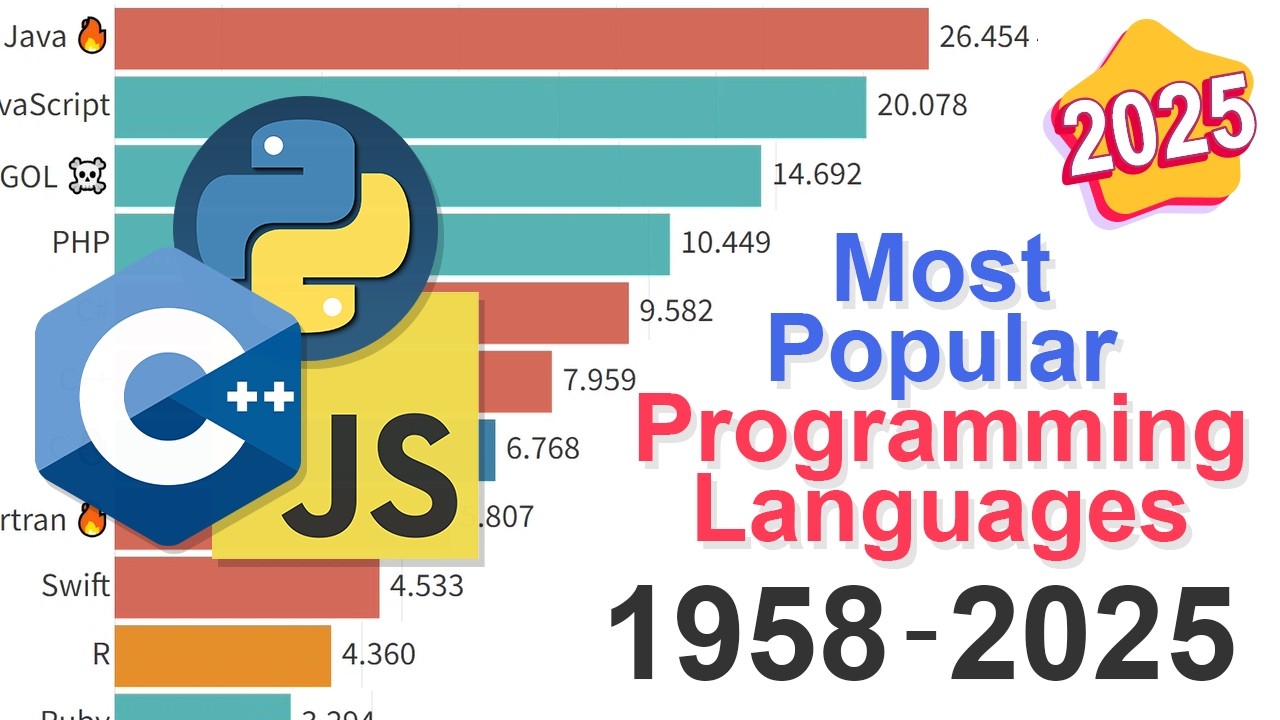
This is an interesting video that tracks the popularity of programming languages from the 1950s to 2025.
Fortran had a 20 year run at the top and C had a 16 year run.
1 Like
Yup, Typo.
One thing I do recall is that the /etc/passwd file wasn’t well protected. IIRC, usernames were in cleartext with passwords hashed in some basic way but if you had a user that forgot their password or employee who quit and you wanted access to their account you could just edit the file and put the password hash from an account whose password you know in place of the account you want access to and … voila.
It was a simpler time.
I had forgotten Ada’s brief popularity and the position of Lisp near the top for awhile is surprising too.
The C language family has collectively dominated when considered together.
That is still the case for Linux if you use the default password authentication scheme (I just made a test user to verify it) and for local users, at least on Debian-derived distros. But today the scheme is a bit more advanced. First off, although /etc/password is readable for everyone, the actual password hash is now located in /etc/shadow (readable only by root), making it more difficult for ordinary users to crack passwords. Also, the hashing algorithm is more advanced and more expensive to calculate compared to 1980s and 1990s style password hash. But why do it in this roundabout way when you can instead just do a passwd user as root?
1 Like
I think the inherent security offered by representing less that 5% of OS utilization is Linux’s best security feature.
I started using Linux Mint when Windows 7 went EOL. While it was a struggle in the beginning, for the most part I have come to accept the limitations, or found workarounds.
With the advent of Windows 11, one might get the idea that Microsoft views users as an ATM…and why not, Enterprise users are what keeps them relevant and profitable.
Sorry, just an Operational Support guy, who still remembers tape reels and 10.5" floppies, sneaking into the code monkey room…
Back in the 90s when I was helping to bootstrap a new commercial credit bureau, high speed internet connections were both far from universal and untrusted in terms of perceived security, so we had a lot of data MAILED to us, much of it on 9 track tape, which I had a reader for on my desk. Others were proprietary tape cartridges that we paid a local provider to convert to ASCII files for us.
I remember installing Motorola’s ISDN cards back in the 90’s…just to get around the bottleneck of the serial port…and daisy chaining ethernet adapters with BNC connectors…prior to Token Ring…
Man, I had hair back then…and it was brown…
Only if you only count desktop users. If you look at web servers, cloud infrastructure and other servers and services on the Internet, the numbers are much more favourable to Linux. All Android smartphones and tablets run a Linux kernel. Do you have a WiFi-router? The chances are overwhelming it runs Linux. Same with a lot of other network infrastructure boxes. Do you have a NAS box? It’s probably Linux. Linux is also extremely prevalent in a diverse range of embedded systems such as billboard systems and POS systems (for example, the POS system used in one of the big supermarket chains close to where I live use Linux, and the bus and train companies in our area use Linux to run their billboard and onboard information system (I’ve seen the occasional crash + boot screens that prove it)). All supercomputers on the top 500 supercomputers list run Linux. So the argument that there are FEW Linux installations does not hold. They are just used for different things than e.g. Windows and MacOS.
1 Like
Enterprise operation and security, as you point out, is highly invested into Linux. This is something I used to follow before I retired from the industry reading all the security bulletins to see who got hit and how.
Admittedly, my concern now is strictly based on my desktop. I do appreciate the autonomy Linux offers me.
As do I. I’ve tried using Windows for my personal hardware out of curiosity, but each and every time the ecosystem lock-in and hostile anti-privacy shit (especially now with Windows 11 and its telemetry nightmare and forcing the user to create a Microsoft account) and decreasing customisation options makes me turn away, disgusted. I don’t play games, so I don’t need Windows. But I once installed a Windows VM to have, just in case (haven’t booted it for a very long time — close to a year, I think). And I have a cheap second-hand laptop with Windows that I use for one purpose only: to update the firmware of a device I have. The rest is Linux.
1 Like
Same here. Don’t really use MacOS very much really, since 100% of my paying work is on a Windows Server 2022 instance out in the cloud. I think it’s being upgraded soon to whatever the current version is. Windows Server lacks the “AI” and intrusive demand for a M$FT account, although I have had one for years anyway, again incidental to work.
When I retire it’s quite likely that I will spin up a Linux VM and make that my main environment. Neither Windows nor MacOS of late have done anything to endear themselves to me.