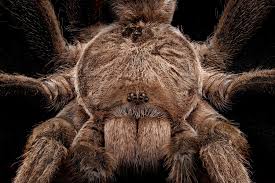
Donning my invertebrate zoologist pedant hat again … in part for the amusement of the audience, and in part for educational purposes …
ALL spiders are venomous. The vast majority of these are not of medical importance to humans, because they do not possess chelicerae and fangs powerful enough to penetrate human skin. The only manner in which humans would be introduced to the toxicity of the venom of these species, is via scientific intervention, and injecting humans with a random selection of spider venoms, is an experiment fraught with ethical concerns.
Then, we have the species whose chelicerae and fangs can penetrate human skin. Of these, the majority do not pose a medical hazard to the majority of humans, though of course there are unfortunate exceptions that will be propelled into anaphylactic shock, even by these species.
Among these species, we have the various members of the Family Theraphosidae, commonly referred to as “tarantulas”, of which there are over 700 species known to science, and new species are being added to the list of late at the rate of about one every 14 days. Familiar species include the various Grammostola species from South America, the Poecilotheria species from the Indian subcontinent and Sri Lanka (Poecilotheria metallica in particular is prized for its intensely sapphire blue males), and the various ‘big boys’ from South America, spread across genera such as Acanthoscurria, Megaphpobema, Pamphobeteus, Xenesthis, Lasiodora, Pseudotheraphosa and Theraphosa itself, the Genus containing the Goliath Bird Eater.
But before moving on to other spiders, I’d like to introduce people here to some newcomers. For example, the Antilles Pink Toe, Caribena versicolor, which looks as if it was painted by a five year old girl, Then there is Pamphobeteus sp. “Machala”, which is a vibrant purple, and still awaiting proper formal scientific description. Likewise, we have the Purple Earth Tiger, Cyriopagus sp. “Hati Hati”, which also exhibits an interesting purple colour, and again is awaiting formal scientific description.
The Australians in the audience are already familiar with the Family Sparassidae, containing the Huntsman Spiders, several of which are large, but the largest of them all is a cave dwelling species endemic to several caves in Laos. This spider, Heteropoda maxima, has a 12 in leg span, and can move like greased lightning. If you don’t mind seeing some fairly unsettling sights, this YouTube video featuring some German explorers hunting for this species in caves in Laos constitutes compelling viewing (German language audio).
Now we come to the last collection of spiders - the ones that pose medically significant threats to humans. Among the best known are the members of the Genus Latrodectus, of which the Black Widow, Latrodectus mactans, has the most alarming reputation, though all members of this Genus should be approached with care. Though I can inform people here that members of this Genus tend to be relatively even tempered, and require a fair amount of provocation to bite.
Much more aggressive is Atrax robustus, the Sydney Funnel Web. Whose venom is unusual. This spider, and its taxonomic relations, evolved to hunt for large insects (of which Australia has many) in underground tube webs. As a result, why the venom of this species is so lethal to primates requires an explanation, particularly in the light of the fact that many other mammals are unaffected by the venom - cats in particular, will brush off a Funnel Web bite as being a mild irritation.
The one you really need to be wary of, however, lives in South America. To be precise, there are eight species in the Genus Phoneutria (aptly derived from the Greek for “murderess”), and all of them are dangerous, even more so than the Funnel Web. Best known, and most frequently encountered, are Phoneutria nigriventer and Phoneutria fera, both referred to by the name “Brazilian Wandering Spider”, or occasionally, “Banana Spider” (though this epithet is applied to other, unrelated species).
The various Brazilian Wandering Spiders are members of a Family known as the Ctenidae, and ALL of the spiders in this Family are fast moving pursuit hunters, of prey such as ground beetles and cockroaches.
What makes Phoneutria species special, however, is that they are pursuit hunters of their local cockroach fauna. That fauna includes some real giants among the cockroaches, such as Blaberus giganteus, a species that reached four inches in length. This cockroach is fast moving, is well armoured, and because it feeds upon tough, fibrous plant leaves, it has powerful jaws. It’s a herbivorous insect that’s capable of fighting back when attacked by an invertebrate predator.
Phoneutria spiders have evolved to deal with these cockroaches. First, they can run across the ground at alarming speeds. When you see one of these in action, you know you’re dealing with a species that deserves respect. Second, they have powerful chelicerae and fangs, capable of penetrating the cockroach’s armour like anti tank missiles. If one bites you, it can drive its fangs clean through your thumbnail. That’s a party trick you don’t want to savour first hand.
Third, and most important, the spider has to deal with the cocokroach’s interesting nervous system. Cockroaches have a partially decentralised nervous system, which includes various ganglia along the central nervous cord emanating from the main brain. These act to provide lightning fast reaction to threat sensory input, which is why cockroaches are such bastards to catch when they start running - the have, in effect, a multiplicity of brains along their bodies that can act in coordination to keep the cockroach dodging threats.
Phoneutria species deal with this with brutal efficiency. They possess an extremely powerful neurotoxic venom, which shuts down the cockroach’s nervous system literally as if a switch has been thrown. The cockroach has no chance to run or fight back, once the spider has caught up with it and delivered a venom payload. That venom payload also begins the digestion process, so that the spider has a nice, easy to consume meal.
The BIG issue with this spider, is that the venom is also tragically effective at snuffing out humans. You really do not want to experience a bad envenomation from this spider - it will propel you into your final pine box resting place in about 45 minutes. Combine a powerful venom, a powerfully built delivery system, a sensory array that provides the spider with a frightening level of situational awareness, and the ability to run at speeds that make you want to shit yourself when you see this in action, and you understand quickly why this spider doesn’t run away when confronted. Because it’s equipped for hardcore combat, and knows it.
The standard response to any potential threat on the part of Phoneutria spiders, is to rear up and wave the front legs in a threatening manner. This is the spider’s means of saying “Cross that line and DIE!”. Fail to heed that warning, and the spider goes into attack mode. There’s some frankly terrifying footage shot by the BBC Natural History Unit, featuring one of these spiders doing just this in a Brazilian barber’s shop. The spider runs out of a pile of hair sweepings, jumps onto the proprietor’s broom, runs up the handle and goes for him. You do not want to mess with a spider that possesses that sort of attitude, and backs it up with weaponry.
Prior to the advent of the modern antivenin, Phoneutria nigriventer and its siblings used to kill around two dozen people per year in Brazil. These spiders are also the size of a man’s hand when fully grown, so intimidation is the word of the day when these show up.
If you want to see what these spiders are like, this YouTube video provides a suitably compelling insight.
Needless to say, I didn’t embed the videos above, because the arachnophobes in the audience would come after me with flaming pitchforks if I did. But, if ever I decide to become an evil overlord with an invertebrate army, you now know what I’m picking for some of the shock troops.