If you are going to ask a question then you should end your sentence with the appropriate symbol. I’ll show you how to do it.
Q. Does rat_spit lie about himself?
A. Yes.
There. You see? That wasn’t difficult, was it?
If you are going to ask a question then you should end your sentence with the appropriate symbol. I’ll show you how to do it.
Q. Does rat_spit lie about himself?
A. Yes.
There. You see? That wasn’t difficult, was it?
Unless there is objective evidence saying otherwise, there is no difference between a fictional supreme being and a real supreme being.
There could have been many demonstrations of supreme power in the past that went unobserved and unrecorded and thus we would never know about them.
But even observed and recorded instances do not qualify as objective evidence for them unless corroborated by multiple contemporary sources.
Therefore, fictional and real supreme beings remain on exactly the same footing until objective evidence changes that equation.
So, if you have some objective evidence for a supreme being, then please present it.
?
Whilst I applaud the effort, you will find you’re tilting at windmills here.
Except the misplaced word “real” of course, a cursory Google of it’s definition might help, sadly ratty has proved impervious to dictionaries, definitions just bead up and roll off his erroneous semantics.
Otherwise we’d have to accept identically subjective claims that someone has seen a mermaid for example, or have a standard for credulity that involve closed minded bias.
Tumbleweed time if past experience is any reliable indicator…
Ah, thanks to your input Sheldon I think I see what’s happening here.
There was just such a person who operated along the same lines in Ex-Christian.net. They were careful to stay just within the boundaries of forum etiquette so as not to earn any censure from the Mods, but were still intent on using the forum to get a rise out of other members, for whatever perverse pleasure it gave them. I won’t go into any details. Individuals like these aren’t worth that effort and they also seem to thrive on any attention given to them. So, unless exceptional circumstances demand it, from now on rat_spit will just receive dead air from me.
Thank you,
Walter.
To be clear ratty can play nice, and contribute when he wants, but at other times he slips back and just regurgitates the same tired old claims that have been shot down time and time again, at those times it often seems like ice skating uphill.
I can’t say what posts are and are not worth the effort, sometimes it does get very repetitive though, I have learned from painful experience that these go nowhere.
In any debate though, the person making the claim has the burden of proof, no matter how they feel about it, and each person gets to decide if they have met their threshold for credulity, or not.
As I have said repeatedly, if one was to accept an entirely unevidenced and subjective claim about personal experience, then one would have no criteria for rejecting any of them.
Fair enough. A limited consciousness can only do just as much.
Where I disagree is in the evaluation that all evaluations of the text are subjective. Some may be quite objectively close to the intentions of the people behind the stories.
Where as JK Rowling’s objective meaning is something akin to a story about a wizard made up in her mind, the objective meaning of the authors of the new and Old Testament are made referencing soemthing somewhat more important.
I don’t think you understand the meaning of “propped up”. A thing can be propped up even under the most unfortunate of circumstances.
I think there is a strong difference between claiming a deity “can’t be wrong” and claiming a deity can “do whatever he wants under the circumstances to create an intended effect upon a limited human psyche.”
Immutability grants the deity the power of deception as well. Why should he be limited to granting the human a truth as only a human can understand “truth”?
Why do you think it has failed to do so in your case but not in the case of countless others?
Certainly. I would never presume to do the work of a supreme being. But, Sheldon - why do you think a supreme being is slow to act on your behalf?
Within the field of your very limited data set, yes.
You failed to appreciate satire. Get over it, DAN.
Okay. You’re a little “special” I see. Don’t worry. I have schizophrenia. You can share your secrets with me, Dan. Were you dropped on your head as a child? You can confide in me, my friend.
The objective evidence would have to be supplied by the being. If he was fictional, the evidence could not possibly we supplied. If he was not fictional then it is the case that the evidence could be supplied.
So with regards to signs from God, you will now only accept cases of multiple witnesses? It will be hard to convince you in particular when and if He gives a sign, won’t it? You do indeed hold your God up to a very high standard…
I do not. Nor do I see how a limited being could convey the power and supremacy of an unlimited being. I would leave it up to the unlimited being to supply such “objective evidence”. Which you of course, would reject if not “witnessed” by multiple parties. Apparently your own eyes cannot confirm what they see …
 I love you too Sheldon. I really do. And let me just say for the record 1. No one asked you to come to my defence and you did.
This much is true. I have been guilty of “obscuring reality” for my own sake at times. I am a schizophrenic after all. And let me just say for the record 2. You have all at atheist republic been extremely accommodating to my personal illness.
We all know this to be true. You and I seem to “perform to the crowd”- often waxing philosophical when other members have had enough. Admittedly, I do not know how to end our love affair 
I never made any such claim.
We can’t know what their intent was, only what the text says.
That’s a subjective opinion, and it misses the point, subjectively attaching value to any text tells us nothing about its veracity. This is as true of the bible as any other book.
I’d bet my house my pension and every penny I have, that I know exactly what I meant, when I asserted that you can’t prop up an unevidenced claim, with more unevidenced claims. In fact anyone can scroll up and read where I carefully explained what I meant above.
Goal posts ahoy!!! 
If you go back and read my original response you will see where I covered that logical extrapolation, and yes hypothetically one could claim a deity lied, and that’s why the bible is wrong, but as I explained in that response Occam’s razor renders that a poor argument.
You’d have to ask them, I already explained my own reasons.
You seem to have ignored the part of my post you quoted, and answered something else?
I can only asses the claims and arguments that theists offer.
Rage bait at it’s finest.
Debate has to involve argument, they are synonymous, this requires reciprocity. If reasonable challenges to the claims and arguments in one’s posts induce rage, then one ought to ask oneself why this is?
I am not sure why you always get like this when your theistic claims are challenged for their lack of evidentiary support. You are after all bringing them to an atheist debate forum.
I don’t agree with your criteria of what constitutes “objective evidence”. I also don’t agree with your criteria of what constitutes “subjective bare assertion”. We fundamentally disagree on what is and is not a criteria for knowledge.
There are also many other grievances I have with your style of debate. I find it hard in general to argue in good faith with you. Many of the cheap shots you throw, I’m sure you’re not aware of. I meet them blow for blow and the whole thing invariably devolves into non-sense. And this has been, as you know, observed by third parties. It isn’t just me who is guilty of misusing the hammer of logic or the shield of argument - with “indifference” or by “misuse”.
We both take cheap shots. We both take offence to the other. And there does not appear to be any sign of reconciling our differences. I don’t mind continuing, but we invariably seem to reach the exact same impasse at around the exact same number of exchanges on around every single topic that comes up. I enjoy my time here. I enjoy going back and forth with intelligent people. Quite honestly intelligence is not the most common feature of a theist community and for the very exact opposite reason I seek discourse precisely in this corner of the web.
You are undoubtedly one of those people possessing a strong streak of intelligence. I am perhaps more “biased” than my intelligence compensates for. And perhaps that is what irks you most (in our exchanges). However it is my wish to continue posting here. I don’t see a way to both do that AND engage with you in our well established philosophical trenches.
If you can tell me how to better interact with you I’m all ears. But if not - I think our epistemic compasses are diametrically set to different coordinates. Perhaps if we focused on one item of discussion at at time? I don’t know …
Don’t take criticisms of arguments personally, they are not aimed at the poster.
You seem to have offered a solution to a problem there, if you care to remove that bias? For example when you said:
Well you’d need to be specific of course, but a voice in my head that no one else hears would obviously be entirely subjective, it cannot be otherwise, and impossible to evidence.
Oh I doubt this is universally true, but if it can’t be shared and objectively explained in a way that is verifiable, then I’d call it experience not knowledge. For example you will often here some theists claim to “know” a deity exists, but this claim on it’s own is unfalsifiable, no knowledge has been shared to examine.
Above all stay calm, and don’t take any criticisms of beliefs expressed as a personal slight. As I said debate requires opposing opinions, it is impossible to debate something without that.
I don’t understand why “entirely subjective” cannot also be “truth”.
For example, at age 21 I experienced what some people would call “ego death”. Though at the time, I called it “the end of the world”. It is something I could describe. I won’t go into detail. It was a “subjective experience”. And yet it was one of the most informative experiences of my life.
Just recently I was talking to a friend who’s returned from Mexico. He went there to get clean. While under the influence of a powerful psychedelic, as he explained to me, he “died”. His ego “completely dissolved”. And I pressed him on it, because I wasn’t sure that we were using the same language and I wanted to confirm something. So I followed up with some questions. He then said “oh yeah. I collapsed the universe.”
It was then that I knew what he meant by “ego-death” was precisely what I had experienced at 21.
So, my point here is that he and I were pointing to exactly the same subjective experience. Completely internal, completely personal - the same existential “truth” about what we call “the ego” or the “self” and the “death” of it.
Well. Dag nabbit. My subjective personal experiences are the source of some of my most profound truths! My deepest held beliefs! It’s hard to argue with you when you deny the validity of “pure experience” as a source of knowledge. I honestly don’t know what you even mean by “objective”!
Perhaps I can offer some help here?
If you don’t understand why “entirely subjective” cannot also be “truth”, trying considering this.
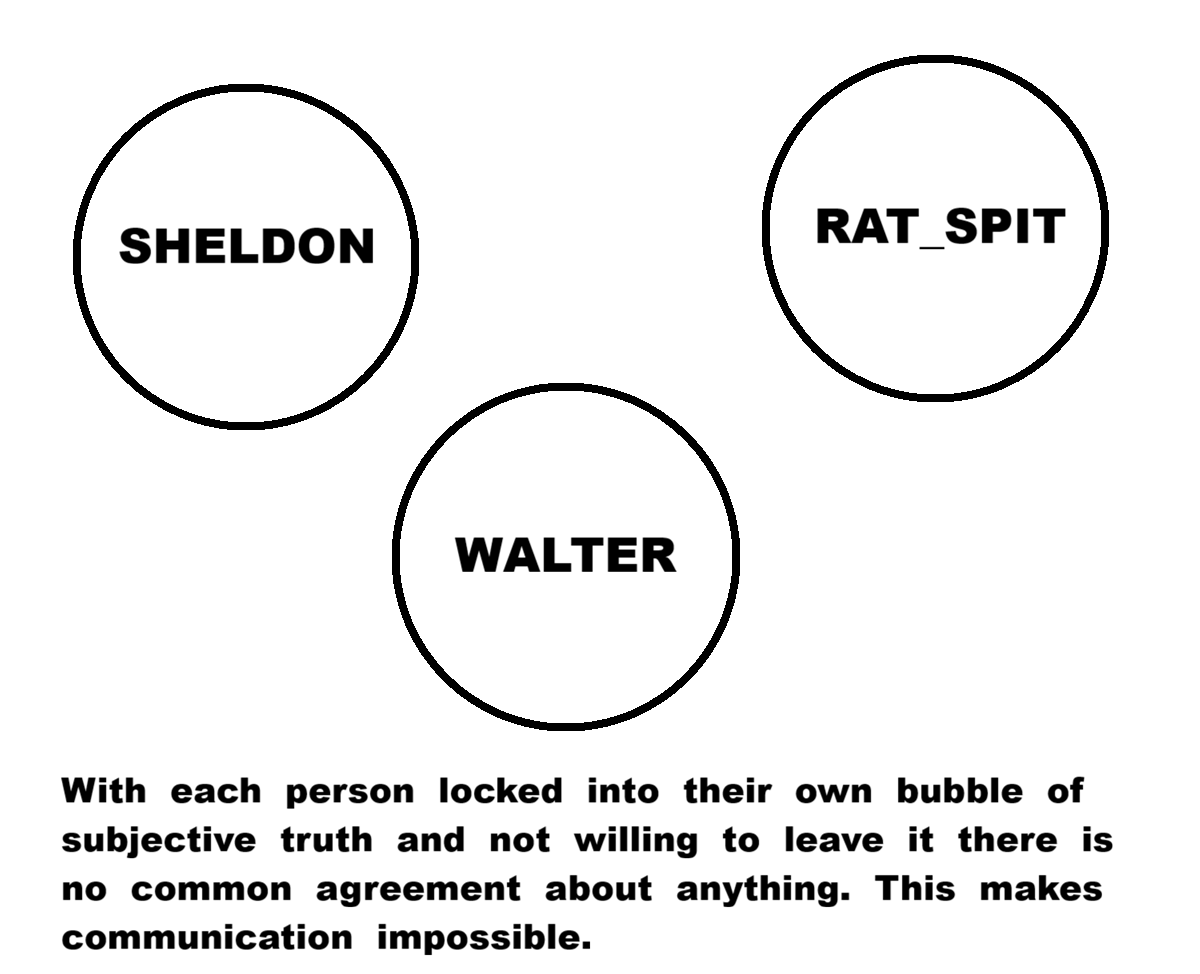
If we accept that something entirely subjective (that is, happening only in the mind of a single person and in nobody else’s mind) is true, then we have to accept that ANYTHING entirely subjective happening in ANYONE’S mind is also true. Which then means that EVERYONE has the truth in their minds.
But this immediately generates a problem.
It would mean that there are 8.3 billion subjective truths in the world. With so many different subjective truths the words ‘objective truth’ (one single truth that is commonly experienced by everyone) would become meaningless.
Without one objective truth for everyone it would be impossible for human society to function. Nobody need follow any laws because they could claim that a law falls outside their subjective truth and so doesn’t apply to them. The police, the law courts and the prisons couldn’t function.
Likewise, international law couldn’t function because a politician could claim that in his subjective truth the borders of his country extends across those of other countries, putting them under his jurisdiction. Passports, immigration, treaties, what constitutes international waters and who owns an oil field or a mountain range would be hopelessly confused. Everyone claiming that their subjective truth entitles them to believe whatever they like about these things.
Science couldn’t function because physicists, chemist, engineers and geneticists could never agree with each other, each scientist claiming that their own subjective truth properly describes the behaviour of atoms or bacteria and everyone else’s is wrong. No two scientists could ever work together on anything. Nothing could be studied, no research could be done and nothing new discovered.
Hospitals would become the scenes of mass death and terrible suffering. Each doctor disagreeing with every other one, all of them believing that their subjective truth about what is making the patient ill to be correct, but everyone else’s to be wrong. No disease could be diagnosed and treated by any medical team because teamwork would become impossible.
Families would fall apart because the father, the mother and the children would all have their own subjective truths. Parental authority would cease to exist because children could claim that in their own subjective truth they don’t have any parents. Or vice versa, with the parents disowning their children as not being part of their own subjective truth.
Human society only works because everyone generally accepts that we all occupy a commonly experienced reality, which becomes the objective truth for everyone. Some people think they can opt out of this but actually they can’t and they don’t. Even those people who think that their own subjective reality is the truth still cooperate with others AS IF there was one commonly experienced reality.
The fact that this dialogue is happening at all is proof of this. Sheldon, you and I are all cooperating and all following the rules of syntax, diction and grammar. This act of mutual cooperation is a sign that, at least on this level, we all tacitly accept that we are all experiencing this dialogue in exactly the same way. That’s what humans normally do. They cooperate on the basis of the unspoken rule that everyone experiences reality in more or less the same way.
So, while someone can CLAIM that they experience reality differently from everyone else, (subjectively) when it comes down to the acid test, they don’t live like that. They live by cooperating with everyone else, which means agreeing that all of our experiences are commonly shared.
Ok, you might object to this, but if you do so in writing in this forum, then you’ll be contradicting yourself.
Thank you,
Walter.
This is a fundamental issue with theists generally.
In saying that your personal experiences are inadmissible as relatively objective data in determining what is or isn’t true, no one is saying that your experiences themselves, or your mental and emotional responses to them, didn’t happen and don’t influence you. Anymore than I would be denying that someone’s claimed experience of “personal salvation” or “answered prayer” didn’t happen or didn’t seem real to them. I would only be claiming they con’t mean what you they think they mean, and don’t come from where they think they come from.
Another example would be that of the betrayed lover. Say you met a girl, and things really clicked, and you had wonderful experiences together including transcendent mental, emotional and physical connections of all kinds, spending all your time with each other, planning a future together, and then you walk in on her in the throes of passion with someone else. Does that negate and invalidate all that passed between you? Not in the sense of “it never happened”. Only in the sense of “I misjudged her character”.
There is a difference between what feels “truthy” and what is actually true. The whole point of rational discourse and scientific inquiry is to separate those two concepts and stop confusing them.
I think I understand what you’re saying, Ratty. If so, I can agree (at least to a certain extent).
It’s about how reliable a claim is, and the objective evidence that verifies or supports something the more reliable it becomes, an entirely subjective claim is the lowest bar.
Exactly, we would have no unbiased criteria for disbelieving any other subjective claims, even where they contradict each other, and thus violate the law of non-contradiction.
This is a very good point, if we went to a doctor and they said we needed antibiotics for an infection, and a friend said their gut instinct was that we did not, we’d likely listen to the doctor, because what they are telling is is based on objectively verifiable evidence, a blood test for example. the doctors claim is a very reliable one, the other claim is entirely subjective and not at all reliable, that a subjective claim might be true isn’t really the point being made. How do we know if it is true in any reliably objective way?