I’m not speaking about any specific “truths”, just the potential for something to be true, but not possibly subject to objective evidence. As per the examples I have given in previous comments.
I was just going by the descriptions online such as:
“Scientism is the belief that science and the scientific method are the best or only way to render truth about the world and reality.” (Wikipedia)
I acknowledge that in the context of this definition, you have stated that objective evidence is the best method to render truth about the world and reality.
I have also acknowledged that where objective evidence is suitable, it is the best method. My only point is that there are times when it isn’t the best method (favourite colour example) or isn’t applicable at all (simulation confirmation example)
I am not trying to reverse any burdens. (and I know you haven’t claimed I have. Just pointing out it is not my intent)
People who exist in reality objectively exist, and have subjective experiences that are reality, but subjective.
Consider that a person’s perception is subjective. We have no way to have a direct objective experience, so everything is subjective.
In essence, literally all objective evidence, aside from evidence of “existence” in general, is subjective. This cannot be escaped. We experience objective evidence subjectively, so it is dependent on subjective experience.
I just offered two method to objectively evidence pain, one for the person experiencing it, and the other for clinicians, you clipped both from that quote?
Indeed, but is can be used as an objective indicator for a person experiencing pain.
You have changed position on your example it seems.
Not if we are measuring it against other far superior methods, you seem to determined to find bias where there is none, and not notice where it is obvious. If we accept a belief is epistemically justified based solely on entirely subjective personal experience, then this by definition would involve subjective bias.
It’s not a question of subjective vs objective, but about how much subjective bias a method removes, the more it removes then the more reliable the results. Most religious apologists don’t like this fact, because they know there is no objective evidence for any deity or deities, and they seem to be emotionally invested in that belief.
I don’t care either way, only that what I believe is true, and by extension that I believe as many true things as possible.
No it isn’t, the superiority of those methods are manifest in the results.
Of course I can, when belief alone can design and fly a plane as reliably as science and maths, or at all, I will accept that those beliefs have merit. Or when someone can demonstrate that something exists beyond the natural physical material universe, or the supernatural if you prefer. You are decrying the best methods, because they don’t give you the results you want.
It would be circular if I was assuming this prima facie without evidence, but I am not, the merit of methods that remove subjective bias and garner objectively verifiable evidence is not an assumption, it is an objective fact, irt just doesn’t evidence any deity or deities or anything supernatural.
Treating those claims to a different standard btw, is the very definition of bias.
Scroll up, you are projecting bias, and projecting unevidenced assumption onto my assertion when I used neither.
You pointed out that a claim that no one has made, cannot be made?
Well all non-existent things for a start.
And that context is objective reality, which was precisely the context I sued when I said those methods were exponentially superior. To imply the methods inability to evidence something is a flaw in the method, rather than that thing not existing is quite an assumption, but I don’t need to know that deities and the supernatural don’t exist, it is sufficient that they are not evidenced, that alone is reason enough to withhold belief, as I would for any and all claims, not just god claims.
You keep implying disbelief is a claim, that is a fundamental error in your reasoning over atheism.
There are numerous potential answers to such a question, but in part, they pre-suppose potential motives of a potential god. My hypothesis isn’t intending to address this, only suggesting the mindset as stated.
As a general sense though, I would say that potential proof of such a thing generally is not possible, because such a possibility cannot be proven no matter what evidence is offered (i.e., there is no conceivable or inconceivable evidence that would be sufficient to prove to a reasonable degree of specificity)
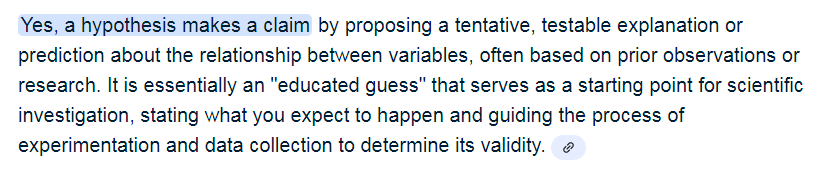
No, that’s specifically a scientific hypothesis, which is context specific. I am not making a scientific hypothesis - I’m presenting a possibility, not asserting a truth.
The dictionary gives a more general definition:
" 1. a proposition, or set of propositions, set forth as an explanation for the occurrence of some specified group of phenomena, either asserted merely as a provisional conjecture to guide investigation working hypothesis or accepted as highly probable in the light of established facts."
I am proposing a means by which individuals can - if they so choose - seek if there is a truth or not .
I don’t expect you to believe anything. I can only present my hypothesis and answer questions relating to it. If you choose to believe or disbelieve me or anything I’ve said, that is up to you.
Just as there are numerous answers to the question do mermaids smell of the sea.
I think evidence is more apropos than the word proof. Though of course the quality of what constitutes evidence would expand that point.
An epistemic possibility, so not better than we don’t know.
Only subjectively, if that’s the standard one sets for “truth”, then nothing is out of bounds, and the word truth becomes meaningless.
Thanks, but I don’t think this even needs stating, anyone can set any standard for personal credulity they wish, but if they “genuinely are seeking the truth” then it makes sense to set a standard that best achieves this.
FWIW, an alternative to Pascal’s wager, might be to objectively demonstrate that any risk exists either to belief or to disbelief in any deity / deities.
This for me, this is where Pascal’s wager fails, at the first hurdle.
yes, because they weren’t relevant to the point being made. Yes there can be limited objectivity to some degree, but there is also subjectivity that cannot be objectively evidenced, and that is the point I was making. You acknowledged this (the direct experience) and I confirmed that aligned with my point.
yes, but the point is that there is a subjective element that cannot be objectively evidenced.
The position remains that there is subjective experience that cannot be objectively evidenced. The example has been clarified to acknowledge that there are elements that can be objectively evidenced, but there still remains elements that cannot be, which is the original point being made.
I keep finding bias because you keep using it. Again, you mention “far superior methods” - if you are referring to a specific context of things being evidenced, then yes - I have already pointed out I agree with that, but I have also distinguished that there are things for which the method doesn’t work.
As an absolute statement, it would be biased to say that one method is superior. If it’s conditional on a limited scope of things that can be objectively evidenced, then I have already agreed.
Again, this is conflating two states.
If you’re talking about something that can be objectively evidenced, then reliance on subjective personal experience for elements that can be objectively evidenced would give rise to subjective bias.
If something cannot be objectively evidenced - i.e. because it is limited to subjective experience - then it cannot be biased by definition.
Bias is when there are two or more choices A or B (or C, etc.) and a particular choice is favoured as a pre-disposition. If there is only one choice, there cannot be bias. If something cannot be objectively evidenced, and subjective experience is the only choice, then this doesn’t count as biased.
As above, this only applies when objective evidence is possible to begin with. if something cannot be objectively evidenced, then there cannot be bias, and bias cannot be removed.
So in that context, yes it is very much a question of subjective vs objective. If something is a solely subjective experience (like the examples I have given with colour, etc.) then subjective bias doesn’t come into play. It cannot be objectively evidenced to give that choice. If it could, then I agree, one should rely on objective evidence where it fits.
Which ties in with the point I’m making - there cannot ever be, because objective evidence can’t work with a metaphysical possibility of that nature. The very concept of objective evidence falls before such a possibility because objective evidence is limited to the physical world. A metaphysical possibility of that nature would transcend the physical world and is therefore out of scope.
That’s fine, and I’m just pointing out that there may be some truths that cannot be objectively evidenced - if someone wants to believe true things, they should take that into consideration.
Exactly. why are you repeating my evidence that disputes your claim, back to me?
And then you claimed there was no way to objectively evidence pain, either for the person experiencing it, or by any objective observer, and you were and are wrong, as my examples demonstrated.
Other than by the two objective methods offered you mean?
“there is subjective experience that cannot be objectively evidenced”
“The example has been clarified to acknowledge that there are elements that can be objectively evidenced,”
Pretty soon words will be moot, and I shall have to resort to rolling eye emojis?
No you have left out the original assertion you made, about subjective beliefs being justified without any objective evidence, then you offered an example, then objective evidence was demonstrated.
Again your accusation is dishonest, as that superiority is demonstrably according to your own criteria of genuinely seeking the truth.
Non existent things for example, mythological things or entirely subjective beliefs, or deities or anything supernatural for example. Ironically those demonstrably superior methods all fail for those categories.
Indeed, see above. What do they work for BTW? Pick something outside of that list.
Not in your own context of genuinely seeking the truth, however I keep an open mind, please offer some truths that have exclusively been demonstrated by entirely subjective belief, without ever being validated with objective evidence.
Read it again, and respond without the straw man.
No it doesn’t, it explains your straw man.
Of course it does, colour doesn’t exist independently of subjective perception.
It does if you ignore that our perception does not entirely reflect objective reality, that’s not how it evolved.
Begging the question, and of course what we know it cannot work with is non existent things.
Circulares reasoning fallacy, you have assumed, without evidence, that there is something else. When will you presenting evidence for this?
Begging the question again, and of course objective evidence reflects objective reality in an unerringly consistent way, leaving what is out of the scope of objective reality? You know how the word exists is defined right?
Which tells us nothing about what is true. I have no problem with saying I don’t know, but since I care to believe only true things, then I have no epistemic justification for belief when I don’t know.
The point remains, whichever word you call it. The point I’m making is that there is literally no evidence that would distinguish a deity over other possibilities. Once you have any sort of evidence of that nature, no matter what the evidence is, it cannot narrow down the possibilities. It would fall outside the scope of science. Science would see it as something unexplained, nothing more.
the possibility I present is the possibility of personal knowledge - so yes, we don’t know, but the hypothesis is a means by which one may know, and upon knowing, it would no longer be “I don’t know” (I say I not we, to reflect that if/when a person receives knowledge, it would only be personal/individual, and not something shareable due to the absence of the possibility for objective evidence)
I didn’t set any standards. I acknowledge that subjective only truths (i.e., truths that cannot be objectively evidenced) will necessarily have subjective measures (not standards as that would require objectivity) that will vary from person to person, but the hypothesis stated a person being convinced, so the point would be that the person - as long as they are open to the possibility of a subjective truth, would be convinced of it.
Everyone has subjective truths they accept - this is unavoidable because perception itself is a subjective truth - a justified belief. It is impossible to objectively evidence perception because it would be circular - any objective evidence comes through subjective perception so would be dependent on the truth of the perception to accept objective evidence supporting perception as a truth.
So given that you, and everyone else, must have accepted a subjective truth, there would be no logic in rejecting others outright - but as to what relevant measure one applies to subjective truths is up to the individual. It is up to each person as to how they reason or rationalise what can’t be objectively evidenced.
This was in response to MrDawn asking me if I really expected them to believe (that).
When it comes to metaphysical possibilities of this nature, a risk cannot be objectively evidenced - but it is possible. I have outlined how a potential risk in a moral/fair setting can be mitigated, without needing to make any sort of gamble (i.e., no pro-active changing beliefs, etc.)
The hypothesis is contingent on whether there is a moral/fair god or not, but it addresses this in the sense that, if there is a moral/fair god, and a judgement requires specific knowledge, then one has a potential means to be convinced of a truth. If there isn’t a moral/fair god, or specific knowledge isn’t needed, then a truth wouldn’t necessarily be found, and a person can continue with whatever beliefs or lack thereof they still have.
In that sense, the hypothesis is suggesting nothing more than a mindset toward truth - you have already stated that you care “only that what I believe is true, and by extension that I believe as many true things as possible.”, so as long as you’re genuine and open in that mindset, I’m not suggesting anything more. It’s up to you to know/decide whether you are genuine and open.
They weren’t. The claim was that there are subjective experiences (justified beliefs) that can’t be objectively evidenced.
The example given was pain - you have correctly pointed out that pain can be objectively measured to a degree, but also acknowledged that the direct experience is subjective, which fits the original claim I made - that there are subjective experiences that cannot be objectively measured.
So in terms of pain - some elements can be objectively evidenced, some elements cannot be. The elements that cannot be are the elements that align with my claim.
If pain in its entirety, completely could be objectively evidenced, without any limits, then the example would not fit. The fact that we’ve both agreed there are subjective elements that can’t be objectively evidenced means the example - based on those specific elements - fits.
I have clarified a general point about pain, to highlight the example is referring to elements (i.e., the direct experience) that cannot be objectively evidenced, while also acknowledging that some elements can be.
It’s an example - trying to pick it apart, when elements of it suit as an example is becoming pedantic.
You seem to be misunderstanding the obvious there.
if there are elements that can be objectively evidenced, then by extension, there are also elements that cannot be objectively evidenced. If there are elements that cannot be objectively evidenced, then that supports my point.
Words will be moot if they’re not understood.
The original assertion is that some subjective beliefs cannot be objectively evidenced. The example as above, has elements that cannot be objectively evidenced, so they would be subjective experiences not objectively evidenced.
Category error. You’re being deliberately dismissive. I’ve already pointed out there are subjective experiences that cannot be objectively evidenced. I doubt you are trying to claim that subjective experiences that cannot be objectively evidenced don’t exist, but if you are - state that openly so I can shoot it down.
Objective evidence works for physical things, though there can be limits even then, as per the pain example - some elements can be evidenced, but some cannot be. Some of those that cannot be may be possibly in the future but not all.
I have given examples such as pain and colour - a person has no way of knowing that how they experience pain is the same as how other people experience pain. A person has no way of knowing that how they see colours is the same way that other people see colours.
demonstrated? You do realise the circular nature of your request here?
I’ve already given the example of perception. As far as that can be “demonstrated” but that’s the problem - it can’t be demonstrated, because it’s not objective. That said, every person has a perception - we each perceive reality, but it can only be subjective. We have no way to confirm it objectively because any objective evidence comes through that subjective perception. To try and prove it objectively would be circular reasoning.
No. If you want to rebut my argument, you need to support your rebuttal. I’m calling bare assertion fallacy here. You can’t just call my argument a straw man without explanation and think that’s sound logic.
Again - if you disagree, you need to support the position, not just make bare assertions.
Bias only works when there’s a choice. No choice, no bias.
Are you saying there is no other choice other than subjective perception? That is cannot be objectively evidenced? If so then this sounds like you are conceding that there are things that exist that cannot be objectively evidenced. If there’s no objective evidence and all we have is subjective perception, then there can’t be any bias.
Non-sequitur. The whole point of there being subjective perception is that we can’t know whether or not it reflects objective reality. But that doesn’t mean it is subjectively biased because bias only exists if there is a choice.
If someone says, “there is A and there is B, which is better?” and a person says, “A is better”, then the person may be biased toward A. But if someone says, “there is only A”, a person saying, “A is the best then” cannot be biased because there’s no other choice. Bias needs something for and against. To be biased in favour of something, one must also be biased against the other possibilities.
It is not begging the question - notice the key element missing from what I wrote that makes it impossible to be a begging the question fallacy? I didn’t ask a question.
Also you’re being dismissive again. We’re not talking about non-existent things. Either quit with the straw man arguments, or openly state that your position is that things that cannot be objectively evidenced are non-existent.
You’re incorrect. I am not making any such assumption in my argument here. I have only talked of possibility. We’ve already been through possibilities in the other thread. An objective metaphysical possibility is something that is logically coherent. I am talking of things that may be possible.
Still not a question, so still not begging the question. Objective evidence is physical. Science acknowledges this limit. Science is literally defined this way:
“systematic knowledge of the physical or material world gained through observation and experimentation.”
We cannot objectively evidence anything that possibly exists and transcends the physical or material world because objective evidence itself is physical.
It tells us it is true that there may be some truths that cannot be objectively evidenced. It doesn’t tell us anything about what is true beyond that because the statement wasn’t intended to tell anything beyond that.
Which is fine - my hypothesis literally doesn’t require you to believe anything you don’t know to be true. It just suggested that one should seek the truth, which again, you have already indicated you want to that, and it suggested specifically that such a search should be genuine and open, which again, is up to you.
Again, not mutually exclusive. You’re acting as though they’re absolute. “there are elements” is not an absolute - it is very clearly indicating “parts” not the whole.
I imagine it does, that’s rather the point. What’s not clear is why you hold this view.
The two words are distinctly different, thus it is important which one uses in any context.
This would be true of all unfalsifiable ideas, which as you say are discarded us unscientific, since they offer no data to examine.
Or may not know, if one were to trust solely one’s personal experience then one is indulging subjective bias quite deliberately. If my primary concern is that I only believe true things, then this would be counter productive.
Well that doesn’t sound like knowledge, as knowledge can be shared, that just sounds like personal experience. One could make oneself suggestible and open to a belief in a way that might eventually convince you it is true or real, but one could do this for almost any belief, and people who believe in very different deities and religions use this same method to arrive at very different conclusions, so it is useless in verifying the truth of those beliefs.
That is setting a standard for belief, and it’s a very unreliable standard. if one genuinely wanted to believe only true things, one would not accept a belief based on such an unreliable or low bar.
I am dubious this is the case, I might not care too much if the truth or falsity is a trivial matter, but I doubt that I would genuinely accept as true that which could not be objectively verified at all. I think you might be talking about expediency here, not belief.
No one is rejecting any truths here, but nice try, withholding belief is my default position if the “evidence” presented is insufficient to allay my doubts, what is your criteria for disbelieving all other entirely subjective claims, if you accept one? Now that would be bias, whereas subjecting all claims to the same standard is not.
Of course, and as I keep explaining, it is closed minded by definition, to treat claims with bias either for or against, so one would either have to believe all unfalsifiable claims, which would be irrational as this would involve believing their negation as well, or one can believe some which is closed minded, or one can keep an open mind, remain agnostic and withhold belief from them all, including the claims negation.
No, it is epistemically possible, which is to say no more than we don’t know whether it is possible or not. If risk cannot be demonstrated then Pascal’s wager is pointless, as the arguments whole purpose is to reduce or avoid that risk.
There is no potential risk, only a bare claim, and an argument to avoid something that can’t be demonstrated to be real, the argument fails right out of the gate, and this is before we observe the objective fact that humans have created countless deities and versions of those deities. Picking one to believe in without any remotely objective evidence wouldn’t mitigate this imagined risk at all, like buying two or even ten tickets in a lottery, and imaging you’ve increased your chances in any meaningful way.
Again the risk would need to be demonstrated as real, this is the vital stage being skipped I am referring to. Though this is the very least the wager would need to do, a lowest possible starting point. In reality your work would still all be before you.
Exactly, and we have established that the existence of pain can be objectively evidenced, you agreed above, this makes this “belief” you allude to in pain, fundamentally different from theistic or deistic belief for example.
Well there you go.
You just acknowledge that pain can be objectively measured, and even if it couldn’t, one need not accept the experience as true in any epistemic or objective sense, only that it would be expedient not to ignore the experience of pain, since it is not primarily a claim, but a warning sign, and again this can be objectively evidenced, as since pain generally speaking is a warning system living things have evolved, ignoring it can have or may have objective consequences in the real world.
At every turn you are trying to pretend a belief that is entirely subjective is a reliable one, but it simply isn’t. The more subjective bias any method can remove from “evidence”, the more reliable that evidence and that method becomes in explaining reality, and the more objective evidence one has the more reliably it points to the veracity if an idea in the real world.
If one is genuinely interested in the truth, then one would of necessity discard beliefs that were unreliable and strive only to accept ones that were the most reliable, or at least sufficiently reliable.
I disagree, but by all means show an objective way the existence of a deity can be verified in the way pain can? Since this is the belief you are trying to justify on the back of people accepting their pain exists and is real. I would of course note here that it doesn’t matter if my pain is real or not, sticking my hand in a fire will result in harm either way. The purpose of pain is not about belief, it is about a warning system that is hard to ignore. We can ignore it btw, we are all born with a pain threshold, that we can’t change, but we can learn to tolerate more pain.
Not at all, you are trying to make a claim that is not entirely true, and using a false equivalence as a result. False equivalences in essence are when someone points to similarities, but then asserts this makes things the same. As you are trying to do here with pain and belief in a deity, but they are fundamentally different.
No it is you who is misunderstanding that I have not denied similarities, only that you are trying to pretend this would make belief in pain equal or the same to belief in a deity, which of course it would not, and as has been explained, one need not believe pain is objectively real anyway, the results of ignoring it are objectively real, which is it’s sole purpose.
There are other objective measures as well, and though an MRI can’t detect the subjective experience of pain, it can show potential causes. The potential causes of belief in a deity when measured, don’t show a consistent objective cause, but rather cultural educational and geographical and historical biases.
I agree, so do try and understand that similar and same are very different, or else we will be here forever going over your false equivalence here, when we can simply move on to examine the fact that believing you are in pain has expedience, it doesn’t need to be true, now if you’re claiming belief in a deity can be expedient, and doesn’t need to be or isn’t necessarily true, then fine, we can move on to you evidencing the claim that the belief is expedient, as I already acknowledge that the theistic belief need not be true, it’s why I remain disbelieving.
Why I hold the view that it sounds like a non-sequitur? Given that you seem to acknowledge that it is, it would be a strange question to ask.
Or do you mean the view that there are numerous potential answers to such a question? Again, because there are. You didn’t seem to deny the point when you make your mermaids non-sequitur.
Or do you mean a different view? Your responses are either not clear or not making sense.
I would say it depends on the context. Evidence and proof are often used interchangeably. I do recognise there is a difference, but again, your response here is detracting further and further from the original points. We’ve gone from an argument that general proof for such a thing (gods, etc.) is not possible, to your splitting hairs over there being a difference between proof and evidence.
If you want to push the point on this, then fine. Proof is the more accurate word in the context of the point I made.
There can be evidence for all manner of gods. Scriptures are evidence. Witness testimonies are evidence, etc., etc.
I presume your response to that would be that they’re not objective evidence, which I would then respond to say yes, that’s correct, which only serves to highlight that objective evidence versus evidence seems to be more important than evidence versus proof.
But proof is the accurate word in my argument, because no amount of objective evidence would be sufficient to prove a god or similar possibility.
Consider the following: An entity appears in the sky to everyone at once. The entity declares itself a god. It makes the moon and the sun perform a merry dance in the sky. It is heard by every person in their primary language concurrently. Every person with a physical ailment is cured. The dead rise up and are living once again.
All this can count as objective evidence, but it wouldn’t be proof.
that’s the distinction - evidence is something used in support of a claim/argument/etc., whereas proof is when something has been sufficiently evidenced to be considered factual/truth.
My point was and is that no amount of evidence could prove a god or similar, because there’s no framework for proof/evidence. A metaphysical claim for a god (supernatural) transcends science - the physical natural world. If one considers something existing outside the physical, natural world, that can interact with the physical natural world on a whim, then science itself would be invalidated. Objective evidence itself loses all meaning.
With the example I gave, there would be no way to distinguish the entity as being a god or a “lesser” entity. There’s no way to quantify a non-physical measure of power.
Of course, if the example I gave occurred, it could also possibly be explained by science - one could argue it was the result of advanced (and/or alien) technology - given the demonstrated objective evidence in the example (i.e. that such a thing had happened), it then serves to support every possible explanation for which it would be objective evidence.
It could also be a simulation, or it could even be faulty perception - if such a thing happened, how could any individual trust their own senses, even if they were talking to other people who agreed and confirmed such events occurred? If someone has a delusion about an entity appearing in the sky to the whole world, they could just as easily be having a delusion about everyone in the world confirming such a thing happened.
So the word “proof” is the correct term as originally used. potential proof of such a thing generally is not possible, as per the above.
That’s incorrect. Unfalsifiable ideas are ideas which cannot be proved false. The distinction being made here is that some unfalsifiable ideas cannot be proved true.
Some unfalsifiable ideas can be proved true, but cannot be proved false.
Consider the statement: “An entity could exist that will turn the sun blue”
It is unfalsifiable - it can’t be disproved, but if an an entity appears and turns the sun blue, then the statement is proved true.
Again, I have already argued the point at length in my previous comment that subjective bias only applies if there is a choice. If there is something that is limited to subjective/personal experience by definition, then one has no choice but to decide whether or not to accept it based on that subjective experience. Hence there is no bias.
I also pointed out that even objective experience is dependent on one solely trusting their subjective/personal experience, because every person experiences reality as a subjective/personal experience.
My example with the entity in the sky highlights this - in view of such an event, one could reasonably consider it to be a delusion, and a delusion in which they are also deluded as to all objective experiences pertaining to the event.
that would be biased the other way. If some things can only be subjective/personal experience, and cannot be objectively evidenced because of their nature, then one has to consider the validity of the thing based on what is available to do so - which would be the subjective/personal experience.
The question of how one may or may not validate something is a subjective question. My hypothesis states that one would be convinced, so as long as the means by which one considers validation for a subjective experience is reasonable, then they potentially could be convinced by some means.
My hypothesis doesn’t state that one must simply accept something - how you validate subjective experiences is up to you, but it would be illogical to deny that there are some subjective experiences that you accept. If you accept some and deny others based on preconceived notions, that would be bias.
Not all knowledge, no. We can’t share the knowledge of how we perceive colours, or how we directly experience pain, etc., yet it is still knowledge.
My hypothesis hasn’t stated any particular belief or the need to be suggestible - just to seek truth. No claim as to what the truth may or may not be has been made.
the majority of people with such beliefs have either begun with specific beliefs (such as beliefs passed down through families) or have accepted a belief.
My hypothesis isn’t favouring any belief. It acknowledges both that there may be a truth to be found, or that there may not be. It doesn’t address the specifics. It only suggests genuinely and openly seeking the truth - nothing more.
What bar are you referring to? What standard are you referring to?
As I have already pointed out, subjective truths exist. We can’t avoid them. Even in the sense that everything comes down to subjective truth in the end - every person is dependent on perception. We cannot independently verify or objectively evidence our perception externally.
As above, we accept the truth of how we perceive colours, of how we directly experience pain, and our very perception of reality. Perception cannot be objectively verified as that would be circular reasoning. The verification would be subjectively perceived.
If a person considers that certain types of possible truth (i.e., subjective truths) cannot possibly have sufficient evidence because they cannot possibly be objectively evidenced, then that is rejecting possible truths.
Consider it as follows:
A person decides something is true if it has a score of 100 or higher.
A person decides that subjective truths cannot score 100 or higher
A person has therefore rejected subjective truths on the basis that they could never meet the criteria set.
I haven’t claimed any specific subjective claim, so I have nothing to defend. My personal views and/or beliefs are not relevant to the hypothesis. I have made it clear from the outset that the hypothesis isn’t intended to have a specific result, and I have made no claim as to what the result may or may not be - I have only given the two possibilities - a truth may be found, or a truth may not be found.
It is not closed minded by definition. That is incorrect. Closed minded by definition is not being open to possibilities. As per my quote, a person who is open to possibilities then rationalises or reasons over their validity.
Consider, a person may be open to the possibility that there might be increased rainfall in the next year, and they could also be open to the possibility that balls of fire could rain from the sky next year.
They could then reason that increased rainfall is a possibility. Rainfall is not consistent across years, so some years will have a lower amount and some years can have a higher amount. They may consider that from their subjective experience, there has been less rainfall in the current year (yes I know this can be objectively evidenced, but for the sake of this example, the person hasn’t checked - let’s say someone asked him whether he thought it would rain more next year and he didn’t have access to the internet at the time), and so considers there’s a higher likelihood of more rainfall next year than this year.
Conversely, they could also consider that balls of fire raining down from the sky is highly unlikely - they don’t live near a volcano, and even if they did, events like that (as they personally understand it - again, no internet access to check in that moment) are very rare, so it wouldn’t make sense to think that something like that would happen to them next year.
So we can imagine this person - out shopping and being confronted by a salesperson, deciding to buy an umbrella at a discount price, but deciding not to buy the 3-inch thick steel version in the event of unexpected fireballs.
They were open minded as they considered both possibilities, but they used reasoning to decide one was reasonable and the other was not.
Bias only applies when one has a preference for one choice over others - especially when that preference is unreasonable.
If there is a choice then there can be bias. If there is no choice, there can’t be bias.
if there is a choice and it is reasonable to choose one over another (for example, objective evidence versus subjective experience - it is typically reasonable to choose objective evidence when it is a choice), then it isn’t bias either.
One does not have to believe anything - they just need to be open to the possibilities, and then use reasoning/rationale to decide whether something should be believed or not (i.e., withhold belief). As long as one accepts that there are certain reasonable conditions where a possibility could be reasoned/believed, even if objective evidence isn’t available, then they have an open mind.
If one decides automatically that anything that cannot be objectively evidenced cannot be believed by default, then one does not have an open mind.
If one withholds belief from all possibilities without reasoning, then that is being closed minded and biased.
Reasoning can simply be that nothing has convinced the person. It’s reasonable to begin from a position of withholding belief and only shifting to a position of belief if there is reason/rationale to do so. Being open minded simply means being open to the possibility of reason/rationale from a subjective experience basis being sufficient (if objective evidence isn’t possible), if one is convinced.
No. Metaphysical possibilities are metaphysically possible. That’s proven by definition.
That’s the case for many possibilities. The difference between epistemic and metaphysical is different - both are still “may be possible or not”
I’m not defending pascal’s wager - I was talking about metaphysical possibilities of that nature, but as per my initial post in this thread, I’m not defending pascal’s wager in the slightest.
That said, I don’t disagree with it for the reason you’re stating - some risks cannot be demonstrated, but that doesn’t mean they’re not risks. Risks are possibilities. There’s a risk a person could be abducted by aliens. We can’t demonstrate the existence of aliens, but it doesn’t mean there isn’t a possible risk.
That’s a claim in itself - one that can’t be proved.
If by claim, you mean a claim as to something being maybe possible or not, sure, and?
that’s basically a circular argument you’re making.
To repeat, my hypothesis is that a person seeks the truth, and that they may or may not find a truth, if they are genuine and open. If there is a truth, then it would be demonstrated real as a result if a person is genuine and open. If there isn’t, then nothing changes.
I’m not suggesting anything more than seeking the truth - I’m not saying how one seeks the truth other than it being a mindset. I’m not saying anyone has to actively do anything - no lifestyle changes, no need to read texts or anything like that. Just be wanting to find the truth and being genuine and open to it.
Except it doesn’t. Consider that the SETI project has been looking for aliens for years. NASA has spent money sending out probes with phonograph records just on the off-chance there are aliens.
I’m not even proposing any active actions are undertaken - just a mindset, which you seem to have already stated you agree with (knowing more truths)
I haven’t made any such suggestion. As per my hypothesis, if there is a truth, that truth would convince a person of a specific belief, so no picking would be required.
no buying needed, and no need to decide which numbers to pick either. It’s like a company saying you’re going to win a special prize in your lifetime, but you have to keep checking to see if you’ve won. If you don’t bother checking, you could miss out. It may be that the company’s claim doesn’t bear out, but you haven’t needed to buy any tickets or decide which numbers are lucky.
A risk is just a possibility. And given that the hypothesis only requires a person to be genuine and open in searching for truth, there’s no investment of substance required here. If one finds a truth, then the risk has been demonstrated.
The example with pain is that there are elements - such as the direct experience itself, that cannot be directly evidenced.
Trying to pick apart an example doesn’t win the underlying argument, and I have consistently referenced there being elements that cannot be objectively evidenced.
to a degree. As you quoted me saying. Stop strawmanning.
If a person feels pain, it would be illogical to not accept the experience as true, even if the direct experience and some elements cannot be objectively evidenced.
if one feels pain, and personally acknowledges they are feeling pain (i.e., has awareness of pain) that is the equivalent of a claim - even if internally. It is a justified belief (a person - based on their interoception - feels pain).
Not all pain is a warning sign, but that’s beside the point.
You seem to be trying to focus on parts of the example that are not relevant to the argument, forgetting perhaps that this was given as an example, so trying to argue for objective evidencing in some elements of pain (which I have acknowledged) isn’t supporting your argument, you’re just running away with a point regarding an example being used to support another point, when my point remains that the example also has some elements that can’t be objectively evidenced, and it is those elements that support the original point, so as much as you focus on the wrong part, it’s not serving any purpose to do so - you’re just creating strawmen.
This is ad-hominem. I’m sticking to reasoned arguments, and you are strawmanning and trying to reframe my argument to weaken it. If you think my argument/hypothesis can be refuted, do so instead of this.
I am not pretending anything. I have already pointed out that everything is dependent on subjective experience. As to whether a particular subjective experience is reliable or not is dependent on reason/rationale and I have not suggested that anyone needs to forego this.
And yet again, subjective bias only applies if there is a choice. No choice, no subjective bias.
Strawman again. Once again you try to frame the argument as something different. I have explained my hypothesis. Challenges like this are pointless.
And another strawman. No it is not. I have not tried to justify such a belief here. I have simply stated how one may possibly find a truth and be convinced. I have made no claims as to there being a belief to be found - and to the contrary, I have openly stated that one may find something or they may not.
What are you claiming I am trying to claim that is not entirely true?
Yet another strawman. I am doing no such thing. The example of pain was that there are subjective experiences that cannot be objectively evidenced.
If you’re not taking the time to understand what exactly it is that I have stated in my hypothesis at the very beginning of this thread, perhaps you should check back, instead of misrepresenting what I have stated repeatedly and trying to rebut arguments I haven’t made (strawmen).
Nope, and it would be strange for me to sue it in that context if I thought it was incongruous.
It’s not a non-sequitur, the comparison was quite deliberate, and apropos.
???
You don’t think there’s a difference?
Indeed, hence my point about us setting a different standard when we use that word, are the Harry Potter novels evidence for wizardry?
If an omnipotent deity existed, then by definition it could prove it’s exitance, or evidence it beyond any reasonable doubt. So no I don’t accept your claim as it is too generic and vague.
As I said try not to use the word, and prefer sufficient objective evidence.
Then you can’t know what would prove it.
Indeed, but this would also be the case for all non-extent things, so what evidence distinguishes the two characteristics here, now that you’ve abandoned the best evidentiary method we have?
Again this is also true for all non-existent things, indeed existence is defined as being part of objective reality.
No, not if it interacts with the physical world as that would be well within the remit of science, but again if we abandon all empirical and objective methods of verification, this hypothetical deity is indistinguishable from a non-existent one.
Well this depends what what means by proof, which is why I prefer sufficient objective evidence as the standard is a widely accepted one, where denial would be unreasonable, see flat earthers and YEC’s.
No, within science something is unfalsifiable if there is no conceivable way to falsify it even were it to be false, ipso facto no unfalsifiable idea can be demonstrated to be true. The fact that something has not or cannot be falsified does not make it unfalsifiable, only unfalsified. No accepted scientific fact or theory has been falsified, yet they are all falsifiable, they have to be.
No it is not incorrect, as that claim offers no data to examine, it is unfalsifiable, and science would discard it as unscientific. Nor can it be proved true by science, it is a bare claim that is unfalsifiable.
Of course it involves subjective bias, by definition any experience that is solely subjective must involve personal bias. As for any third party they cannot accept such claims, and then disbelieve others without obvious bias.
No, we can use objective methods to test our perception, to remove as much subjective bias as possible, and methods like logic to test our reasoning. Methods that remove as much subjective bias as possible are exponentially more successful at explaining reality than those that don’t, solely relying on personal experience is the lowest bar in terms of reliability.
No, because you are making the unevidenced assumption that such things exist, why would I do that with only the most biased and unreliable methods to confirm it?
I disagree, science has demonstrated this to be false again and again, the answer is manifest in its results. Moving a claim into a category outside of the method does not mean things exist outside of its ability to scrutinise.
Well the only example you gave failed, as per my arguments above. So again I am dubious, and here is a recap of why:
the existence of pain can be objectively evidenced, even though the experience is subjective - unlike the belief a deity exists.
I don’t need to believe it is objectively true that pain exists, as its evolved function works as long it compels to move away from danger - so again the example differs from the belief in an extant deity.
The causes of pain can also be objectively evidenced.
This one is a little more subtle, but lets assume for the sake of argument pain was entirely subjective, like the belief in a deity, and it would be inconsistent to believe it existed and not believe a deity existed, this might demonstrate poor reasoning (be irrational) but it would not remotely evidence the claim a deity exists, since we might as easily reason we have no basis on which to believe pain is objectively real.
.
No it’s a quote that has been clipped to remove all context, the rest of the quote addresses the belief and the arguments. Ad hominem is not always fallacious, and have incorrectly accused me of bias several times, and not once did I try to claim it was ad hominem.
I did so, and you ignored it, clipping the quote here, and elsewhere and not for brevity clearly.
So what, I have explained exhaustively that though all beliefs are subjective they are not equally subjective, the claim the earth is not flat is an objective fact, the claim all living things evolved slowly over time is an objective fact, our perception doesn’t change this, the claim I have a relationship with Jesus is entirely subjective, the claims are poles apart.
And objectively verifiable evidence, which is exponentially more reliable at understanding reality. Personal experience can easily mislead us, it is much harder for methods like science to do this.
All beliefs are a choice, they are the affirmation of a claim, even if they remain unexpressed we are choosing to believe something, in the case of personal experience on very unreliable evidence.
No, you are choosing to ignore my argument that the two beliefs whilst subjective, are not equally subjective. Therefore your argument, as I said right from the start, is a false equivalence.
You may have avoided stating it outside of your profile, but I find it hard to believe you came to an atheist forum by accident or purely by coincidence. Ultimately you are priming your arguments to justify that belief. this decrying of objective evidence is not a new argument, I have seen countless apologists try this on here, you are a little more subtle than some, but the gist is the same.
Go back to my post you quoted and called pedantic, and it’s there.
Pain can be objectively evidenced, and you started this thread to argue for a deity, with a version of Pascal’s wager? The constant accusations of straw men is becoming tedious now, and look like evasion.
Then what relevance has it to your argument for a deity here? Pascal’s wager argues that belief in a deity is justified to mitigate risk, you are using a version of that. You introduced your flawed example of pain as a purely subjective belief, when it was pointed out that no risk can be demonstrated as it is an entirely subjective claim, as is the belief a deity exists.
For clarity you view this as a non-sequitur, but someone answering questions about a deity they imagine to be real, looks no different to me than someone offering answers about mermaids.
However since you think the comparison is a non-sequitur, perhaps you can explain some objective difference in answering questions about a deity, and answering questions about mermaids, that might help me understand why you think it is a non-sequitur?
I’ve given up debating with him because of his views. I didn’t yield, I just dismissed him basically because his arguments were absurd.
He can say this fallacy or that fallacy to deflect, evade, or correct to fit what’s going on in his mind. But seeing as the end result is to “convince or sell” us to accept his beliefs (which is also the one thing he lies about when he says he’s not here to do that) or how he thinks his hypothesis isn’t a claim he has to prove. He’s offered no evidence for the existence of a deity of any kind. Just his piss poor argument.
That just isn’t going to happen, because he’s failed to do the one thing all Theists come here to do which is to argue us into converting and why they think Atheism is a dead end belief. He’s singing the same old song over and over. And the sad reality is, he thinks he’s doing it differently.
Well he is different in a way. He has demonstrated for instance in other topics here that he’s not a young earth creationist and there is very little daylight between his view on that topic, and ours. I think he is unlikely to be an authoritarian / fundamentalist Christian. I think he is squinting a certain way to tell himself that his theism could be correct if he were open to possibilities, the probabilities of which may be greater than they seem. Or something to that effect.
But mostly he represents to me, the kind of theist I have very little practical trouble with. They know their religious faith is a matter of willing belief despite no evidence, that not everyone can abide that, and so he can be reasonably respectful to, and not threatened by, unbelief.
That’s why I’m not very active on this particular thread and a couple others like it; I don’t care enough about the topics to exert myself on them. I can coexist with people who believe in a god and who try, in their way, to articulate why without telling us we are destined for eternal perdition for failing to agree. In other words he has adequate levels of epistemological humility, and some ability to listen as well as speak.
Contrast that with the typical drive-by postings by people confidently spouting incoherent nonsense. Both fireflies and I have similar responses, for similar reasons. That’s enough common ground for me.
yet you’re not providing any clarity for your intent.
What’s the issue? You said it is important which one uses in any context, and I said it depends on the context.
i.e., in some contexts it is important which one is used, and I’m disagreeing by saying no, in some contexts it is not important.
I do, which is why I said it depends on the context as to whether it’s important.
Which is why I said that evidence versus objective evidence seems more important than evidence versus proof (in some contexts)
I would say “sufficient objective evidence” instead of proof is misleading. Sufficient objective evidence is a subjective viewpoint, as is proof. There’s no objective measure of whether there is sufficient objective evidence, so it makes sense to distance the subjective “sufficiency” from the “objective evidence” - hence the word proof. Also, why use three words when one will suffice?
It’s not about can’t know - it’s knowing nothing would.
It wouldn’t be, no. “All non existent things” would include things that, if they existed, would be physical. At the risk of causing a unicornpocalypse, I will give the example that a non-existent invisible pink unicorn, if it did exist (thereby removing the characteristic of being non-existent by definition) would fall within the scope of science, as a physical entity.
It would be the case for all non-existent metaphysical things however.
As above - not true for all non-existent things, but also not true for any non-existent things as if it’s non-existent, there’s nothing to distinguish or quantify in the first place.
However if you mean things that only exist in a fictional sense, then such characteristics would be dependent on the person responsible for their depiction in the fictional setting.
It would be within the remit of science, yes, but science itself depends on the integrity of the physical, natural world. If something that is not within the remit of science can interact with things that are within the remit of science, then the physical, natural world itself is no longer a controllable environment.
Literally all science has an unspoken caveat “as long as something outside of the known physical world hasn’t otherwise interfered.”
So the speed of light is a constant, ~297,000 km/s as long as something outside the known physical world hasn’t otherwise interfered.
For example, if something could interfere with every test conducted on a thing, the results could still be consistent, but consistently wrong. If that hypothetical something itself transcends science, and only the results of its interactions can be seen - science would only have evidence of the results.
Consider that, for example, abiogenesis has not been recreated in controlled conditions. One could imagine that abiogenesis was the result of an interaction by a metaphysical thing transcending science, and that abiogenesis was otherwise not possible under controlled conditions. (Disclaimer: This is just an example to illustrate the point only, not a claim, not a view being expressed, etc.)
In this context, proof (while subjective) is being considered as beyond the reasonable doubt of a skeptic.
Incorrect. Consider the following claim:
“Someone, at some point in the history of the universe has shuffled a standard deck of cards, and it produced the following order [order stated]”
That claim is unfalsifiable. People shuffle decks of cards all the time, and the number of potential configurations of shuffled decks is such that everyone on earth shuffling decks of cards for a million years still wouldn’t make a dent on the overall number (8.0658 multiplied by 10 to the power of 67)
However, it can be demonstrated to be true, if for example, the person shows a deck having been shuffled with that exact configuration.
If something cannot be falsified, then it is unfalsifiable by definition.
Newtonian mechanics was accepted as a universal theory, and remained in place for over 200 years until Einstein’s theory of relativity showed it failed at very high speeds and strong gravitational fields.
That’s just one example of an accepted scientific theory later being falsified. There are numerous others. And there’s nothing wrong with that - it’s how science operates. That is its strength.
As for all accepted scientific theories being falsifiable, psychoanalysis (Freud’s psychoanalytic theory) was widely accepted in medicine and psychology (id, ego, superego) but have since been argued as lacking falsifiability, and consequently, is no longer considered a scientific theory.
If an entity appeared, and is then testable by science, then that would be testable evidence. If scientists put the entity into a controlled environment, and asked the entity to toggle the blue colour of the sun off and on based on their prompts, and the colour of the sun changed to correspond with the entity following the requests, that would count as significant objective evidence in my view.
If that is by definition, where is that definition? Whose definition?
That’s not in dispute. That is why I specifically mentioned personal experience - as per my hypothesis - personal, not something that can be used to evidence a claim to others.
Any objective methods pass right back through our perception. All we have is consistency. If the outcome of those methods is distorted by our perception, how would we know?
If a person’s reasoning is flawed, they wouldn’t necessarily know this. Consider the Dunning-Kruger effect for example.
As before, I’m not denying that objective evidence where possible is the best option. I’m talking about where objective evidence isn’t possible.
I am not making any claims that depend on unevidenced assumptions. My hypothesis - as stated multiple times now - specifically acknowledges that there may or may not be a truth to be found, and does not commit either way. We’re talking about possibilities, not necessities here.
We’re talking about situations where objective evidence isn’t possible.
Given that this is in the context of objective evidence not being possible for something, please “sufficiently objectively evidence” your claim about science here.
Again, I am not making a claim that any thing exists outside the ability of science to scrutinise. I am making the claim that if something did exist outside the ability of science to scrutinise, then science would not be able to scrutinise it.
My examples didn’t fail. Through further discussion one (pain) has been refined to more specifically state how it serves as an example. How we directly experience pain is a solely subjective experience. How we see light is a solely subjective experience (you’ve ignored this example, yet you’re quick to claim I only gave one example), etc.
You claim it was clipped to remove all context - here is the full paragraph for what it’s worth:
As per my original statement, it’s ad-hominem. You’re focusing on me by saying I am “trying to pretend”
I have responded to every point you have made. When I skip points it is only either because of repetition (i.e., I have addressed the point already in the same comment) or because there is nothing to answer. If you can point out any points you have made that I have ignored, please do so. I can point out countless points you have ignored, and gave an example of an example being ignored above with the colour example - you claimed I gave only one example (pain).
“our perception doesn’t change this” - how would you know? You have no way to independently verify what your perception does. This is an unfalsifiable claim.
As per multiple points in this comment and in the discussion at large - objectively verifiable evidence etc. is not possible in this context.
Are they? How does one choose to believe or not believe something? I think people are capable of influencing their beliefs, sure, but certainly not a direct choice. This to me is an over-simplification of a much more complex process.
That’s the problem. You’re trying to make an argument “that the two beliefs whilst subjective, are not equally subjective” that doesn’t apply to my argument.
The example of pain was an example of how some things can be a subjective experience without objective evidence. Through discussion, the pain example has been refined to pinpoint that there are elements of the experience of pain that are an entirely subjective experience.
This is the key thing to note though. At no point have I attempted to draw comparisons between the subective experience of pain and any other subjective experience that cannot be objectively evidenced, beyond the point that there simply can be subjective experiences that cannot be objectively evidenced.
So what I am most definitely not doing is saying “Well, pain is subjective and you accept that, so why don’t you accept a god based on subjective experience?”
What I am saying is, “there are some subjective experiences that cannot be objectively evidenced. (Some elements of) pain is one example, how we experience colour is another example. This shows that there is a category of things for which there is subjective experience but objective evidence for them is not possible.”
You’re framing it like I’m comparing Donald Trump to Mother Theresa, when all I’m doing is pointing out they’re both in the category of human, nothing more.
I came here to engage in discussions. You’ve seen me engage in discussions with other theists and criticise their posts when they have defied logic and made unsupportable claims, etc.
If I have any agenda, it is to demonstrate as best I can through my own actions that theists are capable of reason and logic. I’m not trying to push my beliefs though. I know that people here aren’t interested in being converted or are waiting for someone to come along with a convincing argument yet with zero “sufficient objective evidence”. At most, I may dispel a few incorrect thoughts, through logical discussion, but I fully respect the purpose of the forum and site, and I am not seeking to sneak in the promotion of any belief system through the backdoor as it were.
The claim - in its entirety, is that there are elements of the experience of pain that are solely subjective experiences, and cannot be objectively evidenced. That in turn supports the fact that there are some things that are solely subjective experiences, and cannot be objectively evidenced.
As above, that is the entirety of the claim - I am not claiming such things are equal, just that they fit into the category of “things which are subjectively experienced but cannot be objectively evidenced”, and that simply proves such a category exists, and that some things (not all things) in that category are accepted as true.
The point from that then is that a thing being a solely subjective experience and not objectively evidenced - in and of itself - should not be a barrier to something being considered true. By all means, there can be other barriers, just that this particular barrier would be biased.
I did not start this thread to argue for a deity. The hypothesis is suggesting a mindset. No deity is necessary for the mindset to be considered - the hypothesis specifically states the outcome could be a truth or no truth. I have kept it as neutral as possible. It also served to criticise pascal’s wager.
If you focus on what I have actually written instead of trying to (presumably) presume an argument I am trying to make but haven’t actually made, then I wouldn’t need to keep calling out strawman. Believe me, the strawmen themselves have become tedious for a long time, and by definition they are evading my actual arguments.
I’m not arguing for a deity. As above, I am suggesting a mindset. My hypothesis is neutral - if a person seeks the truth they will either find a truth or not find a truth. No claim has been made as to what the outcome might be.
My hypothesis proposes that seeking truth is justified to mitigate a hypothetical risk, and as seeking truth is a neutral stance, not requiring any specific belief or action, one can otherwise continue with their beliefs or withheld beliefs and actions/inactions as they see fit.
Risk would be an objective claim, but one that we lack the means to effectively objectively evidence, but that’s beside the point. I accept that in this context, risk is merely a potential, not something that can be sufficiently supported in any argument, but then what has been suggested is neutral, and the bare minimum - no action or change of existing beliefs or withheld beliefs required.
The real question is - putting the point about risk aside, is there any reasonable objection specifically to a person genuinely seeking the truth with an open mind?
Just that - no associated presumptions, no underlying subtle agenda, no “gotcha” or anything like that. If a person agreed that it would be reasonable, there wouldn’t be a need for me to respond to that even.
I wasn’t answering questions about a deity. I said there were numerous answers, but I pointed out my hypothesis wasn’t seeking to address such questions. I gave a more general answer covering the wider range of “such a thing”, but that was an aside, not relevant to the hypothesis.
I haven’t referenced any deity I “imagine to be real” as per above, I have not stated anything beyond being a theist as per my profile.
Mentioning mermaids offered no direct value to the discussion, hence it was a non-sequitur. I presume you had an underlying motive for the mention, but I also presume you were presuming an underlying motive in my discussion and were presumably trying to align your underlying motive with my presumed underlying motive, but my answer had already dismissed the point as irrelevant to the hypothesis, so the non-sequitur offered no value.
I have, from the outset, refrained from even stating what my beliefs are, beyond being a theist. I am not trying to convince anyone to be theists, or to sell anyone on that.
I have - for the most part - answered questions.
This post/thread - my only post to date - aimed to be as neutral as possible - simply suggesting a mindset, nothing more, and acknowledged that within the hypothesis a truth may be found or may not be found, and made no claim as to any expected outcome either way.
I fully respect the purpose of this forum, and I have actively criticised other theists who have made illogical arguments, called out their fallacies, and pointed out when their claims are not supported/able.
I have not made any claims to the existence of a deity of any kind. Again, I have no intention of doing so. I respect the purpose of this forum.
I haven’t failed because I haven’t attempted it to begin with. I understand why you think I am here, and I understand from seeing how other theists have behaved why you reasonably expect me to behave in the same or similar way.
I also understand why atheists believe or withhold belief as they do.
I have my own beliefs, and I have my own ideas, as this hypothesis has demonstrated. I don’t know what opposition my beliefs and ideas may have, so I voiced this hypothesis, not as an attempt to convert people (to the contrary, I tried to word it as neutrally as possible and highlighted that there is no need or expectation for any belief or withheld belief to be changed), but just to understand what other people think about it.
How else can I learn if I only have an echo chamber?
I see since nope didn’t make it clear, it is a negative response to your assertion that I acknowledge it is a non-sequitur, clear enough?
I’ve emboldened it for you. Not sure what else is needed really?
It was a puzzling tautologically redundant response is all. Glad we agree anyway.
More puzzlement? You agree there’s a difference, but accuse me of splitting hairs when I said so, bizarre?
You seem to have missed my question.
Not really, science as a method for example removes the subjective from whether an idea has been sufficiently evidenced, and whether the evidenced is sufficiently objective. There is no such thing as Muslim science, or Hindu science, or Christian science, unlike religious beliefs which are entirely subjective scientific facts don’t vary according to culture, geography or time.
That is a logical contradiction.
Another logical contradiction.
Exactly the point I made, it is indistinguishable from a non existent thing. However since you claim my assertion is untrue please explain how would distinguish “non-physical power” from non-existent power, as perhaps I have misunderstood?
Well that’s a logical contradiction as well, something exists if it is alive or part of objective reality, fiction exists, what fiction depicts does not.
It interacts with the physical world using magic that is undetectable, again this is indistinguishable from it not interacting at all, but again please explain how we might distinguish between the two?
Accurately defining the limits of scientific enquiry is not a declaration that something exists outside of that limit, obviously.
Again this would indistinguishable form this hypothetical thing not existing, we would need a reason to believe something is extant, indeed I am not even sure exitance is the right word here, since it does not form part of objective reality in any verifiable way.
Yes the entirety of science could be a joke by some all powerful nefarious wizard, but no I do not, indeed cannot believe that without sufficient, or indeed any reason. We can create unfalsifiable scenarios all day, where we diverge is that cannot invest belief in them, and keep a rational and open mind.
One can imagine literally anything, but examine the facts shows that life exists, and shows natural phenomena exist, so any idea that adds unevidenced things to the emergence of life, that themselves are unfalsifiable and therefore untestable, and of course have no explanatory powers, clearly would violate Occam’s razor.
Then sufficient evidence would be better, as this doesn’t have the extra connotations, but it’s a personal preference perhaps. It’s just that some people also use the word proof or proved as an absolute, they often use fact in the same way.
Is it unfalsifiable? If we could examine every deck ever shuffled we could falsify it. Not being able to falsify something in reality, does not necessarily make it unfalsifiable. However the last part of my assertion was incorrect, an idea may be both true in principle, and remain unfalsifiable, though it would not satisfy the standard set for scientific enquiry. Since falsifiability in science relates to whether we can test an idea, and not necessarily whether it may be true. Other methods, like philosophy set a different standard. Though again the results demonstrate unequivocally that science has been exponentially more successful in a much shorter time at understanding and explain reality.
Where we would again diverge perhaps, is that I would need a reason to believe anything exists beyond objective reality, and as yet have seen none.
Let me clarify, if something cannot conceivably be falsified it is unfalsifiable, just because we haven’t falsified something in reality does not necessarily make it unfalsifiable.
The whole theory did not fail, that’s why it it is still used, Einstein’s theory did not falsify Newtonian theory of gravity, it amended parts of it to make it more complete. Though admittedly this is my understanding, and I am out of my comfort zone, there are a gfew knowledgeable posters here who could let me know if I my statement is in error.
You misunderstood, as I was not suggested no scientific theory had ever been falsified, only theories that remain accepted scientific theories had not been falsified, and Newton’s laws were shown to be incomplete, not fundamentally wrong.
Indeed, but that is a different claim to “An entity could exist that will turn the sun blue”.
subjective
adjective
based on or influenced by personal feelings, tastes, or opinions.
Objective
adjective
(of a person or their judgement) not influenced by personal feelings or opinions in considering and representing facts.
Consciousness is necessarily limited and interpretive, and thus cannot be perfectly neutral.
Saying something is deliberate indicates you have an intent. My words that said, “yet you’re not providing any clarity for your intent” makes it very clear “what else is needed” - clarity for your intent.
Yes, because you brought up the difference when the word fitted the context - as I pointed out.
I accused you of splitting hairs because like this whole discussion, we end up further and further away from the initial point because when I mention something, you start splitting hairs over things like whether it should be proof or evidence instead of addressing the actual point of the discussion. It’s a red herring. We end up losing the initial discussion because we’re in a series of protracted arguments about minutiae that doesn’t really matter. You know what evidence means, you know what proof means. The point was clear irrespective of whether you agree or disagree on whether the word proof was the most appropriate, so splitting hairs over word use has meant we’re talking about that instead of what was being discussed when the word was used.
It’s not a question I need to answer. I already made my point and you seemed to ignore it in order to argue a point that is not in contention. There’s no point trying to make an argument for quality of evidence when I already skipped past it by addressing the difference between evidence and objective evidence.
The scientific method is not that encompassing. It helps but it can’t measure whether there is “sufficient” anything as this is subjective.
Science can reduce subjectivity but it cannot remove it. It certainly cannot remove subjectivity from whether something has been sufficiently evidenced, unless you can cite an objective measure for what constitutes sufficient objective evidence that doesn’t involve any subjectivity?
Scientific facts and theories have changed over time, and historically, there have been competing scientific facts based on culture/geography.
I recognise that science is now more unified in contemporary times, and as I have mentioned in the past, I have no objections to science or the scientific method, but I also recognise its limits.
It is not. Please attempt to prove your claim otherwise (or sufficiently objectively evidence it if you prefer)
Also not a logical contradiction. Please attempt to prove/sufficiently objectively evidence otherwise.
Indistinguishable is different from nothing to distinguish.
For example, “what is the difference between X and Y?” - we can’t distinguish the difference in this example as we have no data on what X and Y are, so they are indistinguishable.
However, “what is the difference between.” is not indistinguishable, there is nothing to distinguish because the two or more things being compared are missing (non-existent)
To put it another way, there is a difference between, “we know there is something we want to measure, but we have no means of measuring it” and “there is nothing to measure.”
It is not a logical contradiction. Superman is a fictional character. The Hulk is a fictional character. Both characters are depicted in fiction as having matching traits at unquantified levels. The level of each trait is dependent on the person (writer, etc.) depicting the fictional character within a fictional setting.
The word “exists” allows for contingent settings, as per the definition:
“to have being in a specified place or under certain conditions; be found;”
In this case, I specified existence in “a fictional sense”, so the fictional setting was clearly established, and existence contextualised in that specific sense.
Consider that Superman exists in a fictional sense, because there are depictions of Superman in fiction. Xyzzy does not exist in a fictional sense, because there are no depictions of Xyzzy in fiction.
There is no logical contradiction given that the reference to “in a fictional sense” demarcates existence from objective reality.
To state otherwise would be a logical contradiction, because existence is a binary choice - either something exists or doesn’t exist.
If you describe a work of fiction, saying, “the fictional character Superman does not exist, he was not born on Krypton because Krypton and Superman do not exist. He does not work at the daily planet under the pseudonym Clark Kent because he does not exist.” that’s entirely illogical. You would have no way of describing any fiction or many hypotheticals if you over-limit word use outside objective reality.
That’s literally the point I made. In the hypothetical, there would be no way to distinguish between the two, but that doesn’t mean it didn’t happen. Science could potentially be invalidated because of external, undetectable interference, and there would be no way to know. Science can only operate on the presumption of there being no undetectable external interference from a metaphysical source.
Correct. I haven’t made such an assertion though, and have no intentions of doing so.
The point of the hypothesis is the search for any potential reason. I have made it clear from the outset, there is no need to change beliefs or withholding of beliefs until there is a reason otherwise.
as for: “indeed I am not even sure exitance is the right word here, since it does not form part of objective reality in any verifiable way.”
Objective reality doesn’t care what is known, what is verifiable, etc. Objective reality just “is”. if something exists in objective reality, then it exists. Doesn’t matter if it’s verifiable or not.
Don’t you see the contradiction here? You’ve spent so long talking about science removing the subjective, but “verifiable” is a subjective position. Objective reality, by definition is objective. Verifiable is a subjective bias.
It’s not about an investment of belief, it’s epistemic humility - recognising the limits of science, of knowledge, of objectivity and subjectivity.
The point is - nothing - not science, not our perception, not belief, etc. can be beyond reproach. Science works because - for the present at least - it remains consistent, which is great. We have a deep and growing understanding of how the natural, physical world works in the context of that consistency.
It may be that science is wrong - that we’re in a simulation and objective reality is something entirely different, etc., but we have consistency and there’s no reason to reject that consistency unless evidence were to give cause otherwise.
The point being made here though is that the view that science is absolute - that reality can be limited to that which can be objectively verified, is an unsupportable position.
There’s nothing wrong with disbelief or withholding belief in the absence of any reason otherwise, but holding an absolutist view on science and objectively verifiable objective reality is a biased view. My hypothesis only proposes that a person be open to wider possibilities. Reason still comes into play. Disbelief and withholding belief is still fine. I have only proposed a difference between keeping a door closed and opening a door. Whether something is “invited in” or not is still dependent on individual reason and critical thinking, but keeping a door closed is to reject potential truths without consideration, which is biased and closed-minded.
yes, it would violate Occam’s razor, which is a reasonable guideline on favouring a simpler explanation over a more complex one, but this becomes a difference of pragmatic parsimony versus epistemic caution.
I’m not saying “it could be X therefore we shouldn’t accept Y.” - by all means, accept Y. My hypothesis has made this clear. If you accept Y, keep accepting Y. It does not call for any change to occur in this capacity.
I’m saying that, while accepting Y, remain open to the possibility of X. Science certainly does - it’s how we have germ theory, heliocentrism, quantum mechanics, etc. - at some point, these three ideas violated occam’s razor.
And yes, I know that the response to that may well be that objective evidence changed that. That’s not the point I’m making - the underlying point is of remaining open to the possibility of X. That is all.
I agree that would be incorrect usage. I understand your reservations for the word, and I don’t begrudge your preference, I aim to be careful and correct in my usage of the word “proof” and I will challenge others who use it incorrectly.
We can’t do that though. I would say any number of claimed unfalsifiable things could actually be falsifiable if the means of falsifying was essentially unlimited - at least in part.
No, that’s fine, I fully understand this view. I’m not trying to change this. My hypothesis aligns with this too - it’s only suggesting that one be open to the possibility (and wanting to know truth), but reason and critical thinking still apply. Just that one should reason and think critically, and not dismiss something out of hand without reason or critical thought. Nothing more.
I agree on that wording.
No, that’s fine - we’re in agreement. I wasn’t saying the whole thing failed or that it no longer applies. Simply that it is no longer universal and doesn’t apply in certain conditions like very high speeds and strong gravitational fields. It still suits in other conditions though.
Yes, that’s a given. It’s like saying “nothing that is accepted as true has been found to be untrue.” - once something is found to be incorrect, it is removed from the category of “true”. It would be illogical otherwise. Something can’t be true and not true at the same time (in the same context/frame of reference).
I recognised the difficulty with the undetailed initial example, and in accordance with your rebuttal, I further clarified and refined the example to highlight a more detailed instance where it would be correct.
That doesn’t address the point I made though. I asked about the definition of something being solely subjective being biased.
Bias relies on an alternative - a neutral ground from which one is biased away from. If there is no neutral ground - no objective evidence possible, just a solely subjective experience, there cannot be bias because there’s no neutral position available.