Inflationary cosmology has a trick up its sleeve.
One that I haven’t mentioned before now for fear of over complicating things. Thus far I’ve confined myself to describing only what has happened within the confines of our observable universe. However, while the Inflaton field decayed rapidly in observable universe, the theorem and the maths predict that the field does NOT decay elsewhere. Elsewhere, as in regions far, far beyond the limits of what we can see.
Inflationary theorem posits that once a quantum fluctuation gives rise to the Inflaton field, it then continues to expands a volume of space at a rate many, many times faster than the speed of light. Certain regions of the Inflaton field then become unstable and decay, creating discrete regions that undergo their own hot Big Bang. Our universe is just one of those regions.
Did you see what I’ve done in the paragraph above?
I’ve stopped referring to the decay of the Inflaton field in the singular and started talking about it in the plural. Not ONE hot Big Bang caused by the Inflaton field decaying into thermal energy, but MANY. Not ONE Big Bang, but MANY.
The volume of space inflated by the Inflaton field grows exponentially and never stops growing. Within that volume, many separate regions just like our observable universe are birthed by the spontaneous decay of the Inflaton field, giving rise to an exponentially rising number of such regions.
So, while there was just one quantum event that started the Inflationary process off and its energy creates an ever-growing volume of space, which is the entire universe, within this volume are regions that each undergo their own hot Big Bang, each ending up as it’s own observable universe for whatever observers happen to populate it.
This description of a single universe birthing many regions that each undergo their own hot Big Bang is exactly what is being described in the science paper I mentioned in my last post, the Borde – Guth – Villenkin or BGV.
https://en.wikipedia.org/wiki/Borde%E2%80%93Guth%E2%80%93Vilenkin_theorem
So when Craig uses the theorem in his apologetic arguments he has to be talking, not just about the origin of our observable universe, but also about the origin every observable universe birthed by the Inflationary process. Not just one and not just ours, but ALL of them.
He has no choice in this. That’s what the BGV theorem is all about. As mentioned in its introduction.
Introduction.—Inflationary cosmological models are generically eternal to the future. In these models, the Universe consists of post-inflationary, thermalized regions coexisting with still-inflating ones. In comoving coordinates the thermalized regions grow in time and are joined by new thermalized regions, so the comoving volume of the inflating regions vanishes as t =1. Nonetheless, the inflating regions expand so fast that their physical volume grows exponentially with time. As a result, there is never a time when the Universe is completely thermalized.
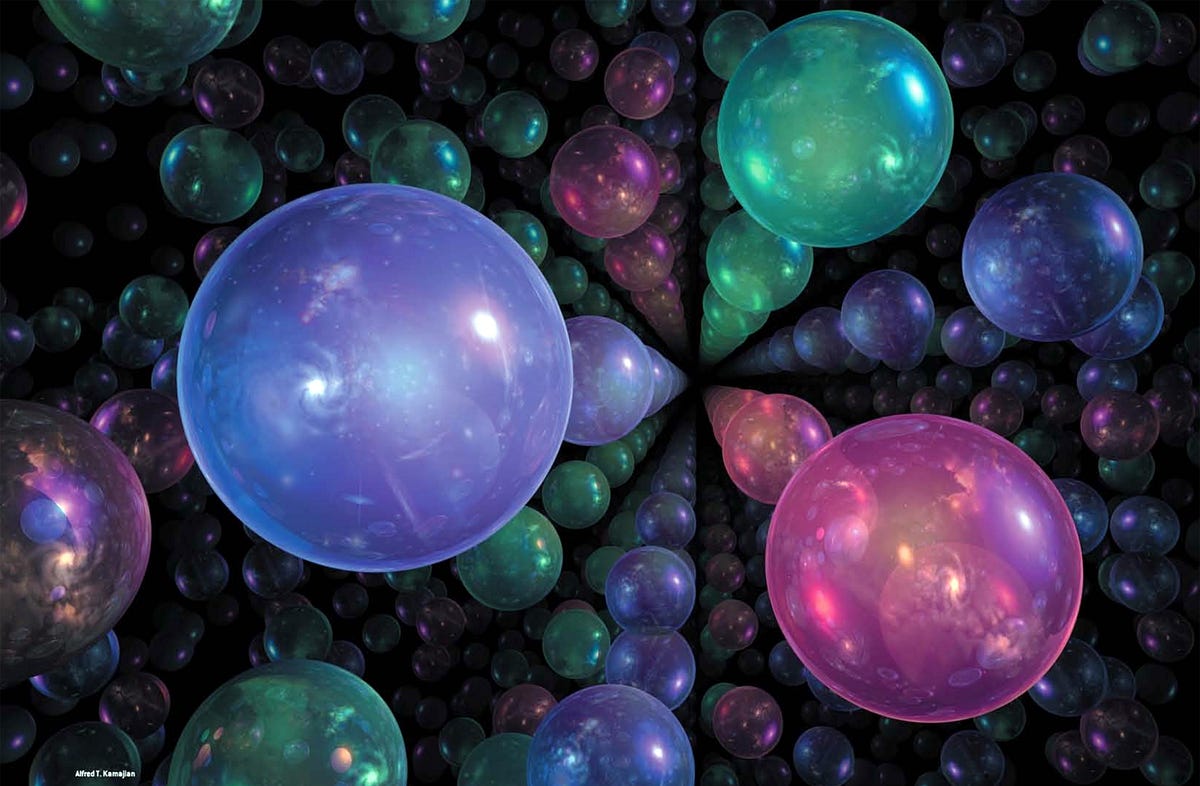
Or, in plainer language and in more popular terminology, this theorem is talking about an Inflationary Multiverse. Each post-inflationary thermalized region equates to one of the bubble universes shown in this illustration. Our observable universe is just one of the very many (trillions?) of such regions. Purely theoretical, of course and without any hope of directly detecting these other regions, probably pure speculation too.
Here is an artist’s impression of such an Inflationary Multiverse.
Please note that this image is in no way scientifically accurate. It’s just a guess about what is theorised to exist out there. Also, please don’t go thinking that each bubble corresponds exactly to the volume and size of our observable universe. Being approximately 100 billion light years in diameter. No. Our observable universe would probably be no bigger than a single pixel in one of these bubbles, on the scale of this image.
Anyway, since Craig appeals to the BGV theorem in his apologetic arguments, he has to own what it says. All of it. He can’t just cherry pick what he wants from it and ignore the rest. He can’t just select the part of the theorem that says that the Inflationary process must have a beginning and then deselect everything else. Whatever the BGV says about an ongoing, ever-growing Inflationary Multiverse also applies to Craig’s apologetic argument for god being the cause of the Inflationary process.
To cherry pick from the BGV wouldn’t just be Craig arguing in bad faith it would also be inconsistent of him to do so. In his previous apologetic argument using the earlier Hawking – Penrose Singularity theorem he accepted all of that theorem, even if he didn’t understand the full implications of it, which were left unmentioned by those two scientists. You can’t go all in on one theorem and then cherry pick from another if you want to be taken seriously. That’s inconsistent.
So, by trying to find a beginning in Inflationary cosmology where he can insert his god Craig has no choice but to incorporate the entire Inflationary Multiverse into his arguments.
Oh dear. That’s bad for him. Very bad indeed.
Why? Because if he also uses the Fine-Tuned Universe argument to claim that our observable universe was intelligently designed by the god of the Bible, then he’s making a supernatural claim. Not a natural one. He’s claiming that a supernatural agency finely tuned the constants and conditions within the observable universe to make it life-friendly and possible for us to exist.
That argument might work if he were claiming that one and only one universe exists. Then he could claim that because there is no natural mechanism for fine-tuning it must have been done supernaturally. But, if Craig were to promote a theorem where a natural mechanism for fine-tuning could exist, then he can’t viably claim that it was done supernaturally. There’s no need to invoke the supernatural to explain something if there’s a viable natural explanation for it.
And guess what? There IS such a mechanism in the BGV. The very theorem that Craig uses to claim that Inflation must have had a beginning.
An Inflationary Multiverse, as predicted in the BGV, would contain untold trillions of regions like our observable universe, each one having undergone its own Big Bang. It’s an integral part of the Inflation process that the conditions inside each region are decided randomly. On the basis of pure chance.
Many such regions will be sterile because the physical constants operating within them are not life friendly. But others will be. And as time marches on and the number of such regions increases exponentially, the number of life-friendly regions will increase proportionally too. There will be billions upon billions of life-friendly regions, some with exactly the same physical constants as our observable universe. If you wanted to you could look at the artist’s impression and consider that the different colours of each bubble correspond to the different arrangement of physical constants operating within them.
A vitally important point to remember when considering these crazy numbers is that we cannot know if our region was the very first created in the Inflationary process. It may have been – in which case we will know that the process has been running for at least 13.8 billion years. Or the process may have been up and running for billions of years prior to our region being birthed by it.
Any way you cut this, an Inflationary Multiverse such as the one proposed in the BGV creates more than enough regions to act as a natural mechanism for Fine-Tuning our region. Our observable universe.
That being so, Craig can no longer use the Fine-Tuned universe argument to claim that god finely tuned the unique arrangement of physical constants that we see and that enable us to exist. He’s shot himself in the foot and probably doesn’t even realize it. By embracing the BGV for the beginning it appears to give him he loses more than he gains.
Thus, Inflationary cosmology turns upon him and bites him in the butt. Hard.
Thank you,
Walter.
 . Do not mistake the silence here for lack of interest or lack of attention. I guess it is more because there is not much else to say, and not really anything to oppose against
  . For the moment, we do not have any creationists in here to use it against, but when one comes along and brings up these topics, I’m quite sure they will be used. Again, thank you for your effort.
