Merriam-Webster also has this usage note regarding this particular use of “of”:
The reason for why of came to be used for have is that the latter word (and even more so its contracted form, seen in could’ve, should’ve, would’ve) is unstressed when spoken. There is very little phonetic difference between “I could’ve paid attention in English class” and “I could of paid attention in English class.” The spoken version of this is far more common than the written one, but there is considerable evidence of both.
This use, it should be noted, is widely shunned by usage guides, schoolteachers, people who send you annoying articles on social media about the declining state of education today, and well-nigh everyone else. So why do we define it? Because of that considerable evidence mentioned in the last paragraph.
[…]
The amount of written evidence produced over more than two centuries means that we are inclined to define a word, but it does not mean that we recommend that it be employed (unless, of course, it is for a desired effect). Our usage guide, the Merriam-Webster Dictionary of English Usage, addresses this matter in some detail and provides a stark assessment: “you had better avoid it in your own writing.”
Edited to add: Just noticed the rather hilarious URL pointing to the above usage note:
Errors in common usage can make their way into the dictionary of course, if they become prevalent enough. I am thinking of the misuse of nauseous, which originally meant causing nausea, but it was so often misused instead of nauseated to describe how one felt, that it’s primary definition has now changed to reflect this.
I do remember an article claiming that the word literally had been popularly misused in an ironic sense so much that it’s primary definition changed, and recall a friend, a lecturer at a Bristol university with a wicked sense of humour, stating he was “literally” exploding with rage. Made me laugh anyway.
Don’t get me started on aggressiveness, even heard someone say intuitiveness, and …I can barely bring myself to repeat it, braveness, and humbleness.
My “angerness” may require me to have a quiet a lie down…
Yes, you could probably do with some calmness. As for me, I’m literally dying to do something about my thirstiness. I should of had a cup of coffee now.
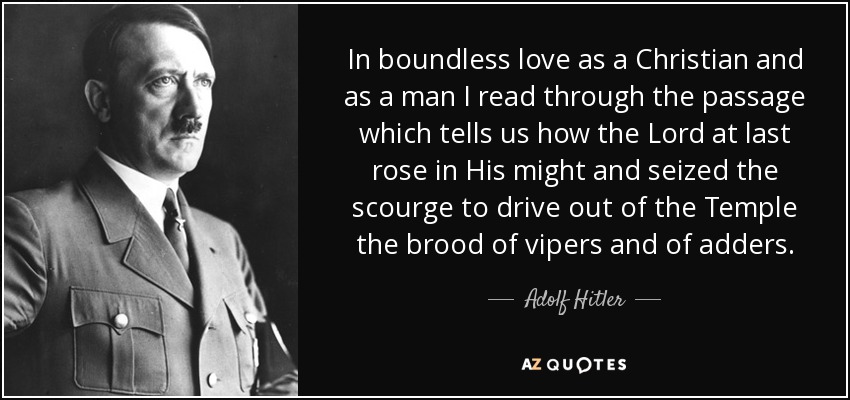
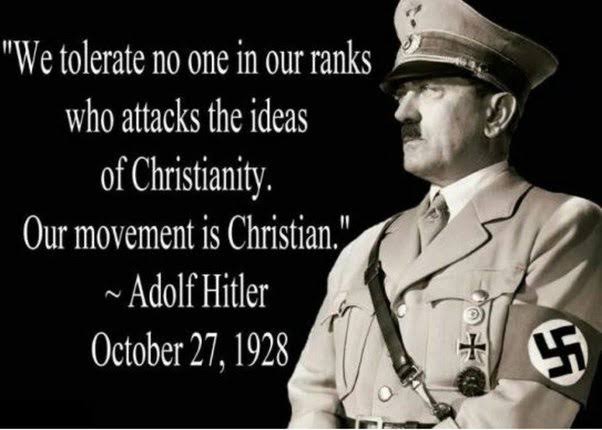
Nazis were, in fact, pretty much Christian. You might not like that fact, any more than you might like The Ku Klux Klan being essentially Christian but, while I grant their interpretation of scriptures might differ from yours, they were and the KKK are.
I’m sorry, but this is the dumbest statement you’ve ever made. Yes, they were Christians. Perhaps not up to your standards with your religious bs. But because you don’t want to believe they were Christian, does not make it so. The Nazi’s put up Reich Landeskirchen all over Germany. Hitler himself believed he was sent from God to cleanse the world.
Historically the German Evangelical Church viewed itself as one of the pillars of German culture and society, with a theologically grounded tradition of loyalty to the state. During the 1920s, a movement emerged within the German Evangelical Church called the Deutsche Christen, or “German Christians.” The “German Christians” embraced many of the nationalistic and racial aspects of Nazi ideology. Once the Nazis came to power, this group sought the creation of a national “Reich Church” and supported a “nazified” version of Christianity.
The Bekennende Kirche—the “Confessing Church”—emerged in opposition to the “German Christians.” Its founding document, the Barmen Confession of Faith, declared that the church’s allegiance was to God and scripture, not a worldly Führer. Both the Confessing Church and the “German Christians” remained part of the German Evangelical Church, and the result was a Kirchenkampf, or “church struggle” within German Protestantism—an ongoing debate and struggle for control between those who sought a “nazified” church, those who opposed it, and the so-called “neutral” church leaders whose priority was the avoidance both of church schism and any kind of conflict with the Nazi state.
That is a completely flawed statement .The large majority of Nazi Germany was Christian. Ever heard of the German Freethinkers League ?, It was a atheist organisation which opposed power of churches in the state the Nazis shut it down in 1933 and deported it’s members to concentration camps and turned it into a Christian organisation the Nazis outlawed atheist and freethinking groups . Here is even quotes from top Nazi officials including from Hitler who was a Christian theist .
That’s a lie, over 96% of the population of Germany indentified as Christian in a 1939 census, the results are available online even now to any objective reader…
A more interesting question might be, are Christians Nazis, there is ample evidence that tens of millions of German Christians absolutely were, in a wider context there is ample evidence that others are as well. At least one Pope as well, now I think of it.
Some would be sure, but equally I imagine some atheists would be Nazis. I tend to towards atheism being the result of intelligent evaluation i.e. there is no evidence of god and no currently accepted scientific explanation either requires or requests the action of deity. I believe that tolerance and the general wish to respect and aid fellow humans is also the result of intelligent evaluation so it always surprises me when I come across an atheist who is extremely right-wing. Indeed I’d go as far as to suggest that ruling classes the world over are not particularly religious and simply use religion to control the masses.
So no, while it might err in that direction (certainly seems to in the US), I don’t think Christianity is fascists per se. Can’t say for other religions as I lack the expertise.
Why? lacking belief in any deity or deities doesn’t tell much else about a person, also the ethical or moral standard you set is subjective, you state as much right from the offset (see emboldened text), It’s axiomatic that lacking belief in any deity or deities, does not mean one must share all other beliefs.
Personally I find the notion that good ideas come only from one end of the political spectrum, and exclusively bad from the other, to be irrational, it strikes as a poisoning of the well fallacy.
Better to try and judge ideas based on their own merits, than on who offers those ideas, but that’s just my opinion of course.
Because, IMNSHO, an intelligent person will generally care about their environment and about their fellow humans so, if that person has arived at being being an atheist through intelligent evaluation they are likely to adopt a more humanistic and less right-wing approach to life. IMO.
You seem to have draw a false equivalence between intelligence and being an atheist, and are making a sweeping claim about atheists, given I have met atheists who were dumber than a bucket of hair, and intelligent people who didn’t give two fucks about the environment, I hope you can see why I’d need to see more than a bare claim?
So humanism might well be synonymous with atheism, but again you seem to be suggesting that people who hold views from one end of the political spectrum are less likely to be intelligent, than those from the other end of the political spectrum, again I hope you can see why I’d need to see more than a bare claim for this, as I must say I am dubious.
I was offering a personal opinion (see emboldened text), how is this twisting your words? You equated intelligence with atheism, then expressed surprise when you encountered atheists who hold right wing views, why?
There are plenty of very intelligent theists, there are plenty of very intelligent people whose politics would be considered right wing. So it seemed like a fair question.
Are you saying right wing theists can’t be intelligent? If not I can’t see why it would surprise you, that’s all. Human beings are capable of all manner of cognitive dissonance in my experience, and I’d say atheism was more likely the ability to critically examine theism, than intelligence per se, there of course might be a whole host of other factors involved.
I saw this a while back but there were server errors and I forgot.
I did say in my opinion (IMNSHO) and “generally” and that is my experience.
See above.
Never said they did.
As was I.
I have no issue with someone thinking or even believing there is a god but doing so on the basis of scripture is at least one step towards insanity IMO.
IMO being able to think critically is the mark of intelligence and there will be some who use their intelligence for nothing but personal gain, status or power but a truly intelligent person will realise that such things are transient and that even they do, they’ll do better in the long haul adopting a more liberal POV.