The staff at my workplace is heavily promoting Copilot(1) . Luckily, I am working on stuff where using AI shit(*) is out of the question due to interpreting real world measuring data, reverse engineering, and the very important aspects of explainability and reproducibility.
(1) I’m not calling all AI shit, but I’m calling Copilot et al. in their current state and incarnations shit.
There’s a world of difference between asking about X in TV series Y, which is more complicated than locating rules about X in the Y body of regulations, in which the body of knowledge is very clearly defined and non-ambiguous.
Not really. Dozens of sites have full listings of TV series episodes, so there’s really no excuse for an LLM like ChatGPT to mess this up. After getting bogus results from ChatGPT, I tried to find a source that had the exact same error as reported by ChatGPT and couldn’t find one, so I can only conclude that ChatGPT hallucinated the answer.
Is Intel back? Its stock was up 24% yesterday, and up 124% for the year. I hope this trend continues, as we need more competition in the fab market, especially since the industry leader, TSMC, is only 80 miles from mainland China, which as been itching to take Taiwan for decades.
Mixed feelings here. I have always disliked the x86 architecture and the x86/Intel near-monopoly. The biggest reason I use Intel processors (and by extension AMD) is that there are no real alternatives. Yes, there is ARM and MIPS-V, but they are not real alternatives for general desktop use. I miss the days of competing architectures like 680x0, VAX, MIPS, SPARC, HP PA-Risc, Alpha, and PowerPC. As for foundries, I really hope Europe can step up its game and fund and host a home-grown one.
I have mixed feelings about x86. I’ve also worked with the 68K, VAX, MIPS, and Alpha and think some of them are better, more consistent architectures. I’m intimately familiar with the very lowest levels of the x86 architecture since I’ve written an operating system (with demand paging, memory protection, etc.) for it in 100% assembly language. Sure, it has quirks, and has lots and lots of special cases, and it isn’t very orthogonal, but it works and it’s ubiquitous, and the underlying processor architecture used makes no difference to most users.
I’m also very familiar with ARM, and, while I think Cortex-M is a better, more intelligently thought out variant than Cortex-A (the variant used in iPhones, Android phones, and Apple silicon), Cortex-A is reasonable and in several ways more modern and easier to write low-level software for than x86. The one area that it soundly trounces x86 is in efficiency per watt–it’s not even close. My Windows laptop with a Core i7 has a 3-1/2 hour battery life. My Apple MacBook has a 12 hour battery life. I’m very impressed with what Apple has done with their ARM processors.
Since I don’t have any experience with ARM: except the different optimisations between M, A, and R (low-power, high-performance, real-time), are there differences in the instruction set, or are there other features that make them distinct?
Isn’t the vast majority of Intel’s product fabbed in Taiwan too? Do we have any fabs in the us that are actually up and running and absorbing a significant percentage of the product demand? I know we have some fabs for certain embedded chips and such but IDK about CPUs or GPUs. For one thing they are more expensive to make here than in Taiwan.
The instruction sets are virtually identical. Cortex-M has a more modern, better interrupt and exception mechanism than Cortex-A. On Cortex-M CPUs, it’s possible to write exception handlers and interrupt handlers entirely in C. Most architectures have a special instruction (iret, or similar) to return from an interrupt or exception, and that requires either writing the handler in assembly or using a special compiler pragma to tell the compiler the function is an exception or interrupt handler. That’s not necessary on Cortex-M because you use the same return instruction for exception and interrupt handlers that you use for regular functions. All Cortex-M parts also have an NVIC (Nested, Vectored Interrupt Controller) that’s very easy to use. It’s how you configure interrupts on those parts.
That is good news. I knew of the existence of the Chandler fab (used to live in the area back before '09) but not what was done there. In fact I think it was built around the time I moved away.
So the big Taiwan exposure is ARM and Ai chips I guess …
TSMC is the biggest operator of chip fabs, and they do make most ARM CPUs for companies like Apple.
Another big player is GlobalFoundries which was spun off from AMD. They make ICs for companies like AMD, Qualcomm, and MediaTek. They have fabs in Singapore, Germany, and the U.S., so no Taiwan exposure. The sovereign wealth fund of the United Arab Emirates owns 82% of the company.
Although none of these three companies have a monopoly on chip fab, one company ASML, for all practical purposes does hold a monopoly on a key component of the chip fabrication process.
ASML is a Dutch company that makes extreme ultraviolet photolithography machines that are used to optically image the mask sets onto the silicon wafer. If you want to make chips at state of the art nodes, you need to buy one of these machines from ASML, and they cost upwards of a quarter of a billion dollars.
The Dutch government has put export restrictions on these machines with respect to China. I suspect that if China ever invades Taiwan, TSMC will destroy their photolith machines to prevent them from falling into China’s hands.
I’m given to understand there’s a kill switch that will do just that. The scenarios I keep reading about are that those machines are destroyed and that fab capacity would take years to re-establish.
It would be ironic if this hurts Apple the most – presumably it would – given that it was, IIRC, Tim Cook’s bright idea many years ago (even before his tenure as CEO) to move all production offshore. Between most production / assembly of Apple products being in China and the demise of Taiwan chip fabs, Apple would be in a world of hurt without much in the way of options.
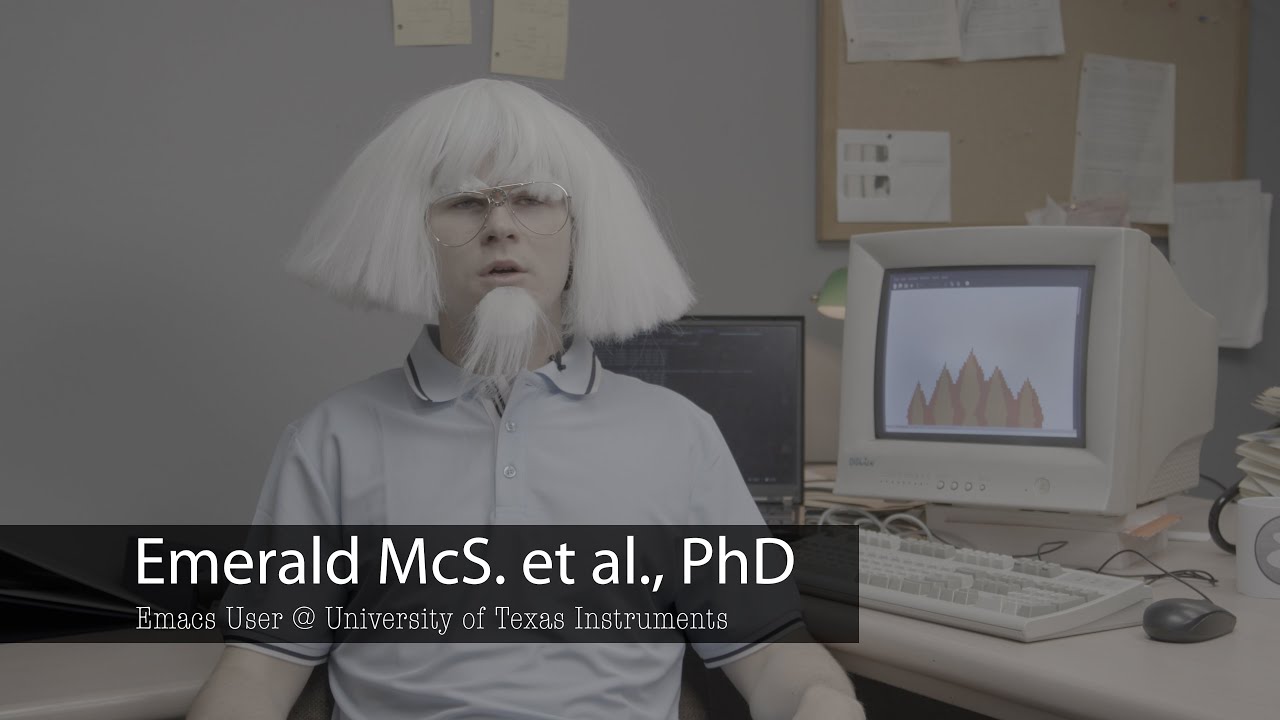
OH yeah, this guy is the best (the video). For anyone who thinks that kind of humor is funny: he has maybe a couple dozen similar videos on that channel.
I love it, but the joke density for lack of a better term is really high; but somehow that makes it even funnier.
Still reading this short book, but already I can see it has some pretty good insight about artificial intelligence and the nature of tech in general. I am particularly taken with its discussion of how computer science is in some ways a “flight from embodied consciousness”, a desire to divorce mind from body. When it comes to AI, I have noted this avoidance of (dare I say, aversion to?) the concept of embodied consciousness, and have long wondered how a hypothetical AGI could be recognizably human-adjacent much less human-replacing without being embodied and having the messy sensory inputs and emotional responses that are part of being human and conscious.
Anyway it is fairly short and concise and worth your time IMO if you are interested in the philosophical underpinnings of “AI”, such as they are.
I swear to whatever you want I’ll spend the next 6 months screaming that Chat gpt did not resolve Erdo’s problem No. 1196.
It was Lichtman, Price and Tao who did it; without their calculations and corrections gpt wouldn’t have done jack shit.
The idea that an LLM is capable of resolving it all in a single passage is even more ridiculous, it took a lot of corrections and preparations from humans to reach the results.
LLMs are just smarter search engines. They’re good at finding and correlating data, but unless someone else has already shown how to do something, whether that’s proving theorems or writing code to perform a specific task, LLMs are useless. If they can’t find a path to an answer in their training data, they’ll just hallucinate something.
 . Luckily, I am working on stuff where using AI shit(*) is out of the question due to interpreting real world measuring data, reverse engineering, and the very important aspects of explainability and reproducibility.