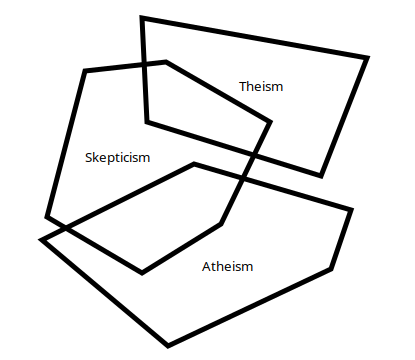
Well it seems like personal choice is taking precedence over fact in this forum. Just as it seems to be in politics, where a politico can clearly do something in the public eye but then choose to describe their actions in other ways, calling it something else.
So when is scepticism not scepticism in this forum?
The answer seems to be when someone chooses to call it something else.
I was simply making a distinction between skepticism and being skeptical in a particular matter. To riff on cynical1’s lists of kinds of skepticism, I’d argue that a young earth creationist skeptical about the theory of evolution is no skeptic. It has to do with consistency and motivation for rejecting claims. Theists tend to reject truth claims independent of evidence in the name of ideological plurity. That sort of thing doesn’t fit any of the types of skepticism he lists, so far as I can see. I suppose “colloquial” comes close but even that assumes some sort of decent evidentiary standard – not merely avoid admitting that you are (or even might be) wrong or something like that.
But this is the crux of the matter. The nub of the argument. The bone of contention. Earlier in this thread CyberLN stated that this forum was designed to focus a/theism, not scepticism. But as I pointed out with this reply…
You’re splitting hairs. An atheist awaits the presentation of evidence by the theistic claim maker. This position entails a necessary scepticism of the claim by the atheist. So, one cannot be divided from the other. Therefore, the atheists in this forum are necessarily sceptical of the claims made here. As I said earlier, it is the working standard of this forum and not just my opinion.
…atheism cannot be separated from scepticism because the former relies upon the latter.
So, surely making a distinction between scepticism and being sceptical in a particular matter is the same kind of hair splitting? A YEC being sceptical about anything first requires them to call that thing into question - which is an act of scepticism on their part. They may be doing it for all the wrong reasons and in the wrong way or not even be aware that they are doing it. But the act of calling the thing into question first requires a voluntary act of scepticism on their part.
Thus, regardless of race. colour, creed or any other factor, anyone calling something into question is engaging in an act of scepticism. They can believe they aren’t, they can deny that they are or they can try and argue that they aren’t.
But facts are difficult things to deny when your actions confirm the facts. As we can see from the reluctance of a certain member of this forum to answer my question about them practicing scepticism towards my claim.
If it walks like a duck and quacks like a duck, then it’s probably a duck. Even if the duck won’t confirm what it really is.
There are rare edge cases. Atheists who are truly ignorant of theism / religion, have literally never considered the question of the existence of gods but have merely assumed their non-existence; they are as they simply because no one indoctrinated them or at least not enough that it “took” or “registered”. I’ve heard anecdotes of people like that who suddenly embrace theism in response to some life crisis causing them to look at theism for the first time. So it is at least theoretically possible to be “without gods” without deploying skepticism. But like I say … a rare edge case, given the realities of living as a small minority in the midst of a theist hegemony.
It is also possible to be selectively skeptical, as we’ve discussed – so e.g. skeptical of gods and credulous about, e.g., ghosts or conspiracy theories. I simply don’t classify those sorts of people as informed, intentional, logically consistent skeptics, which is what I would in a perfect world want all atheists to be. Otherwise it undermines atheism by making it similar to a kind of special pleading.
But I tend to agree with you in practice; generally one can assume that atheist = skeptic.
I don’t think so. I think atheism is a subset of skepticism. I would not call myself, or anyone else, a skeptic if they did not practice skepticism as their primary m.o.
If atheism is a subset of scepticism and since you earlier said that this forum was designed to focus a/theism, wouldn’t that therefore mean that all of the atheists in this forum are also sceptics?
IMO, not necessarily. I think all that can be said with confidence is that people who participate in this forum who identify as atheist are skeptical about theism.
What was said and implied in your diagram was a true subset. Which I do not think is the case. It is more like an overlap, like depicted below (sorry for the crappy graphics, I used some random very non-capable illustration software). I do not claim it to be the be-all-end-all depiction, merely an iteration closer to my understanding. You can be a skeptic in some areas, and have blind zones where you accept shit. I know people who are rational people and natural skeptics about most stuff, but have a blind zone about religion, or who consciously select to not apply it to their religious beliefs. And I know people who are natural skeptics, but have blind zones about other shit. And you have skeptics (religious or not) who practice a more pragmatic approach, in which they do not apply skepticism to religion because it might lead them into trouble or even be dangerous.
Yes, I know what you mean about the inconsistency of the human mind, Goml.
Blind spots and that kind of thing. I used to work with a guy who was a keen amateur astronomer who specialised in viewing the planets. And yet, for all of his interest in science he also held to the unwavering view that the predictions of Nostradamus foretold the ending of the world.
But what really puzzles me about this thread is the reluctance of some people to embrace what they themselves have done, even after its been clearly demonstrated, by logic, by argument and by looking back at their own actions, that this is what they did do. Why won’t they just own it?
Given that they won’t defend their position, by answering simple and direct questions, I can only conclude that they are doing this for unreasonable reasons. Which brings us back to your very point - the inconsistency of the human mind.
Perhaps it’s best to just shrug ones shoulders and accept that people and just going to do what they do, even in a forum where critical thinking, logic should be the working standard.
Ultimately, yes. I can’t know (because blind spots are by definition something I wouldn’t see) if I’m 100% consistently skeptical as a modus operendi. Indeed, it isn’t practical to apply skepticism for every inconsequential claim or belief. However, I think it is fair to say that my default stance to anything of consequence is skeptical. I tend to reserve judgment / withhold belief where I don’t have (or don’t have the time to gather) all the evidence I’d like to have. To me that is being a skeptic, as opposed to being selectively skeptical.
I hope you’re quite confident in that assessment. I assure you, I can speak and comprehend the English language to a degree of proficiency - the likes of which I dare you to contend with - most assuredly in fact, dear sir.
The is a reoccurring theme which, perhaps, I shouldn’t address. This is a discussion between you and me. Not - me, you and Sheldon. I case you didn’t notice - I can hold my own with Sheldon. It’s you I’m worried about
I fail to agree. This forum is not an “ecosystem” unto its self. It’s quite possible that there are members outside the confines of this website who know other people who can relate to the condition.
I mean … you’ve assumed I’m “reasonable” and “rational” …? That’s a bit much
Then I resign myself to the “subjective”. I do not care to dabble in the “objective”. I wish you the best of luck with “her”? “It” - does the objective have a pronoun? I mean subjective would be feminine? And objective masculine? Is that right? Just want to get my cases right here. And obviously don’t want to offend anyone, (unless I already have - in which case I apologize profusely. I’ve been accused of many things - but … okay … here we go again rat_spit - putting your foot in your mouth again). Anyhow! Sheldon! You coming to the BBQ?
And rightfully so. It appears, alas, we have nothing further to discuss on that matter.
Ironically, of the few things we cannot do in dreams, reading is one of them. Those are the rules. Thus, if you level this same accusation against me in a dream I will merely “pinch myself”.
I mean, it isn’t hard to confuse a human after all. But I see your objection. And I concede it. Bend me over and call me Bertrude!
Yet one is complete fiction to all people and the other is only complete fiction to atheists.
Eventually the legend would become truth.
So then you agree that your “physical reality” with its particles and what not are not in fact physical if and when they are not measured? In otherwords you agree that the majority of so called “physical reality” or “objective reality” does not exist as such under conditions of non-condition?
And this has turned into a game of “whateverthefuckthatmeans” …
Would it suprise you if I wasn’t?
It would not only know everything, it would know every possible permutation of everything. It would know “everything about everything”.
Seeing every possible outcome of every possible situation is “all knowing”. You assuming that objective reality follows one simple, calculable trajectory of actualization - like some arrow of time - does not, in fact, even qualify you to comment on temporal matters. God does not need to know the “one” future - as if any such thing exists (up to such a time as history rests). You seem quite possibly to be a “strict determinist” in this sense. Can I suggest a pound of marijuana and a copy of “Being and Nothingness” by Jean Paul Satre?
What else could reveal to me the nature of of infinity but anything other than an infinite “being” or “nature”? You at least have to admit that I was temporarily omniscient … I mean I’ve been trying to convince you of as much?
Did you read the paper? They associated what someone reported anecdotally with a purported decrease in brain activity along regions known for maintaining “normal” perception. This actually goes to the core of the experience. The tools measuring this experience identified a “lack”. That is exactly what the experience is. It really doesn’t “objectify” it more because it’s now been forgotten in a laboratory
It’s a matter of perception, rat_spit.
The Donald perceives himself to be an intelligent genius.
This is a discussion between you and me THAT SHELDON CAN OBSERVE. On that basis I asked him to check to see if he could understand the points I was making. Thinking about disallowing me that option?
No. Until such time as people outside of this forum who can relate to this condition actually join it and declare their hand, they might as well not exist. Please note that I’m not saying that they don’t exist. I’m saying that as regards this thread and this forum they are irrelevant and might as well not exist. So my point stands and yours is shown to be irrelevant.
The Oxford English Dictionary (OED) defines existence primarily asthe fact or state of having actual, objectivebeing. It broadly encompasses reality, the state of living, and continuous presence in the world.
Do you see what this means for your claim of an extant deity?
And yet you invest belief in a subjective experience, that is unsupported by any objective evidence?
The first claim is untrue, one could easily find such claims, and the second inaccurate, since lacking a belief differs from holding a contrary belief. Either way the number of people who believe something cannot rationally be asserted as evidence for the truth of it, thus the important similarity remains relevant, claims to have experienced mermaids like claims to have experienced deities are unsupported by any objective evidence.
The point remains, that just because people make claims to have subjectively experienced a deity (or anything), that any similarities in the claims are not evidence that what they have claimed to experience is real.
No, you are referring to an as yet unsolved paradox in science, so 1) I don’t invest beliefs in mysteries or not knowing something, and 2) the exponential success of science in understanding objective reality demonstrates it is not a flimsy method.
The idea that objective reality is an illusion is not supported by objective evidence, now purely as a hypothetical, if it were, then you would not be adding credence to entirely subjective claims and beliefs, again as a hypothetical, destroying what is now a successful method, doesn’t make unreliable methods more reliable.
No I do not agree, and said so several times now, and explained why several times. I don’t base beliefs on appeals to mystery or an absence of knowledge. Even if this changed it does not strengthen unreliable methodologies like entirely subjective beliefs. If you want me to accept a wizard is behind the (invisible) curtain, you will have to demonstrate this with sufficient and sufficiently objective evidence, as this is the most reliable way we have of ascertaining the truth of a claim or idea, if one were able (hypothetically) to cast doubt on that method, this would not make me accept weaker less reliable methods.
Which part of the assertion is unclear and why? Here is the full exchange for clarity:
You know what whataboutism means, here is a simple explanation. Google Search
So for example I point out that entirely subjective beliefs are unreliable, and that beliefs based on objectively verifiable evidence are far more reliable, rather than address how unreliable the first is, you try to denounce the second, which does not strengthen entirely subjective beliefs.
Then ipso facto it would know exactly what the future was going to be, before it happened, and thus all autonomy for it and us would be an illusion of course. This is precisely the concept of deity the Muslim apologists offered, his arguments contradicted themselves relentlessly. As he kept making that claim, and simultaneously claiming we had free will.
I assume nothing of the sort, and knowing all possible outcomes, is not literally all knowing if it does not know the exact outcome that will happen.
I am an atheist, so it would be silly to imagine I attach the term necessary to characteristics people assign the deities they imagine, but one cannot assert that a deity literally knows everything, while simultaneously asserting there is something it does not know. Whether it is possible to know this is entirely moot to that point, as by asserting something cannot be known also directly contradicts the assertion that a deity exists that literally knows everything.
I don’t accept the premise of the question, as it assumes things that would need to be supported by sufficient objective evidence.
No, I do not, and cannot accept this.
So this “experience” is not entirely subjective if it can be supported by objectively verifiable evidence, unlike the claim to have experienced a deity.
You cannot place limits on the objectivity of a deity or type of Being which does not reveal itself to everyday people like yourself.
In my opinion the plentiful sensory data was more than enough to convince me of its reality. Since humans rely on sense data to establish existence, this shouldn’t be surprising. You can rant all you like about sense data being, I don’t know, nefariously or notoriously unreliable - it doesn’t matter. You would be nothing without your sense data. Your appeals to science as a “better” source of “objective” data presuppose the ability to use our senses. After all, how do we “read” or “interpret” data - it all happens through the senses. Moreover - the more organized and intentional a set of sense inputs are, the more indicative they are of an ordered reality.
You cannot see the difference between claiming mermaids exist and claiming a deity exists?
I’m going to once again refer you to sense input as objective evidence of the existence of entities.
The veracity of the claim is in the reliability of the sensory input. Claims about mermaids may rely on sensory input - however we can at least conclude that these sightings are mistaken - given the unlikelihood that there is a creature which has a lower half like a fish and an upper half like a human - given our understanding that mammalian ape like creatures are not adapted to live in the ocean the way a whale is.
The issue of a deity is entirely not the same.
It’s not an unresolved paradox. The fact that unmeasured “objects” behave less like particles and more like probability functions is well established. Tell me what the paradox is.
It has reached the bottom most levels of reality and found that all of our macroscopic observations are inherently flawed. All of your “objective” facts about “material existence” are inherently mistaken. There is no objective reality. There are only potential realties.
it’s not merely a claim or a belief. It is sensory input from a source. It is no less reliable a source of observation than the world itself.
I don’t think you fully understand the implications quantum mechanics have to the most advanced manner by which science understands physical reality.
Again, the phenomenon I’m pointing to are established as existing based on sensory input. Given the ordered nature of the sensory input it is reasonable to conclude that the source of the input is real.
No wizards. No invisible curtains. A force capable of producing supernatural demonstrations of its own existence using sensory input. In fact, by exploiting the way that sensory input in fact operates.
Not going to click on that link. If you can go to the trouble of creating a link, you can go to the trouble of posting the definition. I do not know what “whataboutism” is.
So please explain something to me. Before our society acquired what you consider to be “objective” means of verifying what you call truth, how did they go about their daily lives? How did they tend to the farm, count money, forge swords, raise horses, hunt partridge?
For the sake of argument, give me one example of a phenomenon observable to the senses which is made “far more reliable” as a belief because of “objectively verifiable evidence”.
If the future was predetermined. Demonstrate to me that the future is predetermined.
Again, as you clearly have failed to understand and acknowledge, my autonomy and the autonomy of the Deity remains perfectly in tact because the future is not predetermined.
Knowing an exact outcome presupposes a predetermined universe. Demonstrate to me that the universe is predetermined.
the funny thing about this is that you don’t appear to understand quantum phenomena either. You don’t understand how an object can exist over time according to changes in its state which are “potential” or “probabilistic”.
It does not know the predetermined future because the future is not predetermined. If it wanted to know a predetermined future it could pretend the future was predetermined, but this would have no effect on the future itself. If it wanted to force the course of time into a predetermined set of events it could. But this would, as you correctly demonstrate, revoke my autonomy and its autonomy. This is not an issue for me because existence does not follow a predetermined course of history.
I don’t accept the premise that there is anything “objective” about your ways of gathering evidence, especially when your best science demonstrates that “objective reality” changes depending on the subject who is observing it.
You can accept it. You stubbornly refuse to accept it.
The claim to have experienced a deity rests on observable sense data. Since sense data is the primary source of knowledge for all living beings your objection that further “objectively verifiable evidence” is required makes no sense. If you were taken from this world and placed in another which had been created for you by a deity you would conclude, like anyone would, that the source of the observable sense data is that of the Deity.