Can Atheists and Theists find common ground as Agnostics?

One example I’ve used to understand where Sheldon is coming from is a nugget I picked up from an atheist podcast.

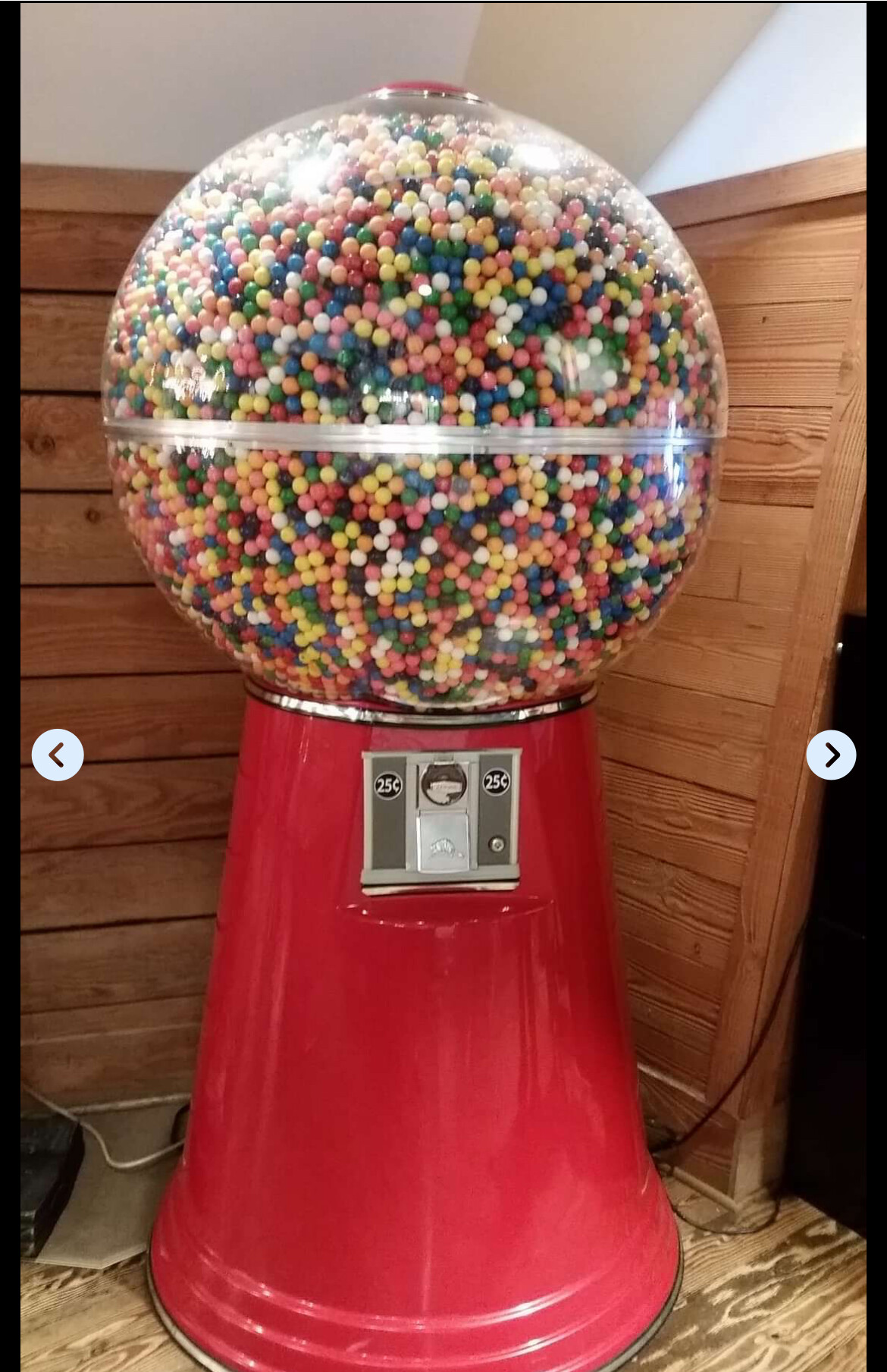
A bubble gum machine…


A claim is made that there is an even amount of gumballs.
There is no evidence for this conclusion.
Does that mean “believing” it is an odd number?
Nope.
Still no evidence for that either.
Until the balls are taken out and counted can you know whether it’s even or odd.

There is no evidence for god/s. Likewise, produce the evidence there isn’t any :person_shrugging:… there could be, but doesn’t give a rat’s ass - or was one and it died (caused the Big Bang :stuck_out_tongue_winking_eye:)

I withhold belief or “confidence” in a deity/deities. There’s no good reason to believe.

2 Likes

Well you can stay with what you state, but I’ll stay with what is actually going on around me.

Definitions almost always are a tit for tat exchange and almost always, terms like agnosticism and atheism will always be in contention because definitions and meaning change all the time , and people view definitions differently.

So if you want to stay with the recent vernacular that’s fine with me , but I’ll stick with the reality that is going on around me.

It is a statement of fact that the current dictionary definition of agnostic is a person who believes that nothing is known or can be known of the existence or nature of God. Ipso facto anyone claiming to know anything about a deity is not an agnostic. Your subjective and unevidenced anecdotal claims about personal experience are irrelevant to that.

You also failed to address the argumentum ad ignorantiam fallacy you used, So whilst you may be content to make irrational arguments, and ignore what this infers, I cannot.

You also made a false accusation that I had defended the possibility of theism, yet despite being asked twice to offer even a single example, have failed to offer any quote from me to support this. What else can one infer but that this was either an error or mendacity?

No they certainly don’t change all the time, though overtime some words do change, and etymology whilst fascinating does not change the current definition, which reflects common usage.

The dictionary definition reflects common usage, so why would I accept your subjective opinion based on vague and unevidenced anecdotal claims for personal experience? Not only is this is exactly the kind of theistic arguments I reject all the time, but your claims were sweeping absolutes, and when I offered a qualification to help you, that some agnostics themselves wrongly misinterpret agnosticism, you simply ignored it.

Now of course you can believe the moon is made of cheese if it makes you happy, but your claims of personal experience of agnostics are anecdotal and unevidenced, and would not apply universally anyway since they are subjective, and they contradict the dictionary defection of agnosticism which reflect common usage, and your arguments are irrational, using an argumentum ad ignorantiam fallacy to imply that a lack of evidence or proof for a deity, proves it doesn’t exist.

Agnostic
noun

  1. a person who believes that nothing is known or can be known of the existence or nature of God.

Now compare that with your claim here:

By definition an agnostic can make no claims about any deity, so if someone claims a deity is possible, then they have ceased to be an agnostic, at least in that instance. If you have misunderstood them however, and all they did was claim a deity might be possible, which is the same as saying it might not be possible, then they have no actually made any claim to know whether a deity is possible. I think perhaps your sweeping claims and absolutes, and the poorly worded arguments are just a poor use and understanding of language, time here might remedy that, but only if you are prepared to keep an open mind.

You also didn’t address your risible claim to know what will be known in the future.

As I said it is simply risible to claim to know what may or may not be known in the future, with or without the absolute certainty you used, which merely indicates a closed mind. As I said earlier you’re confusing hubris and hyperbole with confidence, my confidence directly reflects the amount of objective evidence that supports any claim, no matter what that claim may be.

You should stick around, and read some of the debates that are recorded here, it will help you enormously I think to better understand what strong well reasoned arguments look like and why.

For example did you even read @Whitefire13’s or @Cognostic’s posts? They both explain a fundamental error in epistemology that you’re making here. Disbelieving a claim is not the same as making a contrary claim, and whilst the former can rationally be based on a lack of knowledge, the latter cannot. Basically if we cannot know whether a claim or belief is true, then we can rationally disbelieve it, but we cannot rationally claim it is untrue. this would apply to all unfalsifiable claims of course.
1 Like

You can lead a horse to water…

1 Like

…but a pencil must be lead… :smirk: :innocent:

True dat…

Where? …???

Please define “recent vernacular”. Please provide details of how the “reality going on around” you is effecting the definitions of words.

Thats quite a post you made!

I’d say you corrected me to a tee here and i really do see what your trying to relay in terms of defining what agnosticism is through the lens of your viewpoint as well as the provided dictionary definition contrary to mine.

So as a now duly and soundly corrected individual on the matter of agnosticism, I am sincerely compelled now to ask you a simple question using your particular understanding of agnosticism and not mine as you very eloquently relayed in your response to me.

Are you agnostic as well in regards to Santa Claus, the Easter Bunny, the Tooth Fairy, Hogwarts including Fluffy as well mind you, and South Park’s underpants gnomes?

I look very much forward to reading your answer!

I am agnostic about all unfalsifiable concepts, I believe I stated this more than once. However since there is objective evidence they are works of fiction, and this represents knowledge about their nature and existence, I would not be agnostic about them. I don’t know who or what Fluffy is, so I must remain agnostic about it, but still withhold belief. Though you have of course not offered any definition of the concepts or what you’re claiming about them of course, what does “in regards” mean for example? So this is a prima facie observation based on the facts we know about them.

FYI the definition is not my opinion, and not presented through any lens, I quoted the dictionary verbatim, and linked it. Only you are offering (naught) but a subjective opinion about what agnosticism means.

You also failed again to address your use of an argumentum ad ignorantiam fallacy, and failed to address how you claim to know what will happen in the future, and failed to offer a single quote from me to support your claim that “that I had defended the possibility of theism”…

1 Like

Basically he needs to offer something beyond bare assertions, I am glad someone else noticed.

As far as the etymology of the word agnostic goes " Agnostic first appeared in 1869, (possibly coined by the English biologist Thomas Henry Huxley), and was formed from the Greek agnōstos (meaning “unknown, unknowable”) ."

CITATION

1 Like

Simply by pointing out that there is plenty we know about God. First it only comes from and is sourced completely by human invention and is found nowhere else in the universe , exactly like Santa Claus, the Easter Bunny, the Tooth Fairy, Hogwarts and fluffy and South Park’s Underpants Gnomes, and all the other concepts that come out of the human mind.

To state that you don’t know, or it can’t be known, as per the stock definition of agnosticism, is not really being completely honest about it because people actually do know quite a bit about where God and similar concepts come from. Its always sourced from people and people alone and entertaining such concepts with a reply of, I dont know " becomes neither a confirmation nor dismissal , which why i regard agnosticism as a position akin with fence sitting because it allows for any and all possibilities , when its quite clear by now since the dawn of man those possibilities are just not going to ever manifest.

Maybe that will help somewhat to get an idea on my perspective here.

I thought I made a pretty darn good case for the easter bunny and for the tooth fairy citing objective evidence I might add.

When I was about 6 and stilled believed in god I prayed every night for a week asking him to tell santa to bring me a roy rogers 6 shooter and a cowboy hat. Was my prayer answered? No Nada No way. The next christmas I went straight for the big guy himself hopped on his lap and told him that he didn’t deliver last year probably because god forgot but that I still wanted that roy rogers 6 shooter and that cowboy hat. Voila that christmas what did santa bring exactly what I asked for. Santa won god boo. I’m with you on god but leave the holy trinity (santa claus, the easter bunny and the tooth fairy) alone or I’ll have to ask TinMan to make up a list of every citation in all of the books and songs that praise them. And above all santa knows if you’ve been naughty or nice and where you live. :smile: Cheers carry on your debate.

2 Likes

I stopped at this because I’d like more information from you before proceeding. Please provide the mechanism by which you hav3 determined that anything is found nowhere else in the universe.

People do NOT know these things. Religion survives on this ‘FACT.’ People “believe” all sorts of woo and they “believe” they have ‘Knowledge’ of the same ‘woo.’ (Knowledge is a subcategory of belief. Are you aware of that? Knowledge is a belief held to a degree that it would be life altering were it to be demonstrated wrong.)

A person cannot hold a belief in god and non-belief in god at the same time.

Says you. Demonstrate that the Bible is not divinely inspired and the word of God.

What a moronic comment. Of course, it is not found anyplace else in the universe. We are created in the image of god. The universe was created for us. You are so amazingly ignorant of the Christian position.

Demonstrate God is an invention of the human mind. How do you separate the God that is an invention of the human mind, the one you are talking about, from the real god which exists?

And this is where your facts are wrong, but the conclusion is correct. The reason it is fence sitting is that the question being asked “Do you believe in a god?” is not being answered. They are giving you a politically correct response and avoiding the question completely. The question IS NOT, “Do you have knowledge of a god.” The question is not: “Do you know a god exists.” To these the person could respond, “I am agnostic.” I don’t know. The question, “Do you believe in a god?” is about “belief,” not 'Knowledge." You either believe a god exists or you do not and that has nothing at all to do with 'Knowledge." I have already demonstrated this with diagrams, Biblical verses, and the corroboration of colleagues. YOU ARE DEMONSTRABLY WRONG. Repeating the same shit over and over just makes you look ignorant.

1 Like

Have God come down or one of his angels and have them announce just how wrong people like me are.

Otherwise , it is exactly as I say.

Sorry to break it to you.

God is a complete human invention and it’s only humans that will ever do all the talking and walking on behalf of what is a deaf, mute , and blind imaginary dieity.

You will never ever see God out in the universe anywhere because it is entirely in your head. That’s the only place where God resides and when your lifetime comes to an end your God will die with you.

That’s just the facts and there’s nothing you or anybody else can do about it. Not your church , not your pastor or preist, no one. Its all human sourced and invented. Believe me I tried when I was a Christian a long time ago. God was nowhere to be found except for the custom made god I had living in my head which had no impact whatsoever in the real world around me. I found it to be very disappointing that God doesn’t do anything in the real world , but sobering up to the facts of the matter helped me escape the rose glasses and stained glass prison I was in. But I’ll leave that part for another discussion for another day.

Plus the Bible is just an old ancient book full of gaps full of errors and contradictions there’s nothing divine about it. Reading it provides its own adequate proof that is just man-made literature and rightfully belongs with the Greek and Roman Pantheon of Gods.

You can certainly try though , to show me im wrong here.

That mechanism you speak of is just simple observation looking out in the natural world without human fabrications or embellishment. That’s pretty much all it takes. Just stay silent, don’t push your thoughts into anything and just silently observe everything around you resisting any urges to fabricate or embellish what you are seeing and experiencing.

You will find nothing associated with theism in any way. Just the natural universe out there completely
indifferent to what may or may not exist.

Only people running with the concept are human beings and human beings alone and It’s been that way ever since God was first invented by early humans and still holds true to this day.

Well, that observational reach is profoundly limited in comparison to the universe.
If you think that your observation skills are such than what you experience encompasses all there is in the universe then I cannot help but think it either ignorant or egotistical.

1 Like

You could easily demonstrate how the deistic god did exist.

The way I would demonstrate it would be through your complete inability to prove it. ;0)

Seriously?

(20 characters)

Why not? If somebody claimed something existed and yet cannot prove it, what would you think of it?

For myself, I would just dismiss it on the basis that person simply can’t prove their claim in any way.